Hinds Releases Platform For State Senate Campaign
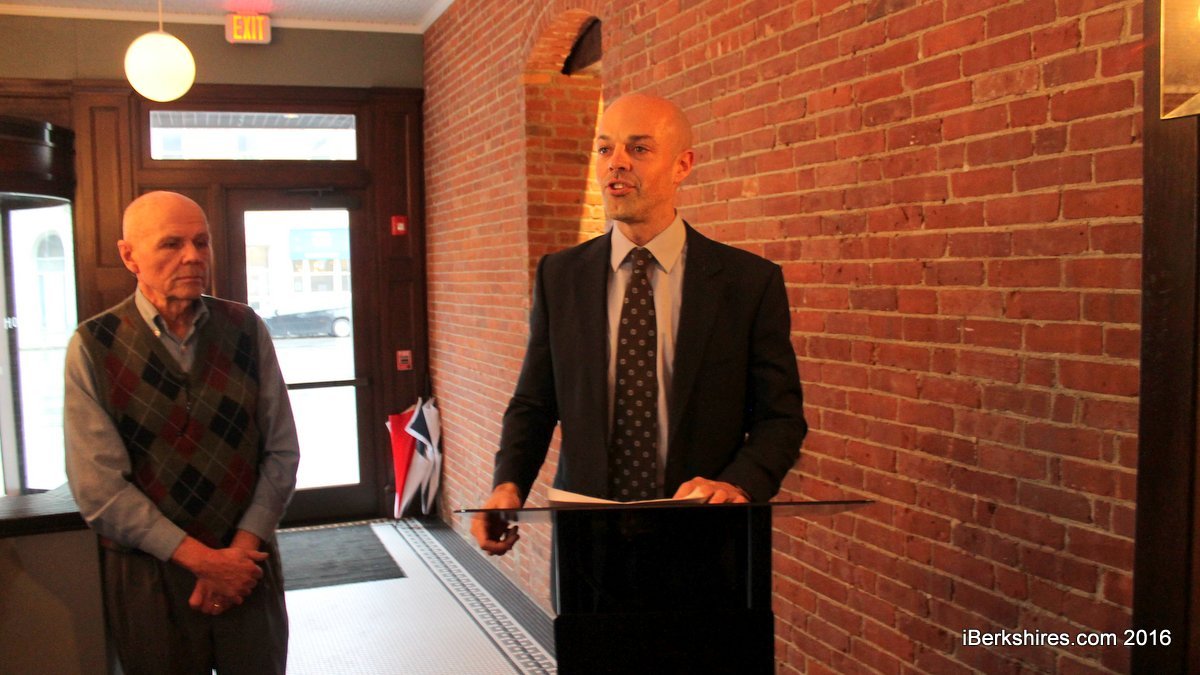
PITTSFIELD, Mass. — State Senate candidate Adam Hinds released his platform last week, focusing on five topics: economics, education, energy, stopping the heroin epidemic, and reversing the population loss.
The candidate says each topic is somewhat dependent on the others and the five-pronged approach is "a plan we can go to Boston with."
Hinds says by creating more high-quality jobs, and strengthening the education system, getting a handle on energy costs, and providing more treatment for those addict to heroin, the district consisting of 52 cities and towns will stop a declining population trend.
"You can't create jobs without attention to education or attention to energy," Hinds said of the plan.
For the economy, Hinds said there are nearly 2,000 jobs unfilled. There needs to be more access to training programs to better matches the job seeker's skills with the needs of the local small and medium-sized employers, he said.
His economic plan aims to tackle the employment needs from entry-level to management.
"We need to make sure specialized training is bolstered," Hinds said. "We need to ensure we have the workforce prepared for these jobs."
He cited a pilot program the Northern Berkshire Community Coalition is launching, "Employ North Berkshire," which matches a participant with a training program specifically catered to a company's need and a mentor to get the person through the education.
Hinds also said it is essential for the state to finish the job of bringing broadband to all communities. Through the Massachusetts Broadband Initiative the state is now figuring out how to connect the "last mile" of homes and businesses to high-speed Internet. The project has been about a decade in the making.
"It is an absolute priority to have this high-quality infrastructure in place. It is a game changer," Hinds said. "It is unacceptable that it's taken so long."
He promises to work with the MBI and Wired West to accelerate the build out of the final mile to connect all homes and businesses in Western Massachusetts to the network.
Energy costs have become a "tremendous challenge" for local businesses. Hinds said one of his priorities will be to grow the clean-energy sector in Massachusetts. He calls the clean-energy sector a "homegrown industry" that returns money to businesses and residents. He hopes to invest in the deployment of clean energy technologies to both reduce carbon dioxide levels and ease energy costs.
Meanwhile, he says the area needs to "increase the percentage of our workforce with college degrees." To do so, he believes there needs to be efforts to lower the cost of a college education.
"The cost of higher education continues to go up while state and federal assistance go down. I will work to reverse this trend to ensure we have the best educated workforce in the state and our young people do not start their lives with significant debt," Hinds said.
On the other end of the spectrum, Hinds is supporting universal pre-kindergarten, which he sees as a way to close an achievement gap that "disproportionately disadvantages low-income students, English language learners, and students with disabilities."
Meanwhile, as the population declines the rural areas are getting more burdened by funding mechanisms and unfunded mandates, he said. He said the high school he attended starts in a deficit of $1 million before a student walks through the door because of the transportation costs.
"Our schools are crumbling under the weight of maintaining their budgets," Hinds said.
He'd like to change the formula for regional transportation to reimburse districts more for the miles required. But, it isn't just that formula he'd like to change. He said how the state calculates the foundation budget needs changing.
"The bottom line is the funding mechanisms don't match up to the needs of the district," Hinds said.
The entire country — and Western Massachusetts is no different — has been struggling with an epidemic in heroin addiction. Hinds too placed getting that under control as a top priority.
"There has been a gap in longer-term treatment," Hinds said. "We have some recovery beds in transitional houses but nothing after that."
Hinds said tackling that scourge requires a mix of prevention, intervention, and treatment. He hopes to bolster school district's support for health education and increase resources for at-risk youth to keep them from falling into drug abuse. He also would like to continue strengthening the state's prescription monitoring program.
He also hopes to give all first responders overdose reversal medication to save the lives of overdose victims. And he says the criminal justice systems needs to have a stronger emphasis on getting addicts the mental health and substance abuse treatment they need.
"This disease impacts a lot of individuals who do things that fall into the law enforcement category," Hinds said. "There needs to be an option to ensure they have the mental health and substance abuse treatment rather than ignore it."
Overall, he says, "we're not going to arrest our way out of this epidemic."
By focusing on those four areas, Hinds believes the declining population trend will start to reverse. He said there is an "urgency" to creating more high-quality jobs, strong schools, and controlling energy costs to halt the decline.
"Population decline doesn't happen in a vacuum," Hinds said.
Hinds is seeking the democratic nomination for the seat being vacated by state Sen. Benjamin Downing. He is currently the executive director of the Northern Berkshire Community Coalition. Before that, he was director of the Pittsfield Community Connection, working with high-risk students and their families. He spent nearly 10 years with the United Nations with a focus on dialogue and community conflict mitigation in the Middle East, including working in Iraq on disputes over internal boundaries and promoting talks between Israel and Palestinians.
So far, only he and Great Barrington attorney Andrea Harrington have announced candidacies for the Senate district.
Tags: candidate interviews, election 2016, State Senate,