PITTSFIELD, Mass. — The baseball field at Clapp Park is being named after former coach George "Buddy" Pellerin.
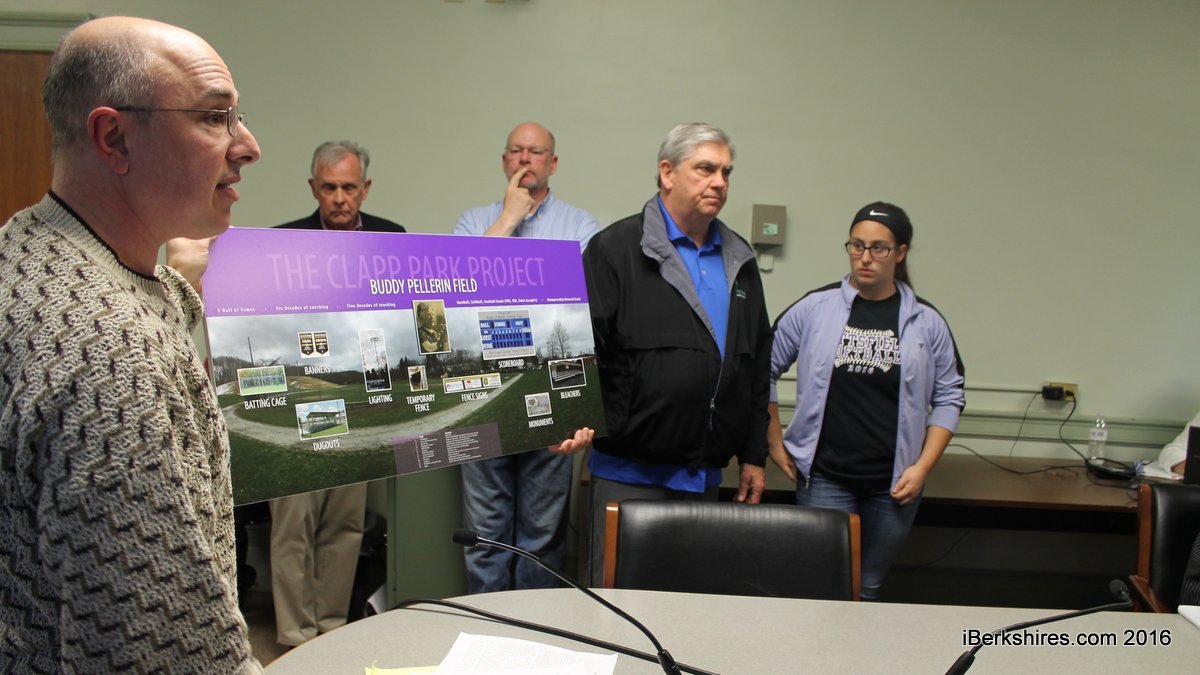
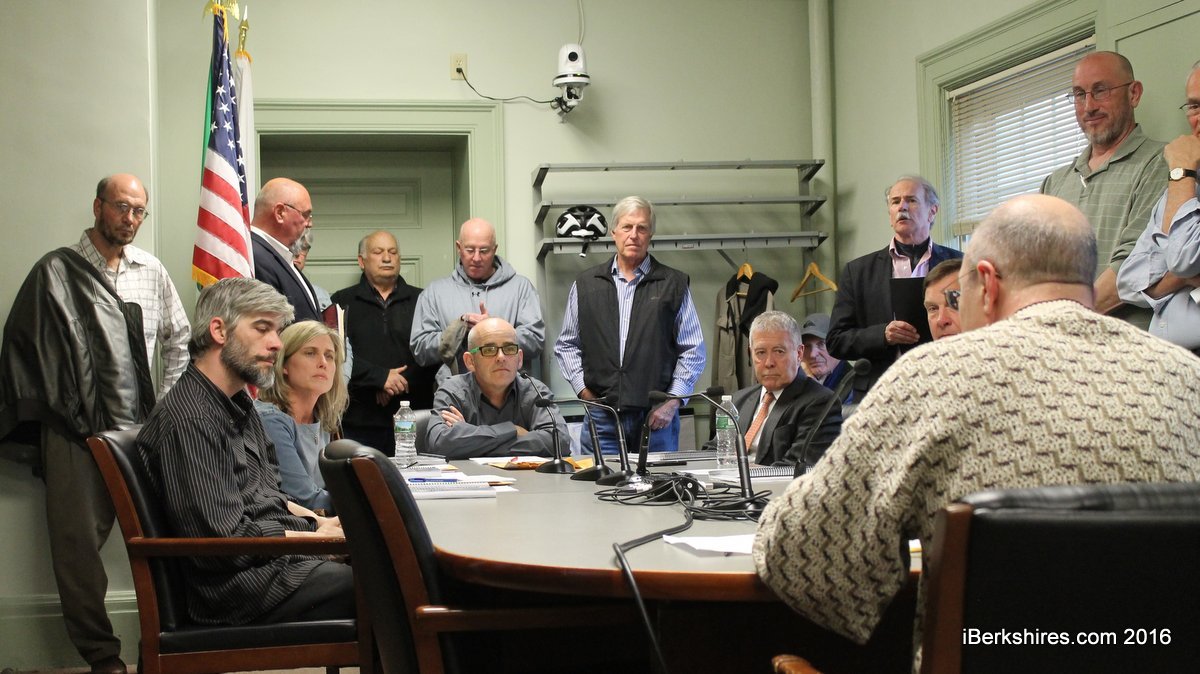
The Parks Commission approved the naming on Tuesday after being overwhelmed by support from former players, family and friends of Pellerin. A large crowd filled the meeting room as Ken Ferris gave a presentation on not just why Pellerin deserved the recognition but also plans to upgrade the field.
"Buddy Pellerin was much more than a coach. You did well on the field but he was much more interested in what you did off the field," Ferris said.
Pellerin was head coach of the Pittsfield High baseball team for 19 years, leading the team to the state title in 1966 and taking the team to the 1974 title game. He also served as athletic director, and head softball coach during his time at PHS.
He handed over the reins of the baseball team in 1982 but remained active in the sport. He went on to coach softball at Massachusetts College of Liberal Arts and St. Joseph's High as well as the city's Babe Ruth league all-star team. He was inducted into the Massachusetts Baseball Coaches Association Hall of Fame in 1988.
"The program itself just turned out successful people and that is the measure of the man," Ferris said.
Ferris said there are "hundreds of stories" of Pellerin inspiring and keeping players on track in their lives.
But Ferris said coach would be "disappointed" in those pushing for the change, and with those who penned the large stack of letters of support submitted to the commission, if the project stopped at just naming the field.
Ferris said so far the committee heading the effort has raised $15,000 and is looking to raise more for a number of improvements to the park. That includes a score board, fencing, signage, and ultimately dugouts, lighting, bleachers, and monuments.
"The vision and the goal maybe lofty by our coach always taught us to, in a controlled way, swing for the fences," Ferris said.
The effort has only just begun, and with a groundswell of support. The plan was hatched at the 50th anniversary reunion of the 1966 championship team. In just a few months since then, a small committee crafted the plan and began to raise money.
"The amount of people he knows is incredible," Ferris said. "It's been very easy."
The Parks Commission was unanimous in its support and opted to forego a public hearing to name the field, an option the commission reserved in its policies. The naming is only of the baseball field — Clapp Park as a whole will retain its name.
The commission also voted to have Ferris and others begin working with city staff on the improvement plans, but the commission still wants to vote on each project.
"We certainly want to make sure we get this done right," Parks and Open Space Manager James McGrath said of the individual improvement projects.
Ferris said the priorities would be to install a score board and fencing. From there, future projects will depend on the fundraising effort — one of which could include sponsorship of signs on the outfield fence.
"It's not just because he's a great coach. It's because he is a great person," he said.
If you would like to contribute information on this article, contact us at info@iberkshires.com.
Your Comments
iBerkshires.com welcomes critical, respectful dialogue. Name-calling, personal attacks, libel, slander or foul language is not allowed. All comments are reviewed before posting and will be deleted or edited as necessary.
No Comments
Pittsfield Man Creates Device to Clear Lakes of Algae Blooms
By Breanna SteeleiBerkshires Staff
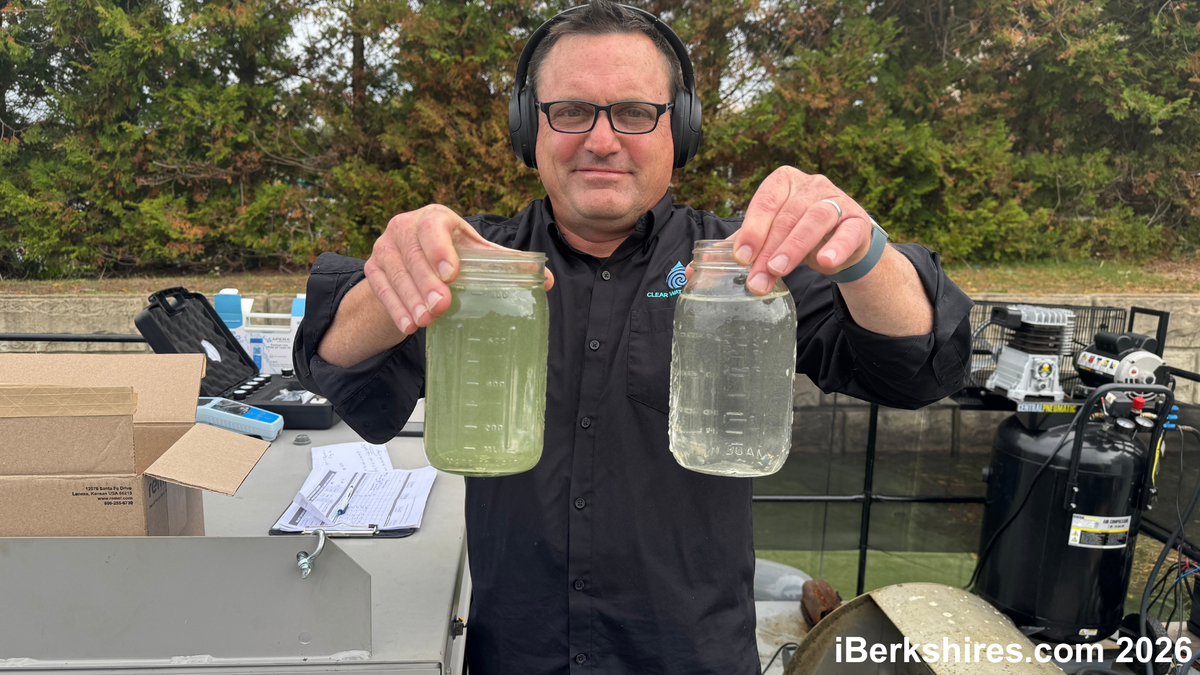
Marc Bellora holds a jar of lake water, left, to compare to water cleaned by his Aqua Clarifier Water System.
PITTSFIELD, Mass. — Marc Bellora has high hopes for a device he's created to treat lakes from harmful algae blooms.
His patented water clarifier can physically remove captured material rather than letting the nutrient-rich material settle back into the lake, which occurs when herbicides are used.
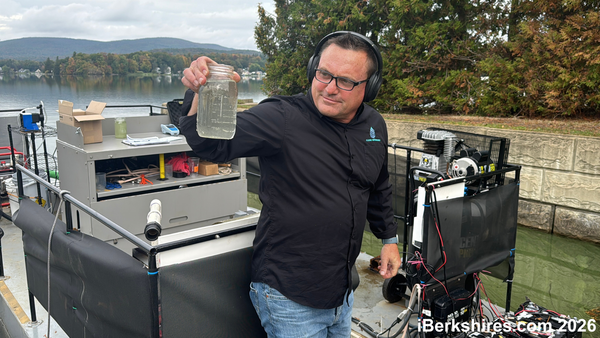
"It's a long-term lake management tool that can be used to reduce legacy nutrients in lakes and ponds over time," he explained. "We built the prototype, this is a prototype. It does approximately 65 to 70 gallons per minute. It's very environmentally friendly. Can be used with air only, or we can use a low-dose potable polyaluminum chloride (PACL) or chemical on board that can help improve results."
The water clarifier barge is based on well-proven technology for water treatment, he said. "It's a self-contained, portable, mobile unit that removes algae blooms, nitrogen, phosphorus, and the associated nitrogen and phosphorus within lakes."
Bellora founded Clear Waterways Group with business partner Mark Simon. They built a prototype mobile unit and are still working out the kinks. It's taken Bellora about five years to bring the project to fruition as he is also a full-time Realtor.
He says the repurposed barge they use has a device that uses air to filter the water to separate harmful bacteria or uses a chemical at low doses. They are testing both to see how well each does at cleaning the water.
"They would do the same thing here, except they would spray it, and it blocks all that stuff together," Bellora said of the use of herbicides. "But then it drops to the bottom. So now all the nutrients that are attached in that plot go to the bottom and contribute to the legacy nutrients only to fuel next year's bloom. Ours removes it."
He said just using air alone has removed 70 to 90 percent of harmful algae where he has been operating on the south end of Pontoosuc Lake.
"Essentially, we take in the bad stuff, we take in the lake water. We separate the good stuff from the bad stuff. Clean water goes back into the lake, and the bad stuff can either be composted, or it can be taken to the wastewater treatment plant, which is what we're doing here," he said.
Bellora explained that tiny air bubbles attach to particles in the water, making them buoyant so they rise and can be removed. The unit can operate with air alone, or with a low dose of potable polyaluminum chloride.
PACL helps through flocculation: it gathers small particles into larger clumps that are easier for air bubbles to capture. He said this can help remove dissolved nutrients that air alone may not capture as effectively.
Bellora said he was inspired to build something like this after noticing the lakes he enjoys being shut down because of algae blooms.
The city issued a health advisory for Pontoosuc in August, warning residents not to swim or come in contact with the lake water because of an algae bloom. The cyanobacteria can cause skin irritations, vomiting and diarrhea and nerve or liver problems.
Bellora previously worked for a company that used traditional dissolved air flotation (DAF) systems to treat water. In that role, he traveled around the country to work at paper mills and food-processing plants.
That experience gave him a practical understanding of DAF, and while flying between jobs, he would see green ponds and wonder whether the technology could be adapted to treat lakes.
His water clarifier can physically remove captured material rather than letting the nutrient-rich material settle back into the lake, which occurs when herbicides are used.
click for more
NAMI of Berkshire County celebrated community advocates and gave its annual report on how the organization has been navigating troubling times. click for more
The Berkshire Vaccine Collaborative will provide public vaccination clinics in Berkshire communities this fall, including the Influenza and COVID-19 vaccines. There are about 49 clinics. click for more
In early February, the airport was approached by a prior tenant, Leon Shabott of Hangar4Planes, about the possibility of constructing a hangar at the airport.
click for more
The state Department of Transportation and CSX have reached an agreement for local infrastructure improvements that will be a "major step" to making the Berkshire Flyer a permanent seasonal service.
click for more