North Adams Planners Give OK to New Airport Building

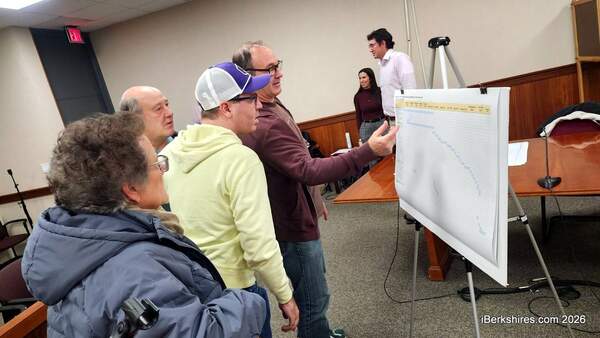
NORTH ADAMS, Mass. — The Planning Board on Monday night approved plans for a $4 million administrative building at Harriman-West Airport.
The new terminal will have meeting and office space, a lounge for pilots, lobby and space for a restaurant and public viewing area of the field.
The structure is being built through the state Department of Transportation, one of 17 airport terminals being built or renovated across the state over five years.
Thomas Mahoney, an engineer with MassDOT's Aeronautics Division, told the board that the construction is the result of a survey of some 36 public airports done in 2009.
"It became apparent that there were several, 17 to be exact, of those airports that were deficient in administrative buildings," he said. "Either they didn't have one or had one that had to be renovated."
So far Mansfield, Bevery and Fitchburg were funded in the first round, with those buildings coming on line within the next three months at a cost of $3.5 million to $3.9 million each. North Adams and Taunton are in this next cycle.
North Adams almost lost out on the terminal for lack of the 5 percent funding match, or about $200,000. Earlier this year, Harry S. Patten Jr., of Turboprop East, a major maintenance hub located at Harriman-West, pledged the $200,000 on the city's behalf to ensure the project's completion.
Janna Kauss, of Boston-based architectural firm Fennick McCredie, said North Adams' administrative building is based on a 5,000 square-foot prototype designed by her firm but with input from the Airport Commission. While the footprints are similar, the municipalities and airports were able to weigh in on space use, exterior looks and locations to ensure the buildings fit their environments.
"The structure will be at the end of [Airport Road]," said Kauss, based on the commissioners' desire for strong visibility. "The most important thing is when you drive down the road you see where the building is."
The steel and timber building will be clad in a geometric siding in a "warm rust color" to contrast and complement the mountains to the south.
"It will really be a kind of striking image when you drive down the road and see it," Kauss said.
The building has two main functions: to operate as an administrative hub and as a public venue. The primary purpose is for operations, so a suite of offices will be developed for the fixed base operator and certain functions like weather equipment and security will be brought into the building.
The state also requires the pilots' lounge, a quiet area where pilots can relax, watch television or plan their flights. A large conference room will be available for airport-related meetings or other municipal needs.
A large space is being set aside for the future restaurant, with access to an outdoor patio and a public viewing area for watching planes. Utility hookups will be put in place for the eatery but other than that, the space will be left for the future tenant to complete.
"We would love to be specific as possible but we don't know what that vendor is so have to be very general," Kauss said.
The Airport Commission's Jeffrey Naughton said the administrative building will be the final phase of the airport renovation, which has included the $6 million runway project.
The airport has about a $12 million impact on the region; at the time of the state's airport study, it cited nearly $12 billion in economic activity and more than 124,000 jobs in the aviation industry statewide.
In other business, the planners:
• Approved a special permit application by James Krutiak to operate a used-car sales business at 559 Ashland St. The board set a condition of 15 vehicles to be allowed on the property. Krutiak had initially suggested 20-25 because of his repair business but agreed to the lower number, saying this was all new to him and he wasn't sure how many he would actually have. Planners told him he could come back if the number was insufficient.
• Approved a change of use for 362 State Road for a secondhand store by Minerva Arts Center Inc. Operator Jennifer Howard said the thrift store is used to raise funds for the center's educational theater program. The store had been operating in Williamstown but had to move when the building it was located was sold. She anticipated being back before the board again in a month because the thrift shop would be moving again to another building on the property.
• Approved an application by Jennifer M. Beverly for property located at 27 Eagle St., formerly the Party Place, to operate a consignment type shop. Beverly, formerly employed by Price Chopper, said the store's closure prompted her to start her own business. She will use the front section of the building as a sort of maker's space for herself and local artisans (she makes soap, candles, etc.) with the handmade items for sale in the back. She will also continue to provide some party wares during the winter to tide the business over.
• Approved an application by William J. Gardner Sr. to operate an automobile repair shop at 54 River St. Gardner said his business had been located there previously but moved several years ago when he and his landlord could not come to terms. The board put a condition that the front of the building be painted gray to match the exterior on the other sides; Gardner and his landlord agreed.
Tags: airport project, airport terminal, artisans & crafters, automotive, Planning Board, secondhand,