End of Session Review: Paul Mark
DALTON, Mass. — The state passed an economic development bill this session that Rep. Paul Mark says will benefit his district through bridge repairs and allocation for the MassWorks program.
The Peru Democrat said the bill includes $50 million set aside for bridge repairs, which is funding small towns previously didn't have access to. His district of 16 mostly hilltowns spreading throughout the most rural areas doesn't have the tax base to foot the bill for pricey bridge work.
"In some of my smaller, rural hilltowns, you have bridges under 20 feet and they aren't eligible for state or federal money normally. Now we set up a special fund," Mark said.
MassWorks is a competitive grant program that helps municipalities with projects. He said the economic legislation includes $500 million for that program and he is currently working on applications with Greenfield on a parking garage project to go with a new courthouse being built and with Hinsdale to fix up the Skyline Trail.
"I put in an earmark into the economic development bill to get that up and running," Mark said of the Skyline Trail. "Unfortunately, that amendment wasn't accepted but I think when I meet with [the Department of Transportation] that is one of the things I will talk about.
"They are programmed on the TIP list but we want to get that done sooner rather than later."
He also secured a $250,000 earmark for Greenfield to build an innovation center and other funds for the Franklin County Community Development Corp. to upgrade a freezer for its commercial food processing center in Greenfield.
"The point of these projects is maker's space. It is a space where for a small town maybe it is too much to open a factory but you can come into these joint office spaces and get something going," Mark said of Franklin County's commercial kitchen. "People go all the way to Greenfield. Fire Cider uses Greenfield. I've seen them there when they've been making it. The head of the company is from Dalton so even though it is Greenfield, it still has impact on the Berkshire area."
He added that the bill includes some $50,000 for the Hilltown CDC for economic development. While some of those projects are outside of the Berkshires, he said it will have impact on all parts of his district.
"They are trying to do more work here in the Berkshires. They actually filed a CDBG application and Peru was included for the first time. It's trying to break down those barriers. There are these invisible lines between Hampshire and Franklin and Berkshire County but we are shortchanging ourselves to act like there is a fence there. There's not. We have to team up," Mark said. "With this district I have, it gives me a good opportunity to connect people."
Mark had previously chaired a subcommittee researching issues surrounding college debt. Last session, the subcommittee filed a massive bill with a number of provisions eyed to lower the amount of debt students leave college with but it did not pass. However, in the economic development bill, Mark says a provision for 529 educational savings plans did pass. That will allow people who are using such plans as a U-Plan, for pre-paying tuition, to have a $1,000 tax deduction.
"There already is a tax break from the federal government but we are one of a number of states that have never offered a match at the state level," Mark said.
When it comes to higher education, however, Mark said he was unable to keep the 50/50 split agreement with the University of Massachusetts, which had previously frozen tuition increases. Another bill he hoped to finally pass but was stalled in the Committee on Bills in the Third Reading is one aimed to increase employee stock ownership models of business. The bill had language that allowed employees the opportunity to buy companies and operate them on cooperative models.
"Every year, it gets a little bit further. This year it got as far as the Committee on Bills in the Third Reading, which is the last step before the House takes a full roll-call vote on it," Mark said. "The problem is when it got to third reading, the Associated Industries of Massachusetts sent out a letter in opposition to it worrying about property rights. I had a really good, productive meeting with them on that and they've agreed to work with me on a way to improve it."
Mark had filed the bill for the third time this session and while it didn't pass in Massachusetts, it did find interest overseas. Mark said a group from England invited him there to speak about cooperative models and tax language making it easier for cooperatives passed in Parliament.
Another highlight of the legislative session for Mark was the comprehensive energy bill. He was a lead sponsor of a bill to raise the net metering cap for solar projects, which made it into the bill.
"We ended up raising the net metering cap. We were hitting our cap and it was holding back the development of solar projects. It was preventing jobs. It was preventing individuals from getting projects on their homes. We finally raised the cap and then we supplement it with an omnibus energy bill that was passed by the House and the Senate which increased our energy portfolio," Mark said.
"We have more access now to hydro-electricity and to off-shore wind. When you think about pipelines, you can't just say no to stuff. If you are going to say no to stuff then you have to supplement it with something else."
He also filed a bill to create a "green bank" dedicated to loaning money for renewable projects. That didn't pass and he said he'll be filing it next year. However, the part that was accepted is property assessed clean energy (PACE) bonding, a type of bond for financing renewable projects or upgrades.
"It's a good step in the right direction. I will refile the green bank in January. A green bank would be a really good place for PACE bonds to be coming out of, that could be a function of them," Mark said.
This session he only sat on one committee: the Rules Committee.
"We set a rules order for almost every bill we discuss and 95 percent of the time none of the members are interested, none of the members have a problem with it. One day they get an email and it says amendments for such bill must be filed by 5 o'clock on Tuesday and we'll have votes on Wednesday and everyone is fine with it. But every once in a while there is something controversial and suddenly it becomes an issue that there is not enough time or we need an extra day or we shouldn't have a rule. But this is how it works. You don't really think that because if you really thought that you'd be saying that on every single bill that comes before you. You are just trying to make an issue because you don't want this bill to pass," Mark said.
That committee sets the rules for budget deliberations and there were some members raising issues over the times for amendments. But in the end, the legislators filed more amendments than ever before.
The budget is one Mark believes is "strong" and makes investments the Legislature hadn't been able to do in the past.
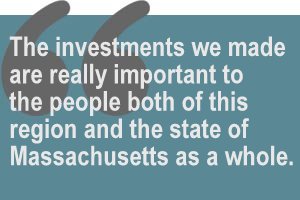
"The investments we made are really important to the people both of this region and the state of Massachusetts as a whole. Since I've been in office we've been fighting against shortfalls and on the brink of deficits and we always have to keep the budget in balance. I think for the first time that I can remember, there was a little more money to spend. But we're being cautious with that because projections are coming in right where expected, not above and not below," Mark said.
He said there is more money going for local education, more local aid, and projects. However, the governor did veto a number of those pieces, which led to a scurry on the final weekend of debate to override them. One of the Gov. Charlie Baker's vetoes included funding for an opioid task force in Greenfield. The Legislature was able to override that, he said.
The formal legislative session under the new Republican administration wrapped up on July 31. Mark said he got along with the administration and had no problems working with secretaries and other officials. But, it was the vetoes that Mark didn't like. He said there is no way for the governor in Boston to know the needs of the Berkshires better than the Berkshire representatives.
Mark is running unopposed in the next election. But, he says that doesn't mean he won't run a campaign. After Labor Day, he will be running radio ads and handing out literature.
"The focus for me become what do you think? What is your feedback?" Mark said, adding that the campaign literature he gives outcomes with comment cards and a listing of his office hours. He hopes the campaign will trigger more constituents to talk to him about issues to take into the next session.
Tags: legislators, paul mark,