Middle East Refugee Plan Outlined to Overflow Pittsfield Crowd
.JPG)
Deirdre Griffin said the project is a public-private partnership.
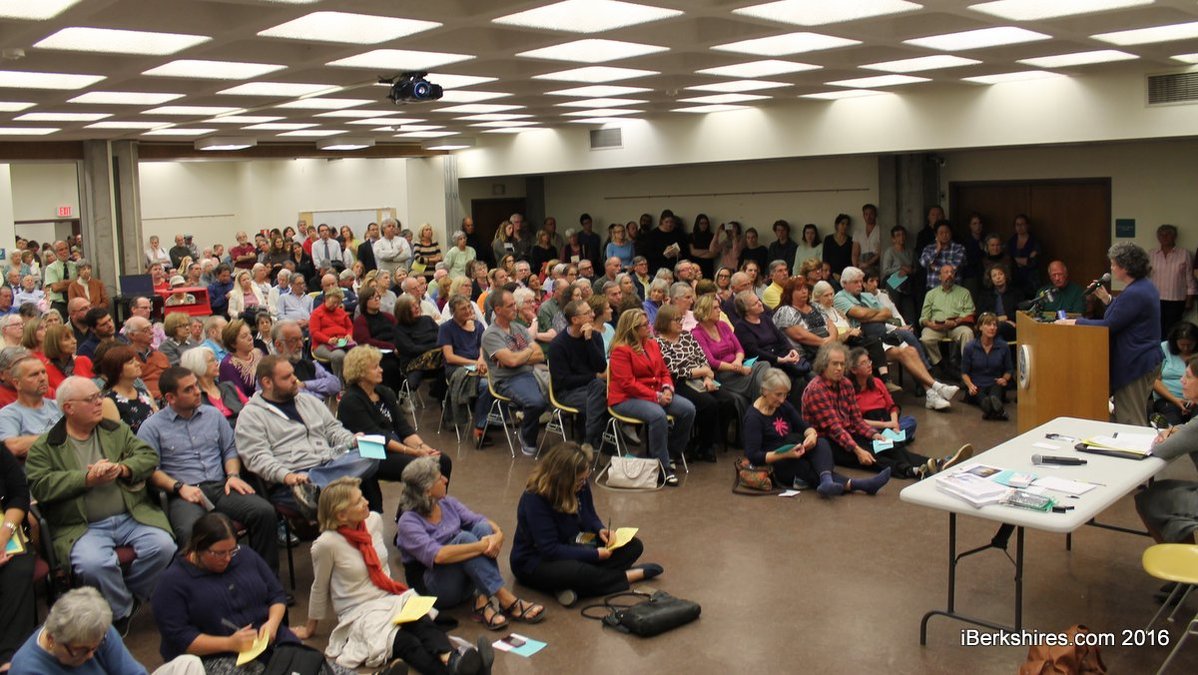
PITTSFIELD, Mass. — An overly packed library auditorium heard an overview of the organization looking to resettle 50 Syrian and Iraq refugees in the city's plans.
But representatives did not field questions much to the distaste of many who attended.
The meeting only lasted an hour with more than 400 people, in standing room only in back and on the sides and overflowing into the other rooms, with Jewish Family Services providing an overview of the program.
The plan will bring the 15 or so Arab-speaking families from the Middle East to Pittsfield and volunteers and the JFS will work closely with them to help them become self-sufficient.
Director of the New American Program Deirdre Griffin said the families will be moving in one or two at a time from this January through September. The JFS will start by working with volunteers and landlords to secure housing and gather donations to furnish it and stock it with supplies. The family will arrive, be fed, and brought to their new home.
"The focus of the refugee resettlement program is on the most vulnerable and the families with children. Most likely, 50 people, that would be 10 to 12 families including 15 to 20 children and probably 15 would be employable adults. We are looking at 10 to 12 families, 12 to 15 jobs, and housing for 10 to 12 households," Griffin said.
Once in Pittsfield, the families will be matched with a caregiver — someone who speaks their language and understands their culture. That person will connect the refugees with services such as health care, education and connect them with jobs.
"The low housing costs make it possible for refugees to begin new lives without the extreme burden of high rent. Local industries with an array of opportunities present possibilities for partnerships that foster refugee self-sufficiency and revitalization of the city and the economy. We already began discussing with several local employers about employing several refugees," said JFS CEO Maxine Stein.
The city has jobs in the service industry available for refugees to start and there are open jobs at the next level for career growth. Griffin said 80 percent of those who are able to work are working within three months.
"There are over 1,500 jobs available in Berkshire County. So 12 to 15 people needing to find jobs is a small percentage of that. Refugees are not given any kind of preference for employment. Our staff and anybody in the community who are willing to work with them to find them a job will be the ones who make that happen," Griffins said.
Many refugees become business owners later in life. The city also offers adult education through Berkshire Community College or the Adult Learning Center and has a school system capable of the teaching the refugee children.
"This a project that really is a project between Pittsfield and us. It is a private-public partnership. We do the work but we also turn to the community and to ask all of you to get your arms around the work."
What the organization hears a lot of concerns about is safety and Griffin said the national refugee program is highly structured by the government, and even provides more screening than other immigrants.
"We are saying yes to something that has a level of unpredictability to it. That is just a reality. There is no way around that. But, I also want you to hear that the reality is that the people who are coming as refugees are the victims of war. They are people who have been fleeing the violence," Griffin said.
"Of the over 800,000 admitted to United State since 2001, three have been charged with some sort of violent act in terms of what may be called terrorism and none have been convicted. So when you get into percentages, can I guarantee that no one will ever have something happen? No, I can't promise you that. We all have to stop and take that in."
Griffin said there are 20 steps in the security process including background checks, medical exams, interviews, and approvals from the United Nations and the U.S. Department of State.
"We have this compassion but at the same time we have to know enough about this process to know that compassion and security can coexist. I would go so far to say they are inherently related," Griffin said.
Worldwide, there are 65 million people displaced from their homes for various reasons. A total of 21 million are identified as "refugees" by the United Nations.
"This term refugee has a very particular meaning. Lots of people leave their homes and immigrate for lots of different reasons, many of them for very similar reasons as refugees. But only those who are formally recognized as refugees are able to be resettled through the United Nations," Griffin said.
And only 1 percent of those get resettled in safe havens. The United States is the leader taking in 110,000 next year. But, even though resettlement programs have been ongoing for years, a crisis has have been growing because the numbers are increasing. In the past, a war would displace people for some time but as soon as it ended, the families could return.
"So many of these altercations and wars are becoming very, very long, so there is no going home. At least not for a very long time. That is why there is all this emphasis now on the global refugee crisis. The United States had a refugee resettlement program formalized since the 1980s. We have a very structured program," Griffin said.
The Department of State and Hebrew Immigrant Aid Society run the resettlement programs and JFS has approval to run it.
"This isn't just about running a program. This is about saving people's lives. This is about enriching our own lives and stepping out in ways that each of us feel called to take responsibility," Griffin said.
JFS started in 1915 and in the 1930s began providing services for refugees. Now the organization, which operates on a $2.9 million budget, provides behavioral health, counseling for adults, children and families, elder legal guardian, aging in place, and citizenship programs on top of the resettlement work in four Western Massachusetts counties. The resettlement program has been ongoing in the Springfield area — taking on 250 in the coming year — and Pittsfield is eyed for an expansion.
Stein said Pittsfield has been a resettlement community in the past with accepting Jewish refugees and in recent years the organization has been receiving calls from residents asking to help some more.
The 90-day program helps get the refugees acclimated to the culture and into jobs and schools. But, the federal government also offers ongoing services to work toward self-sufficiency.
"Of course there will be questions about 'we already have people who are vulnerable, who are struggling with housing, who may be veterans or need some other kind of support.' We want to be clear in acknowledging that those needs don't go away," Griffin said. "The resettlement program is a very specifically streamlined funded program so they are no in competition with each other. And I would take the next step and say vulnerable people are not in competition with each other. We can do ourselves a great service by avoiding that 'one gains the other has to lose' that is not the case,"
The organization has been working with local officials in the faith community, in housing, in schools, and in the government for weeks now and brought the issue to the public on Monday. Next the organization plans to pull together smaller groups and have house party like meetings to iron out the details.
"I think now we want to step back, go into small groups, establish our Berkshire resettlement committee and then take it from there. Then we will see," Stein said.
At Monday's meeting, the group collected question cards and promised to respond with answers. But, many in the community felt they were unable to discuss the project further. The group handled just three hand-picked questions to address and the public had no opportunity to weigh in.
"We do try to listen to everyone and it really was the lack of time and the actual format that we designed that were not able to adequately address all of those needs. We would like to do that in the future should that come up," Stein said, relating to the lack of a question and answer session.
City Council Vice President John Krol agreed that the program was too short and vowed to hold more sessions to allow for additional comments.
"It was a little too short. There were a lot of questions that went unanswered because of the number of people here and because of the logistics. They are aware of that and they'll be back," Krol said. "This meeting was an initial overview. Many people may not be aware how we got to this point so that was helpful for them. There were other people who had more specific questions that perhaps didn't get a comprehensive answer."
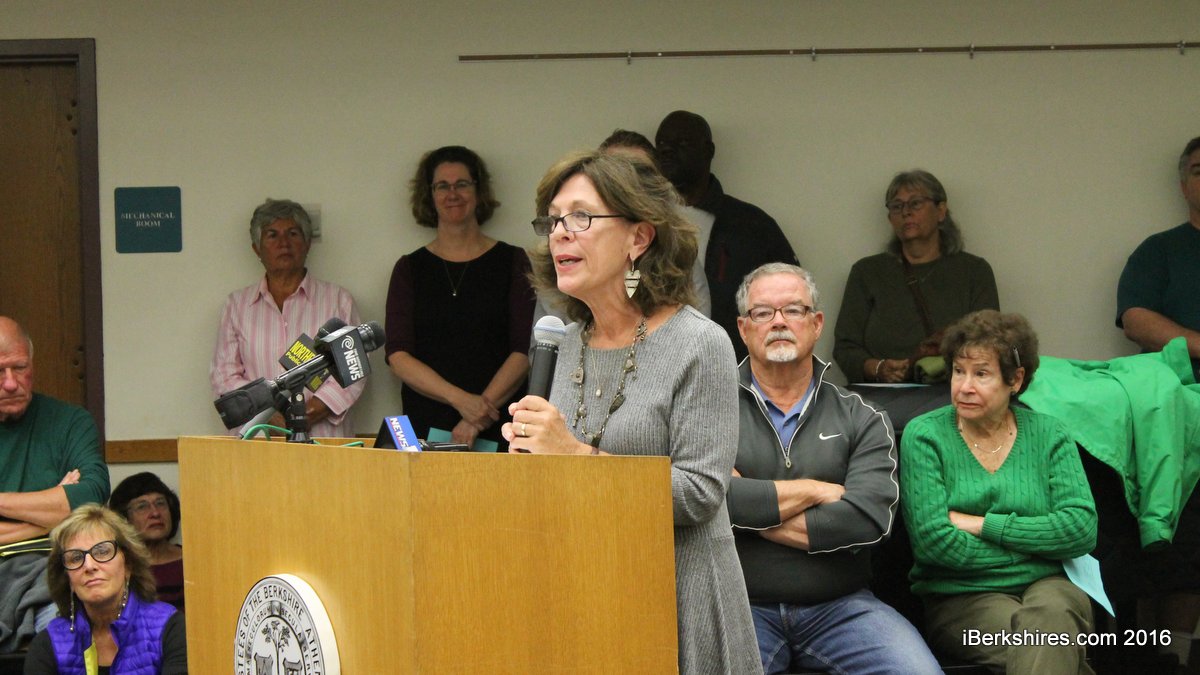
Maxine Stein said JFS is more than 100 years old this year and has been providing refugee resettlement for years.
"I am proud of this community that we had so many people come out. A lot of people are interested in helping. You can definitely see that. That makes me proud," Krol said.
Griffin estimated that three-quarters of the more than 400 people were "enthusiastic" about the program and she said the organization will create venues for to answer questions from those with remaining concerns. Stein said she doesn't expect that to be too difficult.
"I don't think we have to go out and reach them. I think they will reach us. I don't think we would advertise a special living room conversation for the people who are not in favor of it. But, I would hope those people would email us or calls us. One man asked if he could talk to me. I do have a feeling that those sentiments will reach us; they already have," Stein said.
JFS doesn't have any plans at this point for a larger forum giving the public an opportunity to vocally weigh in but once a local committee is formed and local staff is hired, if there is a need for one the leaders say they will hold one.
For now, the group will next be asking the City Council to endorse the program.
Tags: community forum, refugees,