Pittsfield Considering Cutting 73.5 Jobs In School Department
.jpg)
Superintendent Jason McCandless is holding firm on a $500,000 expenditure to change out curriculum materials.
"We can't lose sight of the faces that are attached to these numbers," Elias said.
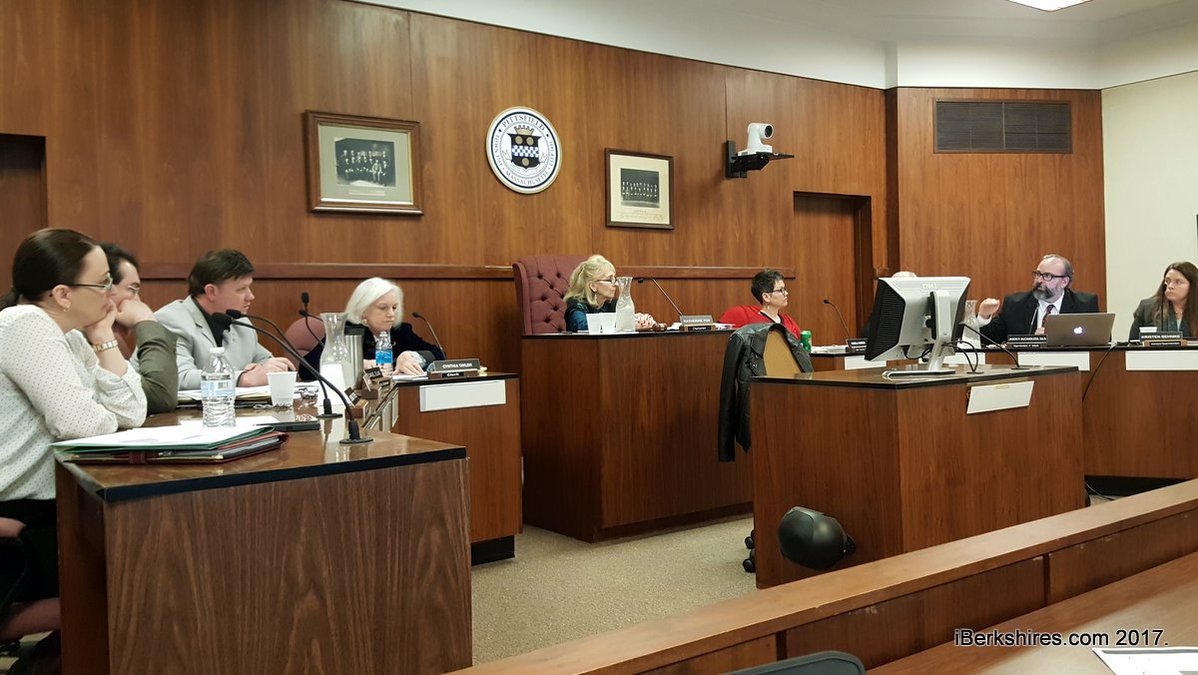
Elias is just one vote on the School Committee that was presented a budget on Wednesday which calls for the elimination of 73.5 full-time equivalent positions.
Those are 29.4 teachers or 5.1 percent of the district's entire teaching staff. Those are 39.2 paraprofessionals, 15 percent of those currently employed. And those are five districtwide positions, 11 percent of those staff members.
"It's unbelievable. It is bigger than most teaching staffs in Berkshire County," Superintendent Jason McCandless said of the proposed workforce reduction.
But, "This is a pathway for right now to get to the bottom line."
That bottom line is driven by two major factors: health insurance and the city's levy ceiling. Pittsfield is approaching its levy ceiling, or the amount of revenue it can generate from taxation according to state law. The law is intended to limit a government to taxing less than 2.5 percent of all taxable property. It is different from a tax levy limit, which restricts annual growths but can be lifted through an override vote. The ceiling is lower than the levy limit and there is no override.
As the city started the budget planning, the Finance Department determined the increase of new money could be $3.3 million. In February, Blue Cross Blue Shield informed the city that it would be going up 12.9 percent, or $3 million.
"That affects every employee. It is affecting the school employees, the municipal employees, retirees, it is affecting everyone," Mayor Linda Tyer said. "That's $3 million in additional costs just for health insurance."
And then the administration started adding up the contractual agreements. The city has employee pay raises, rising utility bills and pension obligations. The contract for garbage collection is increasing.
Before any department budget was even considered, the administration saw that it has $3.9 million in bills and just $3.3 million in revenue. That's not including whatever settlement could be coming from negotiations with the police and fire unions or what will happen with the proposed Eversource electric rate increase.
"As of today the direction to every department, municipal and school, is level fund. That may not be enough. We may have to go even deeper than that," Tyer said.
"Level fund is actually a cut. One of the increases is related to the contractual obligations we have to our employees. We have a commitment to keep that obligation, that means we have to find reductions in other areas. It is people and programs. Level funding is a reduction and we may have to go deeper than that."
For McCandless, level funding means an appropriation from the city of $60,316,338. The School Department, the largest cost sector in the city, has its own contractual obligations. It also saw a $200,000 increase in out-of=district placement for special education services.
"We know we need close to $2 million in spending to keep a level service budget," McCandless said. "We have the dread and the knot in the stomach and the angst and everything else that comes with preparing a budget like this."
Last year, the schools did see a budget increase but it still led to 16.5 positions being cut: nine from the budget and 7.5 more with the loss of a state kindergarten grant.
This year McCandless prepared a budget which calls for 73.5 positions to comply with level funding — the hope is that the positions lost will be through attrition and McCandless has extended the notification period for teachers to take advantage of early retirement benefits.
The cuts include putting the auto body program at Taconic High School on hold until the new school is completed. It ends stipends for department heads in both the middle and high school. It makes cuts to the teen parenting program. It reduces the preschool offerings.The plan also cuts staff from nearly all aspects of school operations.
"This still leaves the city underwater," McCandless said.
The numbers of reductions have increased from the first budget draft, which called for 57 position cuts. That plan still needed a .9 percent budget increase over the previous year so it had to be pared back even more.
"We have to come in level and I'm not absolutely convinced that is going to work," McCandless said.
But McCandless is holding his ground on a few things. He is not cutting sports or the arts. And he is standing firm on a $500,000 increase for curriculum development. That half-million is eyed to be used to continue a cycle of replacing materials across all schools. McCandless says teachers are using tools that are outdated and not aligned with standards.
"We know for a fact that it has been years and years and years that we had money set aside to invest in the curriculum," McCandless said. "We have materials that are not well aligned to the tests."
McCandless called that "non-negotiable."
"We are asking our teachers, we are asking our staff to do incredible hard jobs ... and we are asking them to do it with substandard tools that are not aligned to the test, not aligned to the schools, and not doing us any good," McCandless said.
The United Educators of Pittsfield understands the predicament. President Brendan Sheran said he'll be in contact with McCandless and committee Chairwoman Katherine Yon in the next few days in hopes to save a few jobs and mitigate impacts. But, these deep cuts are becoming a trend happening across the state.
"This is a dire situation for the entire community. It is not just the schools per se, it is the entire community. You have key people, key positions that help educate and inspire kids in every school. We're faced with essentially not being able to raise the funds to maintain the services we have. We are forced to remove some of the things we feel are working really well," Sheran said.
"This is a trend that is going to begin existing more and more in the state because more communities are being constrained by revenue generation."
Sheran said there are some areas in the spending plan he disagrees with. He hopes to keep the team leader stipends, he has a few questions about the particular positions being added to the staffing picture, and wonders if the $500,000 for curriculum could be reduced to save some jobs.
"I think there definitely is some disagreements because there are some additions in there and the curriculum number of $500,000, I wonder if we can get away with that being $400,000 this year and maybe save some crucial roles. I really feel some of the positions that really make the middle and high schools tick are those department chairs, the curriculum leaders in their departments, the team leaders who do a lot of work with their teams in the middle schools," Sheran said.
But overall, he said he is happy with the critical thought that is going into crafting a spending plan that will have the best outcome, despite having to make deep reductions in staffing.
"These are challenging times. I'm happy we have some people who are really thoughtful and thinking through this a lot. Of course, there are places we disagree, with additions or cuts, but we don't really have many good options. I hope in the coming days we can come to some solutions and maybe save some jobs and help the kids."
Sheran had just testified in front of the Ways and Means Committee last week when he called for the state to perform a foundation budget review, revamp Chapter 70 formulas for school support, and invest in the infrastructure to renovate aging schools.
"It is just a sad situation that we are constrained so much this year and it appears to be for the foreseeable future in those three areas, the materials, the people, and the facilities," Sheran said.
It is the state and the federal government that other school officials blame for putting the city is such a difficult position.
| Superintendent Jason McCandless released this video explanation of this year's budget situation. |
McCandless said state support for education hasn't been strong. In prior years, he said the district could see increases of between $1 to $2 million in state aid to help offset inflation and increases. That increase has been reduced to about a quarter of a million.
The district has absorbed the cuts to the kindergarten program and the preschool project is being cut by a third this year — and a third next year and a third the following year.
"For a state government that says we are all about pre-K, it seems pretty apparent they are not about pre-K in a public school setting. They are about pre-K in a private setting," McCandless said.
School Committee member Cynthia Taylor called on Gov. Charlie Baker to reel in the health insurance increases and revamp the way education is funded. She called for "change, equity, and representation" at the state level.
Cutler added, "What exacerbates everything right now is the explosion of health insurance costs. And I'm not one who tends to editorialize much on national politics publicly, but while Obamacare has certainly made access to health care more equitable to all, it has not made it more affordable for all and municipalities like ourselves tend to bear the brunt of this cost. A 12 percent increase in health insurance cost across the board is truly the driving factor in our budget process and the city's budget process."
The city may be losing student age population, which contributes to the formula for Chapter 70 state aid, but the students with additional needs are growing McCandless said. The state aid is staying stable but more and more students are entering school with greater needs.
He said there are two schools with 75 percent of the population considered "economically challenged by the state." He said more than a third of student body in all but one school are economically disadvantaged.
"That's the percentage of students on some type of governmental support program," McCandless said.
The way things are going is not sustainable, McCandless said. The district can't cut 75 positions every year. What this budget does include is money to conduct an enrollment study to analyze the closure of schools.
""We can't layoff 75 people a year. It is simply not feasible. We have to find other ways. I would be committing malpractice if I did not suggest we look at closing a school or closing two schools," McCandless said.
Closing a school isn't unfathomable and has been a growing consideration throughout the county. Most recently, the Adams-Cheshire Regional School District voted to close an elementary school. The parochial St. Joseph's High School will hold its final classes this year. And the Berkshire County Educational Task Force is developing action plans likely to include reduction of the number of high schools in the county. Those recommendations are expected to be presented by July.
"These are natural conversations that you have to have when your student populations are decreasing and funding remains stagnant, but yet those costs of contractual obligations, health insurance, and retirement obligations are always there. We are all looking for ways to do more with less right now. And painful decisions have to be made. The Berkshire County Educational Task Force has been working on this for the past year and while major charges aren't ready to be rolled out, expect to see proposals later this year," Cutler said.
McCandless added he is considering withdrawing from the accrediting New England Association of Schools and Colleges, saying that the recommendations are now becoming more of an add than a need because the district can't afford to implement the changes the organization recommends. He said the state guidelines and NESAC are often completely different and he is finding it difficult to justify paying $10,000 every year and some $30,000 every few years for a review visit.
"To write this check every year and a really big check every year is tougher to do each and every year," McCandless said, adding that one paraprofessional staying on staff with that money could ultimately make a more meaningful impact on a student's life.
McCandless also rejected the notion that the call for a reduction in staffing by such an amount was a "scare tactic" intended to get the council to ultimately give the district more money. He said 85 percent of the budget last year went toward staffing and in this proposal, 83 percent will go toward it. The 17 percent spent outside of staffing goes to utilities, internet, furniture, teaching and assessment materials, and the like.
McCandless said if all of that was cut and students were "learning by candle light" it still wouldn't be enough to hit the level-funding target.
The financial challenges won't be going away anytime soon. McCandless said he recently spoke to a former superintendent from Worcester who said it took that city six years to out from under the levy ceiling.
"There is no single solution. We have to ride out this downturn by cost containment, we have to chase down every piece of new growth, every opportunity for new construction in every area of the economy," Tyer said.
School Committee member Anthony Riello said every year as police chief he would be asked by administrations to come in at level funding. But, the difference is each year he had an opportunity to advocate for the funds. He said there just won't be the funds available to make a case for.
"I never once had a mayor or a town manager or a selectman come to me and say chief we are going to give you a 5 percent increase. It was always level funded or a cut," Riello said.
But, "We're faced with a situation today like none other that I've ever experienced. It is what you see is what you get."
He had the same tone as the other School Committee members in saying, "I don't support what we are doing but I know that we have to do it."
Elias said, "If we don't act responsibly now, the compounding negative effect next year would be irresponsible on our part."
"We don't want to have to eliminate anything. If it were up to us, would we be cutting even one position? No. We would be finding more ways to grow the great things we do with the Pittsfield Public Schools," Cutler said. "But money does not grow on trees and we we have a fiduciary duty to our taxpayers and to ourselves and to the future success of our city to be fiscally responsible and present a level-funded budget to the city council for review this spring."
Pamela Farron said, "We do not want to make these cuts. This is the situation we are in."
And Tyer, "We are in this dilemma of how do we responsibly reduce our budget in the way that we are forcefully reduce to... I can't possibly express how deeply upsetting this situation is to me because I do understand that it is people being affected...This is a serious challenge for all of us. This is a gut wrenching experience for everyone."
The budget will next go to a public hearing next week.
Budget Presentation April 5 2017.pdf by iBerkshires.com on Scribd
Pittsfield Schools FY18 Line Item Budget April 5 2017 by iBerkshires.com on Scribd
Tags: fiscal 2018, Pittsfield School Committee, pittsfield schools, pittsfield_budget,