Stamford Group Asks for Time to Research Joint-Clarksburg School District

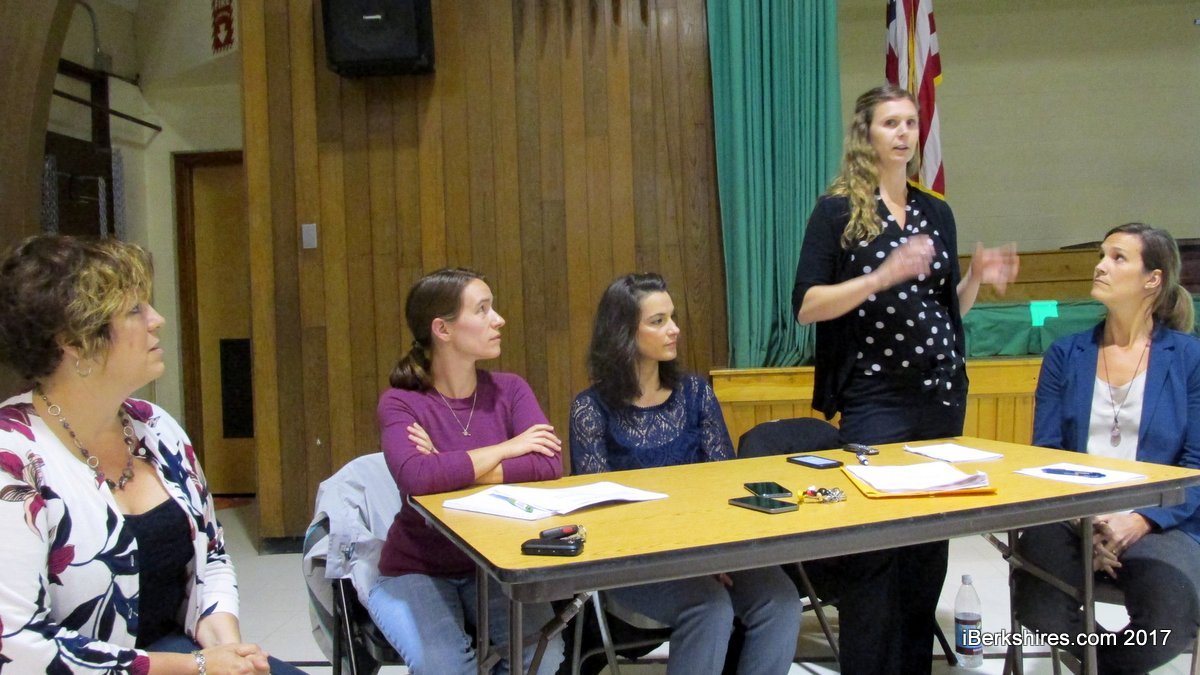
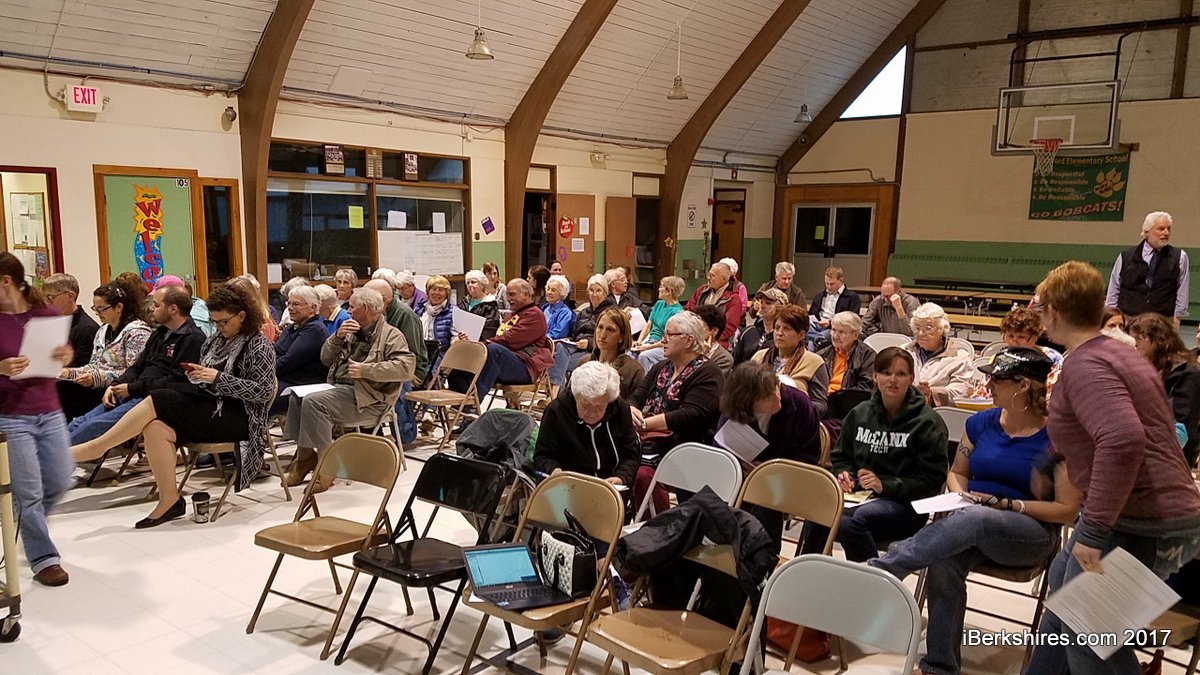
State Rep. Laura Sibilia, I-West Dover, told the gathering that an interstate school district was a valid alternative to Act 46.
Stamford's been wary of how the law would affect its school but some residents think they've found an answer — across state lines.
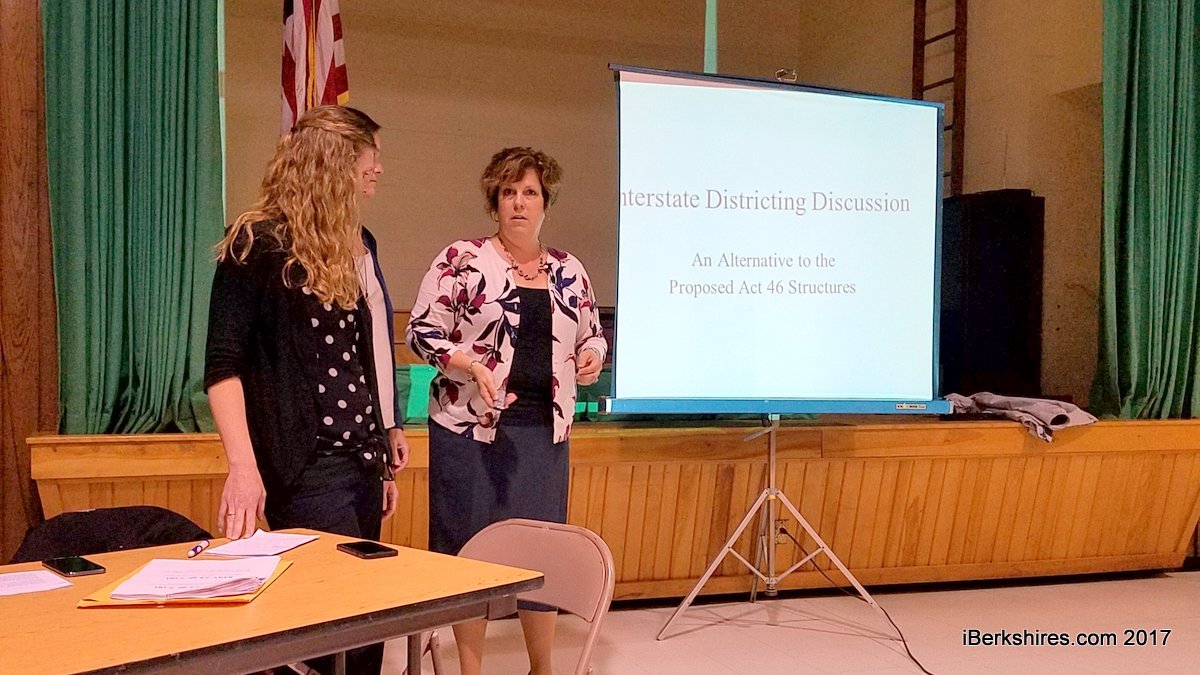
An ad hoc group, with input from the School Board and representatives from Clarksburg, Mass., is exploring the possibility of an interstate school district that will allow the tiny town to look south rather than north.
"We're not the only small school that's struggling right now, that's having problems staying healthy and viable ... we feel that Clarksburg is also going through some of those problems," committee member Colleen Cahoon said. "This idea of the interstate school district, we feel there is an incredible opportunity to help solve many of these problems ... this isn't a quick fix but we see this as something that can keep us healthy for a long time to come."
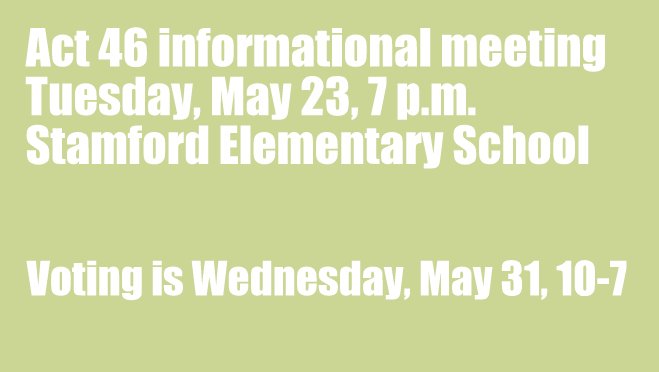
The group is asking for a "no" vote on accepting Act 46 at next Wednesday's election. Rejecting the act will give members more time to come up with answers for residents and give the town breathing room until a decision has to be made in November.
The state had initially pushed for towns to OK mergers by July 1, but that's been delayed until Nov. 30.
The Act 46 proposal put forth for Stamford is to consolidate governance and cost-sharing with its closest neighbors: Readsboro Elementary and Halifax Elementary in West Halifax, 24 miles away along winding Routes 8 and 100.
Many in Stamford don't see the savings in joining with a school nearly 40 minutes away on a good day, and who knows how long on a bad one. They don't share the same suppliers, so there's no purchasing power, and sharing administration would be difficult. Plus, parents are worried that not long down the road, school buildings will be forced to consolidate and children will be bused north.
Stamford has far more in common with Clarksburg Elementary that sits less than four miles away in Massachusetts. There's a relationship between the two towns of blood, marriage, history and circumstance — and high schools.
Kimberly Roberts-Morandi, a member of the group, is an example of that. Formerly of Clarksburg, she's lived in Stamford for 20 years and is director of curriculum, instruction and assessment in the North Adams, Mass., public schools.
There are some differences between the educational standards between the two states, but a lot of similarities as well, she said. Most Stamford students attend Massachusetts high schools so shifting the curriculum will give them a head start. And aligning with Clarksburg puts students at a high-performing, Level 1 school.
It could also offer more opportunities for professional development for teachers since they'd been in the larger and more accessible Berkshire County; children could have more opportunities for technology, cooperative work and additional programming.
"There is such a thing as a school being too small, of a classroom being too small," Roberts-Morandi said.
Other benefits could be savings on transportation costs, higher retention and recruitment of teachers, and immunity to any further changes to Act 46, such as high school restrictions.
"One of the biggest challenges facing rural education systems is holding onto school and district administration," Roberts-Morandi said. "The reason for that, according to research, is that they have to wear so many hats ... There's a high rate of turnover in our rural administration."
What they were unable to answer is how the education funding would work if Stamford falls as a Massachusetts school district. Vermont residents pay a state education tax based in part on income; in Massachusetts, schools are funded by property taxes and state funding arrived at by a complicated formula.
How would Stamford School be used? Would all the children end up in Clarksburg? How would Clarksburg's school project be affected and would Stamford have to shoulder part of the cost? What about the staff and contracts? Would the state allow an interstate agreement? Would Clarksburg even want to do this? How much would this whole process — which requires an act of Congress — cost the towns?
Several months ago, Clarksburg Select Board Chairman Jeffrey Levanos and Town Administrator Carl McKinney attended an informational hearing on Act 46 in this southernmost Vermont town and offered the concept of somehow finding a common cause.
Like Stamford, Clarksburg's been dealing with a declining population and rising education costs. The kindergarten-through-Grade 8 school is part of a four-town supervisory union that shares administrators and costs.
"We're offering to open a conversation with the town of Stamford," McKinney had said to applause. "It's up to you folks. We stand ready to be open to you."
"If this were to happen we would not have to rely on [school] choice anymore," Lev said, adding that it should also open up school choice in Massachusetts to Stamford children. "My guess would be financially for your town, it would not be a big difference."
But Clarksburg School's first priority is moving forward with the school project and the vote expected in September, he said.
The towns' state representatives have expressed support for whatever direction they wish to go. In Massachusetts, state Sen. Adam Hinds and state Rep. Gailanne Cariddi are aware of talks and Cariddi has offered to pursue grant funding for the legal issues on the Massachusetts side, the group said.
Stamford's state Rep. Laura Sibilia, an independent for the Windham-Bennington District, attended Monday's meeting and said the town had three options when it came to Act 46: vote yes, do nothing (and let the state decide) or find an alternative the state would accept.
"This situation with Clarksburg seems more like an ideal Act 46," Sibilia said. "It's not necessarily better, it's the best. So I think if we look at the goals of Act 46 and we take them seriously ... I think that's in your favor.
"Let's be as transparent as we can as quickly as we can with folks at the state and keep doing the work."
One other option would be to apply as a geographically "isolated" school district once the state issues that definition in September. School Committee Chairwoman Cynthia Lamore said achieving that designation would be a safety net to allow the school to operate independently if nothing else came to fruition.
What the group stressed, however, was that a no vote next week would allow Stamford to approach Clarksburg and get more information to both towns before making any decisions. Voting yes next week in Stamford would initiate Act 46 and that might be harder to get out of.
"This can't be something done to Clarksburg, it has to be something done with Clarksburg," Roberts-Morandi said. "We have to be very cognizant of that because these are our neighbors, our relatives ... it has to be a collaborative effort. Six months can buy us that time we feel we need ...
"It's intimidating in some ways, it's scary, it's sort of groundbreaking ... but it's also inspiring, it's hopeful and it feels really good when you go to bed at night and you think, you know what, it's opportunity. I just want to have that time to chase it. That's all any of us are asking for."
Tags: act 46, Clarksburg School, stamford,