Mass MoCA Holds Grand Opening for Massive Building 6

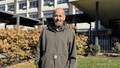
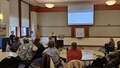
Museum director Joseph Thompson listens to speakers at the grand opening event in Courtyard D.
With the clipping of an abstract (invisible) yet "shiny and glittery" ribbon, Executive Director Joseph Thompson ushered the crowd gathered in Courtyard D into Building 6 — the Robert W. Wilson Building.
Thompson's brevity on this day is understandable. He's been talking about what the doubling of gallery space at Mass MoCA means for years and, more recently, to special previews and rounds of press conferences, local and national reporters.
Well more than 5,000 visitors are expected at the museum Sunday, based on ticket sales alone to the Cake concert in the evening at Joe's Field. Sunday's opening festivities was also free to anyone in the 01247 ZIP code and parking lots around the museum were filling up during the afternoon.
Building 6 nearly brings to conclusion a dream begun in the 1980s to transform the sprawling 16-acre campus and its 28 buildings into a world-class contemporary art museum. Primed with $25 million in state funding, the gamble was that the museum would succor a city that had lost its largest employer when Sprague Electric left the mill behind.
Nearly 20 years later, another infusion of $25 million in state funds, being matched with nearly $40 million in private investment, was a testimonial to the infusion of arts and economics that Mass MoCA has brought to the smallest city in Massachusetts.
"Who'da thought?" said Mayor Richard Alcombright, noting the articles about a city on the cusp that have been featured in numerous national publications.
"We lamented when our mills closed. Some of us rolled our eyes when conversations begin about Sprague Electric becoming an art museum," he said, joking that when people talked about art back then, it was probably someone they knew. "Where the hell would we be if not for Mass MoCA. The cultural, the social, the economic, the aesthetic, the excitement. ...
"The happy that this place brings to this city and to this region and to those who visit cannot be truly measured ... private investment from both outside and local developers stemming from the success from MoCA is unprecedented for this region."
The museum is expected to bring in another 65,000 or so visitors a year, on top of the current 165,000 or so a year. It's being credited with the development of a cultural corridor along Route 2 that links the city with Williamstown and is seeing increased investment, particularly with Tourists hotel and Greylock Works renovation.
"There was so many people who got this going just to do the original Mass MoCA," said Daniel Bosley, the city's state representative when the museum was first being developed. "Then to do this, to make this so much more. This has just put us on the map of being a very unique place."
With an acre of space on each of its three floors, Building 6 is host to wide corridors, expansive mountain views, and light-filled galleries. Ghosts of the old Sprague and its predecessor, Arnold Printworks, can still be seen in exposed and painted brick walls. The design by architects Bruner / Cott & Associates, which worked on the initial museum buildings, was meant to enhance the industrial look of the more than century old building.
Former Gov. Jane Swift, a daughter of North Adams, said she'd learned strength of character from her friends, neighbors, family and faith as she grew up in this city. A tenaciousness that served the city well when she lobbied hard for the initial funding as a state senator.
"It is those values that are built into this building," she said, the building where her immigrant grandmother worked for 47 years "knowing that her children and grandchildren would have a better life."
"That is what was built in these buildings and I do believe it's the character that is embedded in these buildings that the architect honored but which actually give life to what happens here."
On the eastern end, a wide entrance and stairway brings visitors to the first exhibit by James Turrell, an experience of light and color that requires advance signup to limit the number of people entering at a time. Next door is the completed "bike tunnel" with artwork by Mary Lum that runs out to the flood control chute that contains the Hoosic River, and where museum officials hope will soon be spanned by a bridge allowing access to the courtyards via River Street.
On the second floor, are exhibits by Robert Rauschenberg, Louise Bourgeois, Dawn Dedeaux and Lonnie Holly, Joe Wardwell and Barbara Prey along with event space. On the third floor, is the event space mezzanine and exhibits by Jenny Holzer, the musical instruments made or inspired by Gunnar Schonbeck, Laurie Anderson's studio and Janice Kerbel.
"Things are happening in North Adams and this region is a destination that's supporting the largest museum of contemporary art in the country," Alcombright said. "Making us both worthy and deserving of further exploration."
The one thing all the speakers stressed was the support provided at the local and state level in making Mass MoCA a figment of the imagination come true. Bosley called it a village; Mass MoCA Board of Trustees Chairman Hans Morris ticked of a list of seven governors, five state senators, three state representatives, two mayors and a museum director.
"I defy anyone to say one other project in the United States of America that has as much bipartisan support and success," he said, noting that two other supporters and former governors, Willam Weld (a Republican) and Deval Patrick (a Democrat), had both visited the new addition in recent days.
"It wasn't so strange to have people work in a bipartisan way," said Swift, a Republican. "Massachusetts and our state government was seen as a shining city on a hill to set an example for the rest of our nation and I hope the rest of the nation will look to the way we govern today in Massachusetts — across the aisle, between the branches with a balance of power — and take that example."
And picking up on Alcombright's comments, Swift flipped it around. "What the hell would Mass MoCA be without North Adams."
Tags: mass moca,