Gonzalez Looks to Bring Aggressive Agenda to Governor's Race

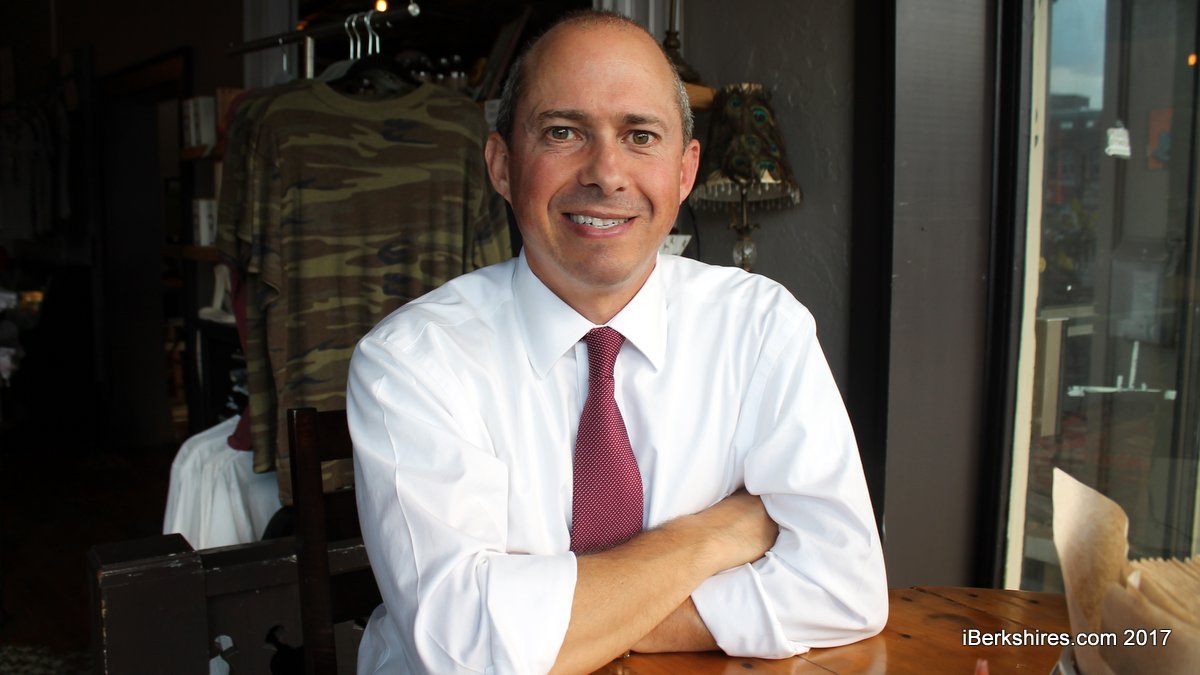
The Needham Democrat stopped at Dottie's for coffee and conversations.
The Needham Democrat says when it comes to transportation, health care, and early childhood education, Republican Gov. Charlie Baker is happy with "the status quo."
"He's way too satisfied with the status quo. He is too often on the sidelines when he should be fighting for people. I think his approach to the job has been one where he basically looks at what we have and where we are and is trying to just do the best with what we have as opposed to figuring out where we need to go and how do we get there," Gonzalez said.
Now, the former secretary of administration and finance in under Gov. Deval Patrick's administration is looking to step into his former boss's job. He believes his experience in both state government and the private sector gives him the experience to deliver on an ambitious agenda.
"I am running on a very ambitious agenda to actually make progress in a lot of areas -- whether that be our transportation system and not just in the greater Boston area but all over the state, or access to affordable child care, or affordable higher education, or addressing climate change, you name it," Gonzalez said.
Gonzalez was born in Cleveland to two young parents, who he said instilled in him a belief that any obstacle can be overcome.
"My dad is an immigrant. He didn't speak English when he came here and never went to college. He was one of the people who worked his way from laying bricks in a city sewer system to becoming a successful small businessman. He is an American citizen now. My mom became a public school teacher," Gonzalez said. "They are parents who overcame great odds and worked really hard."
He moved to Massachusetts in 1998 as an attorney working for Palmer and Dodge, where he got his first real taste of working in government. The firm specialized in municipal finance, particularly in helping cities and towns finance large capital projects.
"Even though I was working at a private-sector law firm, I was working at a firm where all my clients were government entities," Gonzalez said. "The finance part of it wasn't the big driver for me, but I ended up learning a lot about government finance in that role. That's how I ended up with the Patrick administration."
In January 2007, he got the call from the Patrick administration asking him to join the team and oversee the state's capital budget. Two and a half years later, he was appointed as the secretary and oversaw the entire state budget. During his time with the Patrick administration, he also co-chaired the life science center and chaired the Health Connector.
It was his work on the Health Connector, and working on the 2012 cost containment bill, that took him down the path of health insurance. In 2013, he found a job with Celticare Health, which was struggling with just 11,000 members. Since then, he led the company into an expansion with New Hampshire Healthy Families. Now the company has 120,000 members.
He continued to follow state politics and continued to dislike the lack of urgency in the way Baker is governing. In December, he quit Celticare and officials announced a month later that he was running for office in 2018.
"In Massachusetts particularly, we've always been a leader. We've always believed we can overcome any challenge. And I think it is important that we have a governor who is working with a sense of urgency to make progress on issues that are affecting people on a day to day basis," Gonzalez said.
"My biggest gripe is the lack of leadership to actually take on the challenges."
Coming right out of the healthcare industry, he says the state isn't doing enough to provide inexpensive and quality health care. He believes the state needs to have a plan to move toward a single-payer system, which he says will be more efficient.
"The health care system we have now is way too complicated for people to navigate, it is way too expensive, and the quality isn't as good as it should be," Gonzalez said. "I was in the healthcare industry for a while and every additional second I spend in the healthcare industry, the more discouraged I got with how dysfunctional and wasteful it is. I think we need to move to a single-payer system that is simpler, cheaper, and does a better job at keeping people healthy. I think it would cut a lot of waste."
He said he'd immediately call together a group of experts to plot out the way to vastly improve the health care system.
Another campaign promise of Gonzalez is that by the end of his first term, every family would have access to affordable preschool and early education programs.
"The evidence is clear that the access to good, quality child care and preschool is game-changing for kids, particularly lower-income kids in terms of their ability to be successful in school and in life. And it allows their parents to go to work to support their families," Gonzalez said.
The first step would be to expand the eligibility for low-income subsidies to the programs. There are an array of current offerings now from being in schools to private providers, and Gonzalez said he'd push on all fronts.
"We are the most expensive state in the country for child care and preschool. It costs about $15,000 a year to send each kid. Most families can't afford it. It is the most formative period of a person's life, 90 percent of the brain development happens before age five and it is the time we are doing the least," Gonzalez said.
He says it will certainly cost more money and that is why he supports the Fair Share Amendment. Nonetheless, even if that doesn't pass, Gonzalez said he'd find somewhere to get the money for early education elsewhere.
Locally, he is particularly concerned with the expansion of broadband internet and transportation.
"I can't believe that is not done yet. Gov. Patrick took it on as a priority. I was there and approved funding for the Broadband Institute to provide the main line framework to support broadband access to everyone across the state who didn't have it. I know there are issues with getting the last mile connections in a lot of communities," Gonzalez said. "In my view, there is an insufficient urgency toward addressing it."
In the Berkshires, the bus system stops early in the evening and runs little on the weekends. Gonzalez says that doesn't support the creative economy and doesn't support getting people to work in other industries.
"We may not be able to solve every problem on day one, but we need to be trying," Gonzalez said.
He promises to be a governor for "the entire state" and to partner with local officials in spurring the economy.
Meanwhile, on social issues, Gonzalez is again critical of Baker when it comes to "standing up for people." He cited that Baker supports detaining immigrants, opposes Syrian refugees from resettling in Massachusetts, defended southern state flying Confederate flags, and is "silent" on transgender rights. Gonzalez said a government needs to stand up for everybody and that's what should be expected.
The other Democrats currently in the race are Somerville author and activist Robert Massie and Newton Mayor Setti Warren.
Tags: Democratic Party, election 2018, governor,