Mount Greylock Building Committee Discusses How to Deal With Change Orders
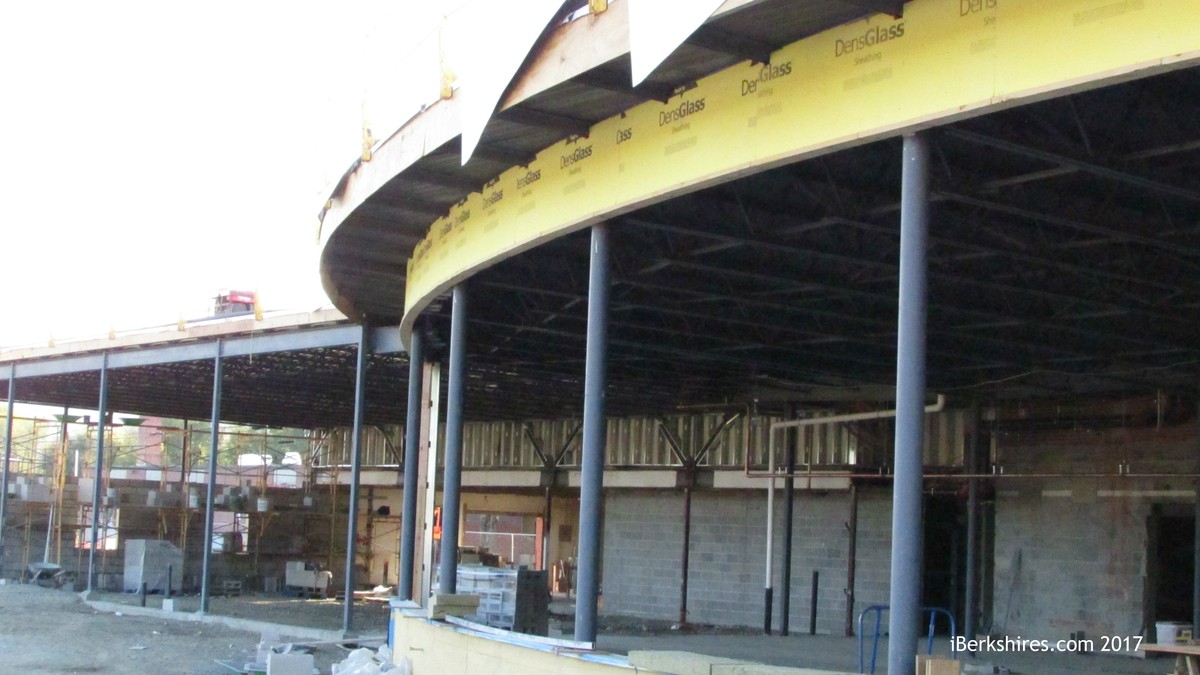
The rounded exterior of the new cafeteria. The windows, which will face Mount Greylock to the east, will be up soon so interior work to continue through the winter.
That process changed a little this summer when the district’s construction manager, Turner Construction, gave the district a guaranteed maximum price for its portion of the $64.7 million addition/renovation project.
Prior to having the GMP, any change orders on the project — which broke ground in the summer of 2016 — would have been incorporated into Turners’s maximum of $52.3 million.
Now, any increase in cost accruing from a change order would be added to that guaranteed maximum price, Owner’s Project Manager Trip Elmore explained. That likely means dipping into one of two contingency accounts on the project, a guaranteed maximum price contingency of a little more than $1 million or a $2 million “owner’s contingency.”
It is the latter contingency from which district officials are hoping to pay for some site work on the project — including a renovated parking lot — next summer.
Although the pricing on the project has generally been coming in at or, in some cases, below the forecast amounts, change orders during construction are not uncommon.
The project already took one hit to the guaranteed maximum price contingency, the committee learned Thursday, with a total of $92,944 in change orders since the committee’s last meeting.
What generated the most conversation among the committee members during Thursday’s discussion was the prospect that the district could be asked to authorize change orders without first agreeing to a price tag.
Up until now, change orders have included a negotiated price worked out between Turner and subcontractors that the district, owner's project managers, and an architect review before the district’s representatives sign off on it.
But that negotiation and review process can take four to eight weeks, and given the multiple moving parts of the project and tight construction schedule, Elmore said some change orders may require district approval without a firm negotiated price.
“Sometimes, there’s a sequence where it’s more efficient to do something,” before something else, Elmore said. “I think if it was a super big expense to come back and do it another time, we’d recommend you do it [without knowing the exact price]. Others are things that absolutely must be done like we found something in the existing building that absolutely has to be changed, and we just have to do it.”
Some months back, the School Building Committee and School Committee authorized Interim Superintendent Kimberley Grady and School Committee and building committee member Carolyn Greene to sign off on change orders of up to $25,000. Now that those change orders will be coming without an agreed upon price, the pair would be relying on estimates from the project managers and Turner Construction.
“We can try to, when Kim is being asked to sign it, give her some rough order of magnitude,” Elmore said. “Sometimes that’s hard if it involves several trades. That’s why I keep it to plus or minus 30 percent.
“If we saw a $60,000 or $70,000 change coming down the pike, potentially, if we saw that and added 30 percent, we’re starting to get a really big number. I think it would have to go out to the committee.”
And the committee’s chair has an option to call an emergency meeting without giving the standard 48 hours notice in an emergency situation without running afoul of the commonwealth’s Open Meeting Law, building committee member Richard Cohen pointed out.
Greene expressed hesitancy about signing change orders over the previously agreed to $25,000 threshold, particularly now that the work will be proceeding without a negotiated price.
“If there is something big that comes along, and it looks like it’s in the $50-60,000 range and it needs to be decided before the next meeting, this committee needs to be comfortable about the signatory signing it, maybe in consultation with the chair of the School Building Committee,” Greene said. “Should we go ahead and sign it or should we wait?”
Chairman Mark Schiek replied by asking the pair if they would be comfortable with a $60,000 change order.
Grady replied that if that were to happen, she would not be making the decision in a vacuum. She would have the guidance of the project manager, the construction manager, and the architect to help her decide if the change is necessary, time-sensitive and in a reasonable ballpark for the cost.
“The worst case scenario is we start calling emergency School Building Committee meetings,” Grady said.
“The reality is you have to delegate,” Co-Chairwoman Paula Consolini said. “I for one feel comfortable delegating to you two the responsibility to judge. If you feel uncomfortable and need to get hold of people, you can get hold of the chair or get hold of say, Thomas [Bartels, an architect, and member of the building committee].”
“That’s got to be your call. It’s why we delegated in this situation. … You have everything you can possibly have knowledge of in terms of the committee’s work, and you have the professionals advising you.”
Bartels suggested that there needs to be a threshold for the time-sensitive construction change directives, as they’re known, before full committee approval is needed.
He asked Turner’s Mike Giso if $100,000 was a high enough number to provide flexibility, and Giso and Elmore agreed it was.
“The upper threshold is fine,” SBC member Hugh Daley said. “You’re going to come to us, essentially, within 30 days with the change order [at a regular meeting]. What I think triggers this is if they find something that’s a potential $100,000 immediate need … we’re going to have a quick meeting.”
Elmore tried to ease the concerns of the committee by pointing out that, “95 percent of all changes will fall between $5,000 and $20,000.”
In other business Thursday, Giso told the committee that gymnasium floor is down and ready for stripping and finishing over the next week. The school hopes to have the gym back online for physical education classes by mid-November and for public events — like basketball games and wrestling meets — by the middle of the 2017-18 winter season.
By Thanksgiving, the contractor said they hope to the bulk of the exterior work done, and work is progressing on the interior of the new three-story academic wing, where Turner plans to have temporary heat available within the next month to allow work to continue through the winter.
The plan remains to move classrooms from the current academic wing to the the addition during April vacation in order to start tearing down the existing building in May.
Last weekend, electrical power was run to the new addition, a process that caused a small hiccup in September. A faulty transformer blew on Sept. 23, the first time the contractor tried to connect the new building.
National Grid and Albany’s Ferguson Electric rushed to get a temporary transmitter in place, and neither school nor the construction work was interrupted.
Elmore and Grady cited the contributions of Mount Greylock’s facilities supervisor and technology director, Jesse Wirtes and Rob Wnuk, for their assistance in making sure the blown transformer did not disrupt the school’s operation.
“This wouldn’t have happened without Jesse’s and Rob’s work,” Elmore said. “We have 100 people or more on the job site every day. You don’t want to interrupt that process.”