Williamstown Planning Board OKs New Williams Dorm
WILLIAMSTOWN, Mass. — The Planning Board on Tuesday gave the OK to Williams College's plan for a new dormitory and discussed zoning bylaw changes the board may bring to town voters in May.
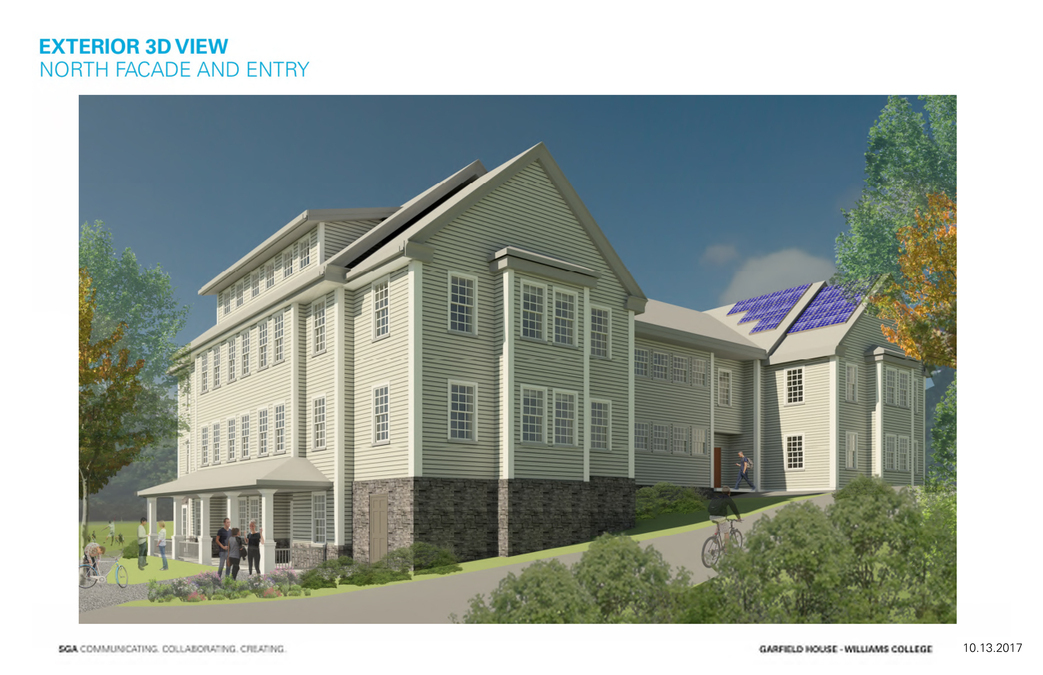
The college was before the board to seek a parking determination and a finding of functional equivalency for the planned 40-room residence hall to replace Garfield House on South Street.
College attorney Jamie Art explained that the new dorm will have fewer than half as many parking spaces as the existing structure, part of the college's initiative to reduce vehicular usage on campus and promote healthy lifestyles.
"Right now, I think there are 16 spaces by the existing Garfield dorm," Art said. "Our proposal is to reduce that to seven spaces. … There's an ongoing effort to try to encourage more walking and biking. Having lots of parking immediately adjacent to dormitories is counter productive to the goal of getting people to walk or ride their bike to get to class, Spring Street or the library.
"We can manage parking by finding other spots for people eligible to bring cars to campus. We would rather not have the bulk of those spots next to people's dormitories."
Three members of the five-person board heard the college's application. Tuesday's meeting was attended by one other member, Chris Winters, who, as a Williams employee, recused himself from the conversation.
The remaining board members were complimentary of the college's efforts to cut down on parking and commented favorably on the lighting plan for the dorm.
The college is planning 10-foot poles for exterior lighting using a full cutoff fixture, Art said.
"In regard to lighting, you've kept most of it going toward another campus building instead of down the street where you have more non-campus residents," board member Amy Jeschawitz said, referring to the new residence hall for the Center for Development Economics, to the north of the Garfield Hall replacement.
Planner Ann McCallum, who has taken the lead on the board's efforts to redefine lighting standards in town, encouraged the college to look at lower temperature lights when it comes time to install the fixtures in the design, but generally expressed her approval.
"[South Street resident] Roger Lawrence, who has been active in lighting issues, called me today," McCallum said. "He's away and wanted me to take a look at the lighting. His concern is not to have too much in a residential district. I think the lighting you've proposed is something he'll be happy with."
Not so impressed was Charles Bonenti, a former chairman of the town's Historical Commission, who used Tuesday's hearing to express his displeasure at the aesthetics of the planned dorm.
While recognizing that the Planning Board had no jurisdiction over the college's design choices, Bonenti encouraged Williams to rethink its recent architectural decisions.
"All the renovations the college has been doing in recent years have been changing the look and nature of Williamstown to a great degree," Bonenti said. "This is an example of a street where many buildings that were college buildings looked like houses, so it had the look of a residential neighborhood. It's losing part of that.
"I thought the CDE [residence hall] was a bland, pedestrian answer to the need for new space behind the CDE building, and I think the same could be said about this. There's a blandification of Williamstown going on with this -- block buildings like the new science center, and from what I've seen of the inn, it's the same.
"It's sad. We're losing our architectural diversity. There's nothing the town can do about that. I just put it out there. I think the '62 Center was the last building of merit I've seen put up in some time."
Art said the college plans to break ground on the dorm replacement project after the end of the academic year and noted that Horn Hall, opened in fall 2016, provides the "swing space" the college needs to take buildings like Garfield Hall offline in order to do needed upgrades.
McCallum continued her discussion on lighting with an initial presentation to her colleagues of a proposed lighting bylaw for annual town meeting 2017.
Her proposal, still a work in progress, aims to encourage less glare from lights used in public areas. It also changes the town's regulation from one based on foot-candles to one based on lumens and degrees Kelvin.
Both her proposed bylaw and one that modifies the rules for housing in several parts of town are available on the town website and will be the focus of more conversation by the board starting in January.
On Tuesday, Jeschawitz encouraged her colleagues to look at the bylaw that she and Susan Puddester have been developing along with Town Planner Andrew Groff. In addition to creating new zones that recognize the actual lots that exist in the town's existing General Residence district, the proposed bylaw, acting on data acquired in a study supported by the Massachusetts Housing Partnership, would create more opportunities for multi-family housing in town among other changes.
Tags: dormitory, lighting, Planning Board, Williams College,