Habitat for Humanity Explains Plan for Williamstown Lot

Paul Austin of Northern Berkshire Habitat for Humanity addresses the trustees of Williamstown's Affordable Housing Trust on Wednesday.
Members of the non-profit's board of directors met Wednesday with the trustees of the town's Affordable Housing Trust to discuss Habitat's vision for the property. Earlier this year, the non-profit was the only respondent to a request for proposals issued by the town seeking a developer of subsidized housing on the site.
The Trust acquired the land in 2015 using Community Preservation Act funds with the intention of developing housing in the residential neighborhood.
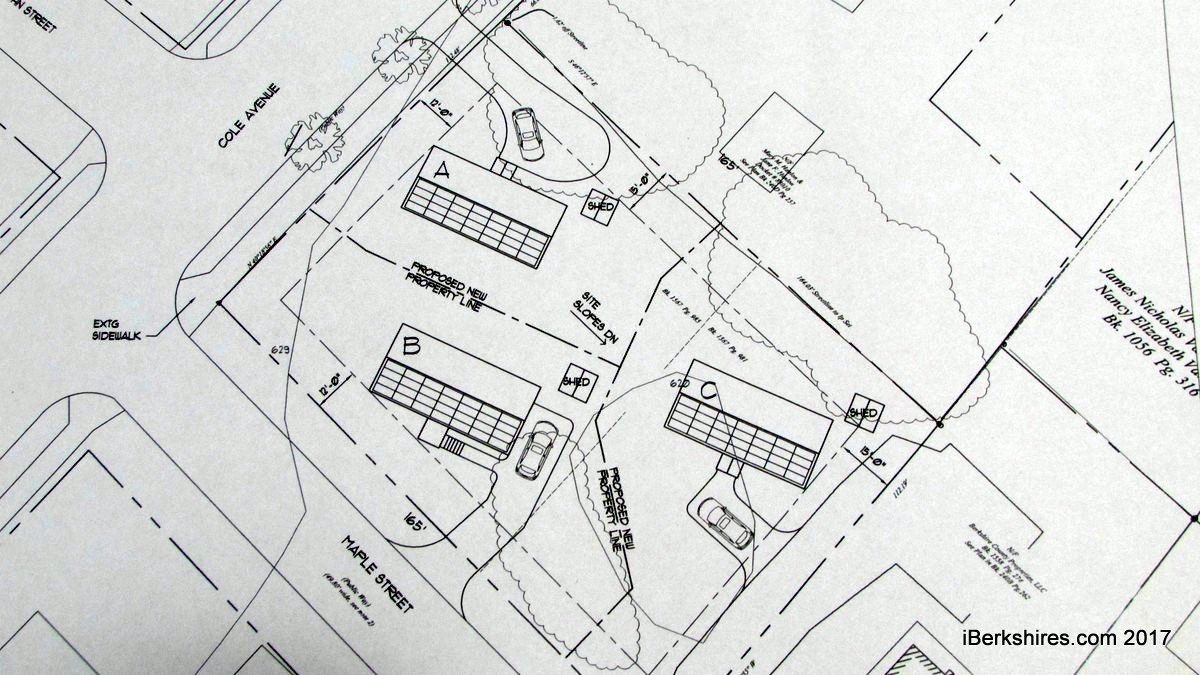
On Wednesday, Northern Berkshire Habitat for Humanity Building Project Manager Paul Austin explained how the group plans to build three two-story homes of about 1,200-square feet, subdividing the lot into three separate housing parcels.
Specifics of the three homes, which likely would be built and occupied sequentially over a period of years, would be determined as Habitat finds owner occupants through a state-regulated application process that likely would include a lottery of qualified applicants.
In general, the non-profit would be searching for an income-qualified family. The number of bedrooms in the resulting home would depend on the pool of applicants.
And the chosen family would, per Habitat for Humanity's practice, participate in the construction of its new home.
That "sweat equity" and volunteer labor is key to Habitat for Humanity International, a 40-year-old non-profit that has helped house 9.8 million people, according to its website.
As Northern Berkshire Habitat for Humanity co-President Elisabeth Goodman noted on Wednesday evening, the Cole/Maple project already has benefited from the volunteer work of West Stockbridge architect Dana Bixby, who did not charge Habitat for the conceptual site plan presented to the Affordable Housing Trust.
That plan shows three building lots on the half-acre parcel.
Goodman, a Williamstown attorney, said Habitat likely would ask the town for waivers from zoning bylaws to situate the three homes on the site. As deed-restricted affordable housing, the homes would be eligible for an exemption to the bylaws under the commonwealth's Chapter 40B provision.
Under Chapter 40B, affordable housing projects are exempt from zoning bylaws in towns that have less than 10 percent of its housing stock in the state's Subsidized Housing Inventory. Williamstown currently stands at 7.2 percent, according to Community Development Director Andrew Groff; that number would go to 9 percent percent if and when 46 subsidized units are built as planned at the former PhoTech mill site at 330 Cole Ave.
Among the elements that would require relief from local zoning in the current site plan is the homes' orientation, directing the buildings to the south to maximize capacity of rooftop solar installations but running afoul of the bylaw that requires homes to be built perpendicular to the road in the district.
"Those houses could be rotated," Austin said. "They would lose some efficiency in the panels, but maybe we'd just add some panels."
Although the project could, by law, be exempted from zoning, Austin and his colleagues stressed their desire to build homes that fit into the neighborhood, and the Habitat for Humanity board members and AHT board agreed to work together on an information session for current residents of the area some time in January.
Austin said he expects to build traditional looking homes with gabled roofs.
Affordable Housing Trustee Anne O'Connor asked why Habitat for Humanity went with single-family homes instead of some kind of duplex or townhome.
Besides the desire to do a project in keeping with the character of the neighborhood, Northern Berkshire Habitat found that multi-family homes are not a good fit for their program.
"We did a proposal in Adams with a townhouse, and we had an open house [for prospective families], and a number of people came in and they were dead set against adjoining homes," Austin said. "They had been in apartment complexes or multi-family homes, and they wanted their own place."
Since Habitat for Humanity is an owner-occupant model, unlike, say apartments built for affordable housing, there are also legal complications when it comes to building and, potentially reselling, homes.
On the resale front, the Habitat board told the trustees that the town needs to establish an entity — either the AHT or the Select Board — to be the "monitoring agent" for the development and ensure, in the future, that the homes are sold for an appropriate price, i.e., one that keeps them affordable to moderate income residents.
In other business on Wednesday, the AHT Board decided to submit a request to the Community Preservation Committee for $20,000 in fiscal year 2019 to fund a pilot home improvement program with Northern Berkshire Habitat for Humanity.
The trustees are hoping to build on the non-profit's Brush with Kindness program, which helps low-income homeowners make necessary repairs in order to stay in their homes. Northern Berkshire Habitat for Humanity helps supply labor for projects like installing access ramps on the exteriors of homes, but it does not supply materials.
The Affordable Housing Trust wants to help defray the cost of such materials for Brush with Kindness projects in Williamstown.
The CPC deadline for applications for Community Preservation Act funds is Jan. 3. The committee will review the applications during the winter and make recommendations to town meeting, which awards the funds in May.
Tags: affordable housing trust, habitat for humanity,