Clarksburg Passes Pot, Solar Bylaws; Nixes School District Article
.JPG)
Voters approve an amendment to one of the zoning bylaws.
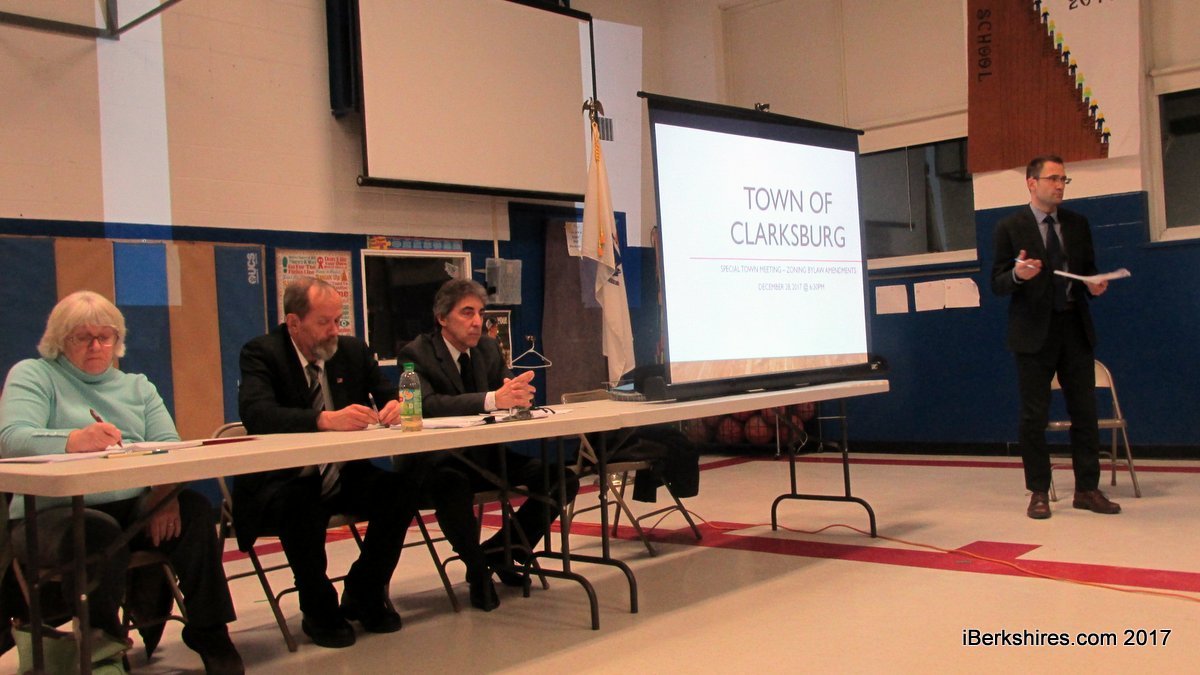
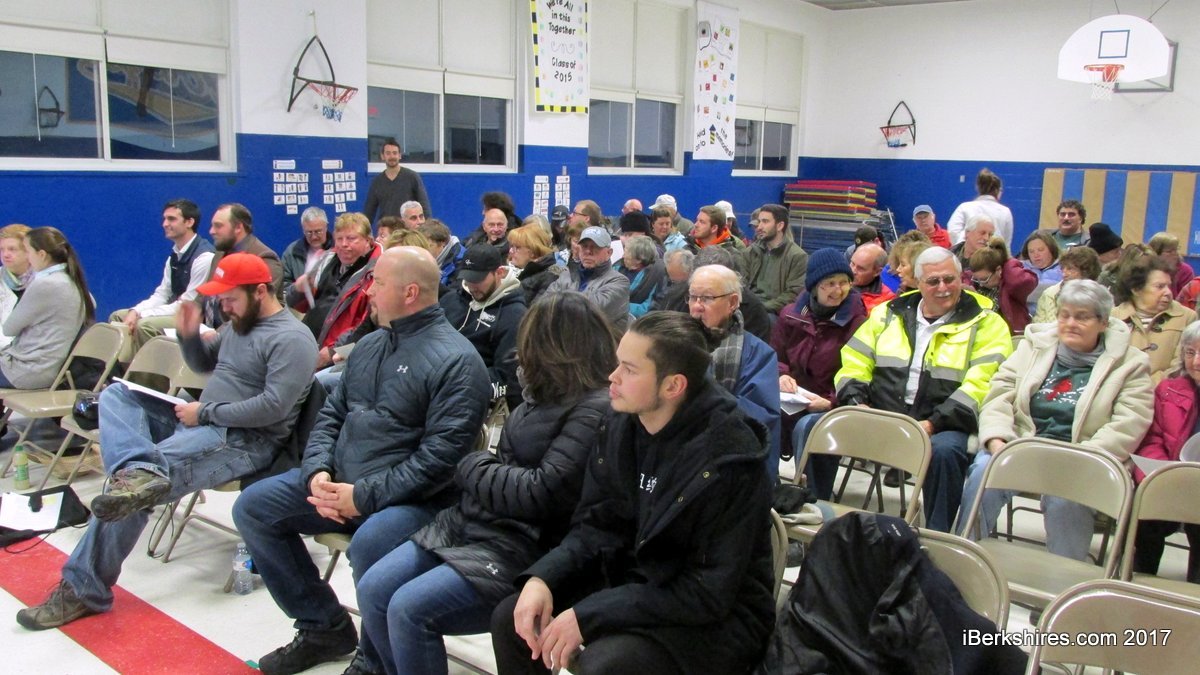
Nine of the 10 articles on the warrant were passed by significant margins by the 77 voters present and changed several zoning bylaws and set regulations for marijuana production and sales, including allowing for more retail locations, and limited solar array locations.
The final article, which would have authorized the town to enter into a school district agreement with Stamford, Vt., was defeated after School Committee members objected that they had had no input on the question and that there was no agreement in hand.
The amended bylaws 1) aligned three industrial zone areas along actual property lines to clarify districts; 2) turned two industrial 1 zones (the town dump land on West Cross Road and the former Krutiak lumber mill) into industrial and service zones, allowing businesses such as medical and accounting; 3) turned the I-1 zone on at the old bus yard on Middle Road to a commercial 1 zone.
Chris Gruba, a senior planner with Berkshire Regional Planning Commission, walked town meeting through the zoning articles.
"They are interrelated but we tried to break them down to be as separate as possible," he said, in case one or more did not pass.
Gruba has been working with Planning Board and Town Administrator Carl McKinney on adjusting and updating the industrial zoning areas as part of a local technical assistance grant that runs out on Sunday.
"With the steep slopes, and the swamps, and the rivers and the roads, we've got about 37 percent of the town that is usable," McKinney said. "So we're trying to edit our zoning bylaws to make it appropriately usable for that 37 percent to promote growth, to promote a tax base we're going to need."
The change from I-1 to I-S, or industrial/service, was to make those areas more avialable to the development of professional services, medical facilities, and financial institutions while still keeping options for light industry. It also added dry cleaners, banks and credit unions, and drive-throughs that were not listed on the town's table of uses.Senior housing had been added to the uses at a previous town meeting.
One change was made on the floor: to allow automotive garages to exist in industrial/services zones.
The amendment was promoted by Robert Bona, who owns the garage building at the bottom of Cross Road near River Road. He noted the table of uses specifically did not allow garages and asked how that would affect his property. The discussion went on for some time and a motion was made to add garages, which passed. Bona's property, however, is actually located in the adjacent commercial zone.
Another industrial zone on Middle Road was changed to commercial and includes four parcels that have several houses and bus yard owned by the Tietgens family. The change does not affect the bus yard in any way but it does allow for future residential use and removed what McKinney called a "cloud" on the deeds of the other residences. Residential dwellings are not allowed in industrial zones but can exist in commercial ones.
At least an hour of the 2 1/2 hour meeting focused on the marijuana and solar bylaws.
The proposed bylaw on marijuana production, processing, testing and retail would have limited those uses to the only existing Industrial 1 zone that encompasses Town Hall to the former Strong-Hewat mill. However, several residents pushed back on that asking that retail or other uses be expanded into commercial, I-S and agricultural zones.
Gruba said they had tried to "get into the minds" of residents in determining what they would like to see in terms of pot regulation. Most of the bylaw was basic permitting and conditions and would require a special permit from the Planning Board. It would allow the town to institute up to a 3 percent tax on marijuana sales.
The state Cannabis Control Commission is in the process of filing draft regulations that are expected to be released in March. The state will begin issuing licenses in April 1, with about 75 licenses expected to be available statewide.
"What we trying to do is get ahead [of the state regulations] and have a bylaw in place, some sort of protection for the town of Clarksburg, before all this hits on April 1," he said. "The bylaw would be marginally imperfect but you can go back and amend that later. But it's better to have something than nothing."
Residents Jason Morin and Michael Milazzo questioned why the industry was being limited to one location, arguing that it should be allowed in commercial and agricultural zones as well.
Gruba said the cultivation facilities would be large, industrial-style buildings that would not be amenable in residential or agricultural areas. Such buildings would also require a lot of electricty and water. At this point, exterior growing is not allowed by the state.
Milazzo objected to the use of two-year special permits for both the industrial zones (specifically gravel operations) and for the marijuana bylaw. McKinney said special permitting was limited by the Legislature.
"So you're talking about somebody investing once again, potentially building an entire facility with a two-year guarantee for business," he said. "I think it should be SPA so you can go to the zoning board with a site plan review the town can approve it for more than two years so somebody can have a chance for recouping their cost. And I think it should be in all three zones: commercial, I-1 and I-S."
McKinney said he was seeking another grant to tackle the town's commercial zoning. Agricultural uses or further review of marijuana could be done at that time.
In the end, the bylaw was amended to also allow retail marijuana in industrial/service areas.
.JPG)
Matthew Parlon, right, of Blue Wave explains the reasoning behind the agricultural solar arrays, which were not part of the proposed bylaw.
Randall had some supporters but others were concerned that the solar panels would be an eyesore. And the information that the arrays would be close to 14 feet tall — about the ceiling height of the school's gymnasium — seemed to cool further support. The panels would have to be that high to allow livestock or crops to go under them, explained Parlon.
The bylaw had already been amended after a public hearing in November with 500-foot setbacks and the creation of a solar overlay district on the more sparsely settled and open west side of town. That decision was also questioned by residents who believed they had land on the east side of town where arrays could be installed without disturbing anyone's views. Could those areas be included or exceptions made?
"If we're talking about that kind of massive change, I don't know how we can write it all tonight," Gruba said. "I can't go back to the office and write it."
Moderator Bryan Tanner noted there were a number of ideas about changes and would the Planning Board and Select Board at some time consider those changes, particularly the large scale overlay?
"Obviously you've segregated one half of the town and said, 'have at it,' " he said. "And yet there are other areas of the town, such as Mr. Davis, where it's out in the middle of nowhere."
McKinney said those could be revisited but his concern was that the town had no bylaw and three arrays have already been installed to some complaints.
"I want to be sensitive to overreaching, we're trying to strike a balance," he said. "We're a Green Community, we're trying to promote nonfossil fuel energy generation where possible, but also to make it work in the town. We held public hearings and it was loud and clear at the public hearing that they wanted to regulate it."
Town meeting also:
• Created revolving funds to capture fees for the Board of Health (building inspector salary), Police Department (for training/equipment) and Town Hall (cable franchise fee for technology). All three funds have existed for years but had not been approved through town meeting.
• Renamed of the town field as Peter A. Cook Veterans Memorial Field, and the installation of signs at Cook Field and the old cemetery at Horrigan Road. Edward Denault, a member of Peter A. Cook Post 9144 Veterans of Foreign Wars, said the VFW would place a plaque and stone at the field and planned to work on the cemetery, which contains some of the town's founders. It will be named Clarks Founders Burial Site, and the sign will include the dates of the first and last buried there.
• Shot down the article to allow the town to enter into an agreement with Stamford after two members of the School Committee angrily objected, saying they had only learned about the article that afternoon.
"We were unaware that this was even on there," Chairwoman Patricia Prengruber said, adding that no one from the School Committee had been invited to any meetings or told of any decisions.
McKinney said the wording had come from the Legislature's general counsel and was being submitted to seek to grant money for a study. The town and Stamford have had informal discussions about forming an interstate district that were prompted by changes in educational groupings in Vermont.
"We've been working on this for quite some time. This is not to enter into an agreement, this is to allow us to negotiate an agreement," McKinney said. A home-rule petition had to been submitted before the town could do anything, he said, and not submitting would mean no grant money and push any further action another six to 18 months out.
School officials, however, said no negotiations or decisions should be made without the School Committee being part of them. Prengruber motioned for the article to be tabled for review, which passed with only a few hands in opposition.
Tags: marijuana, solar bylaw, special town meeting, zoning,