Labor Shortage May Force Change in Mount Greylock Building Schedule

Trip Elmore of Dore & Whittier Management Partners told the Mount Greylock School Building Committee that the project is having trouble finding enough workers.
But the district's owner's project manager said Tuesday night that a potential move-in delay may not push back the planned end date for construction on the middle-high school campus.
Trip Elmore of Newburyport's Dore & Whittier Management Partners told the School Building Committee on Tuesday that he is, "not optimistic at this point we'll be saying April is a done deal."
The issue is an already tight labor market in the rural northwest corner of Massachusetts that is stretched even thinner by the high school project at Taconic in Pittsfield, the unified science center project at Williams College and, more broadly, a massive hotel and casino project in Springfield.
"We are still suffering from a reduced workforce," Elmore told the committee. "This job site needs more people than we're getting. Our initial numbers were considerably bigger in order to meet our dates."
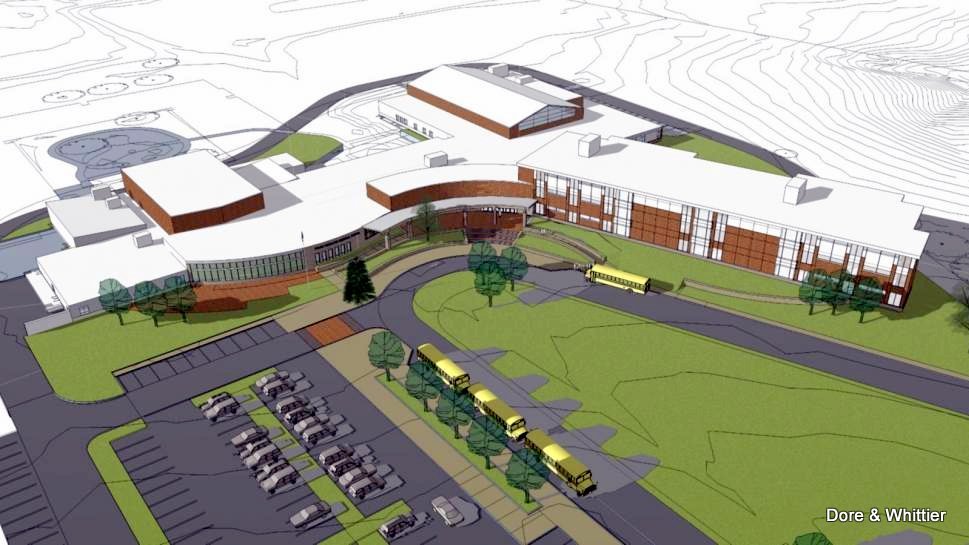
The project timeline conceived at the start of the $64.7 million addition/renovation project had classrooms moving into the new three-story academic wing during April vacation so demolition on the current academic wings could begin in the spring before school ends.
The goal is to have the 1960 classrooms and 1972 addition demoed over the summer in time to plant grass in the areas that will be cleared by the demolition before the frost sets in later this year.
Elmore said after Tuesday's meeting that the October/November planting schedule still would be play even if classes continue in the existing academic wings through the end of the school year.
He explained that instead of focusing on the demolition in May and June, efforts could be instead focused on landscaping and rehabilitating the land around the three-story academic wing -- work that otherwise would have waited until classes wrapped up there in June. The land to the north and south of the academic wing is currently a construction yard for the project.
The phasing of the project may have to be adjusted, but the end date could be preserved, Elmore explained.
The April move was just one delay discussed by the School Building Committee on Tuesday night.
The Mount Greylock community is well aware of the other: the continued delay in availability of the school's gymnasium.
The gym was renovated as part of the plan, and it was originally projected that the school would be able to use the space by November 2017. That date was pushed back to December because of adjustments in the phasing of the renovation and rebuilt central core, which will connect the academic wing to the rest of the school (gym, library, cafeteria, auditorium, offices etc.).
When town and fire officials inspected the gym for a certificate of occupancy in December, though, they required that the school district address the fact that the fire suppression system to cover the gym would not be fully operational until later in the building project.
"We don't have all the systems running in the building as they will in three months," Elmore told the committee. "That meant putting smoke and heat detecting systems in place, which is happening. We are working the issue and hope to turn it over very soon."
Interim Superintendent Kimberley Grady emphasized to the committee that the town's building inspector and fire chief had no choice but to decline to issue a certificate.
"[The temporary system] was recommended to us by the chief and [Building Inspector Ryan Contenta] that day," Grady said. "They were really helpful the day of the inspection. They were not trying to be a hindrance or an obstacle. They were solutions-oriented."
The solution chosen costs an estimated $25,000 and $30,000, Elmore told the committee.
The good news is that the wireless detection system and alarm can be pulled from the gym once the fire suppression system is operational and reused on other projects the district is exploring: a district office for the superintendent and support staff and buildings related to the athletic fields that are being designed under the auspices of the Transition Committee governing the district.
"The hope is to have the ability to reuse it," Elmore said. "If the hardware is 50 percent of the cost or greater, you may recoup a portion of it."
In other business on Tuesday, the committee put off making a decision on a $90,440 expense for modifications to the exterior of the gym. The supplier of the roofing material to the renovated gym is requiring that the district modify the structure to protect against any possibility of water seeping in along the roofline.
The permanent solution in the $90,000 project involves removing a portion of the existing brick, installing metal flashing and reinstalling the brick. There is a lower cost option, the application of an exterior coating for $25,000, but that fix is not permanent; the coating would have to be applied periodically over the life of the building.
If the district chooses to do nothing to address the possible seepage, the roof manufacturer will not warranty its product.
Tuesday marked the second meeting at which the subject came up. In December, the committee agreed that the best option was to install the flashing, but the SBC asked its architect to push back against the roofing manufacturer.
On Tuesday, architect Dan Colli of Perkins-Eastman told the committee that after a "heated email exchange," it was apparent the manufacturer was not budging on the warranty question.
But committee member Thomas Bartels, an architect himself, gave Colli a couple of other lines of inquiry to pursue before the committee makes a final decision: What is the exact lifespan of the seal coating? And what is the chance that water could seep through the brick, stop at the flashing, and freeze, causing damage to the brickwork.
Mike Giso of Turner Construction told the committee it had some time to get more information and make a final decision because the flashing installation, if it happens, would not be done until the spring.
Tags: MGRHS school project,