Williamstown Town Meeting Approves Spending on Pool, Police Station
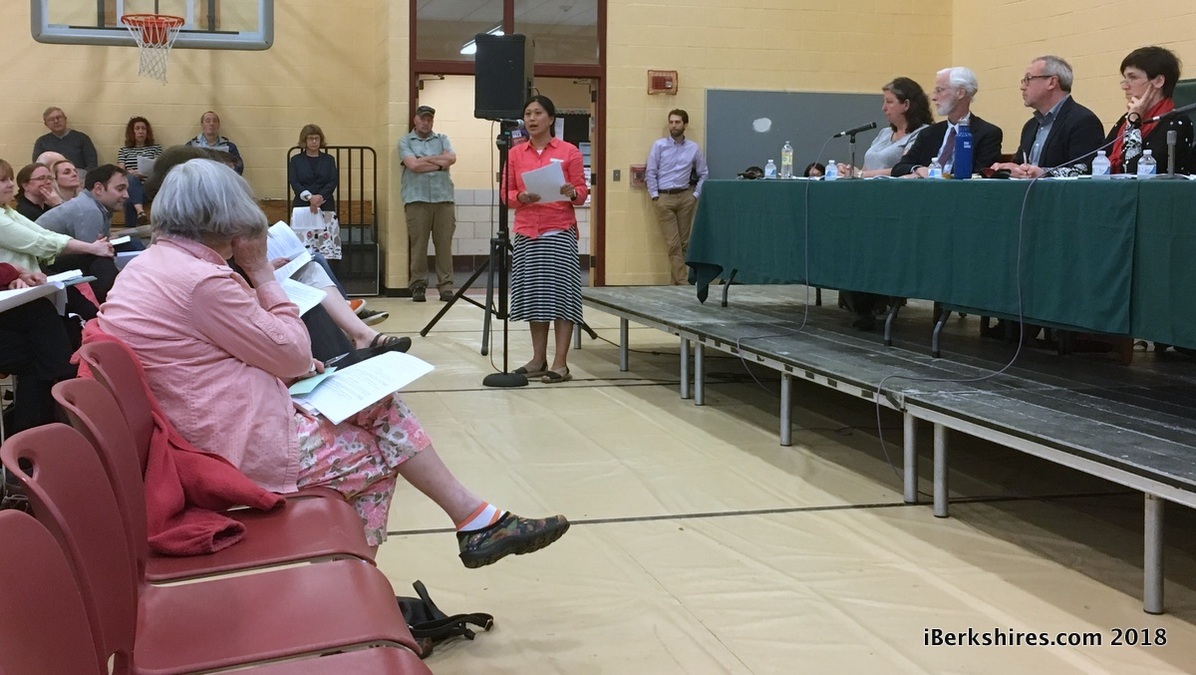
WILLIAMSTOWN, Mass. — A motion to allocate $19,000 to Sand Springs Recreational Center passed by voice vote -- although it was not a unanimous vote -- at town meeting on Tuesday night after only one resident spoke out against it.
Several residents, however, had questions and concerns about the new police station on Simonds Road, and town meeting voters heard from both the town manager and the chief of police before authorizing the $5 million bond by a voice vote. This vote also wasn't unanimous.
Going into Tuesday's town meeting, only the Sand Springs question had generated much public discussion. In fact, while the Select Board had recommended the allocation be approved, the Finance Committee originally had voted against the measure, with only two in favor, four opposed and two abstaining. However, the Finance Committee met before town meeting -- a meeting the committee typically schedules just in case there is a last-minute question -- and after getting more information from Sand Springs Executive Director Geraldine Shen, voted 8-1 to recommend that town meeting voters pass the motion.
In making that announcement, Finance Committee Chairwoman Elisabeth Goodman also said the panel will establish a subcommittee to further study the issue of nonprofits receiving town funding in the future.
With that tide having turned, Shen chose to speak only briefly to the 211 registered voters at the meeting, citing how much the pool is used during the summer by eight Williamstown camps and school groups, who already receive a discounted rate. Discounts like that will be expanded to deals like 20 percent offseason and day passes to Williamstown residents if the pool receives this town boost, she said -- a boost that will only affect a typical town tax bill by about $6.
"What does this mean to you? Hopefully, we'll see you at the pool," she said.
Right down the road from the pool, the proposed new police station actually generated more discussion, with several residents questioning whether a bigger station with three cells instead of the current two indicated any kind of change in the department's community policing philosophy.
"I would ask that we hit the pause button on funding until we have this conversation," resident Peggy Kern said.
Erin Kaiser-Clark said she "morally, ethically and spiritually" couldn't support spending $5 million for a new police station without having that conversation, even if it's a hard one to have.
"That doesn't mean we shouldn't lean into that piece," she said, adding that there were many discussions about previous projects like the new middle-high school and even hotel projects in town, but that the same hasn't happened here. "We haven't done any percentage of that level of dialogue."
Town Manager Jason Hoch and Police Chief Kyle Johnson both responded to the two women and another resident who asked how often both current cells are used. Hoch said it was a "fair observation" to question how a new building would affect how the police do their jobs, but assured the voters that the new building is not intended to change it at all.
"The space we're building is not changing our programming or policing," he said.
Johnson said the current two cells are not up to code and are grandfathered in, and the ability to fix that problem and also add a third cell was a good thing.
"We just can't predict the scenarios we're going to come across in the future," he said.
In the end, Select Board Chairman Hugh Daley came off the platform to speak on the floor, reminding the voters that the decision at this meeting was simply the capital expenditure and that other discussions still can be had. The overall project, he said, was a good one, designed to give the police new space they desperately need, while reusing a current building, thereby being fiscally and environmentally sound.
"It's the best way to proceed with this project," he said. "Tonight is about building the police station, and that's what we need to get done."
The article did pass by a voice vote, with about three-quarters for and one-quarter against. Every other article passed as well, with 14 passing together in one vote under a "consent agenda" format aimed to keep the meeting moving, though only a few articles passed unanimously. There was brief discussion about a transfer of funds from real estate funding receipts for the police station project, as well as a brief question about the police department pulling out of the Civil Service and establishing its own protocol for hiring new officers when vacancies occur.
The lightest moment of the evening came with the discussion of Article 27, which authorized the town to move $19,648 from the County Dog Tax Refund to support public schools. Resident Sam Crane decided to make himself the sacrificial lamb in asking publicly what the article was all about.
"What is the county dog tax and how is it that we are getting a refund?" he asked to laughter from the crowd.
It turns out that prior to 2008, when there was a Berkshire County government, a portion of town dog licenses would go to the county government and then come back to the town in the form of education funding. Since county government disbanded in 2008, that money has been sitting in the town's coffers until officials basically rediscovered it this year and decided to ask town meeting for permission to use it.
Moderator Adam Filson summed it up before the unanimous vote in favor: "So now we all know about the county dog tax," he said.
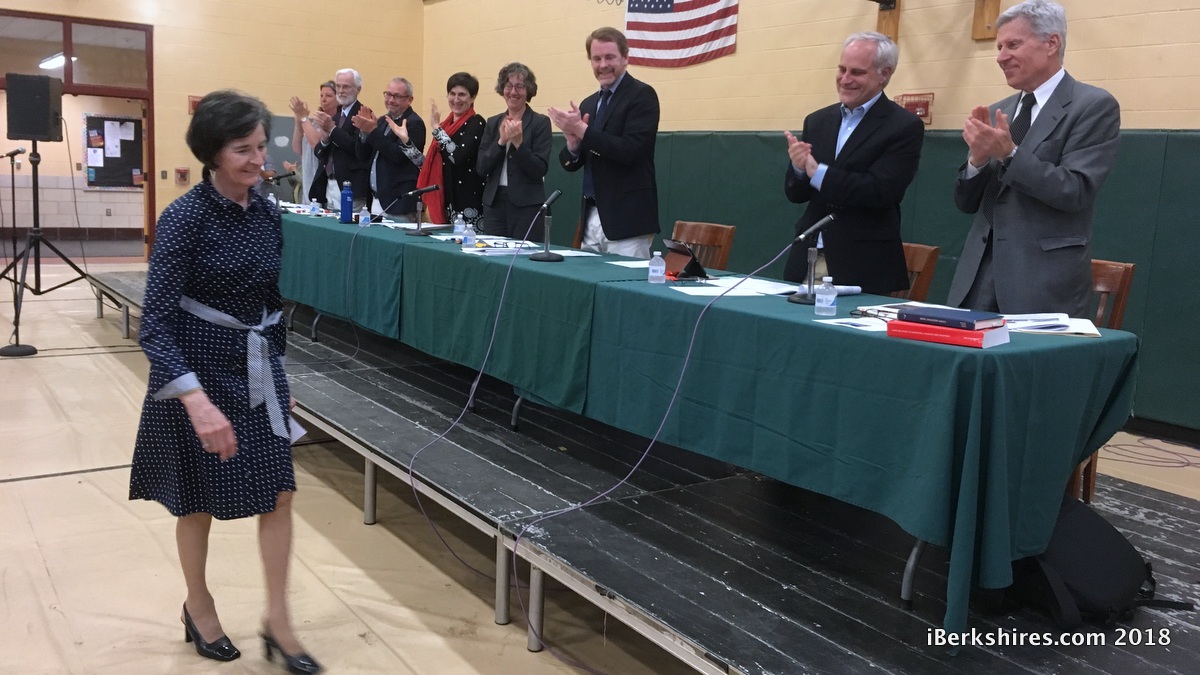
Filson also had the honor of presenting this year's Scarborough Solomon Flynt Community Service Award to Elaine Neely for becoming "one of the most respected members of our community" for serving on the Finance Committee and Hoosac Water Quality District, as well as helping champion the merger of the North Adams Ambulance Service with Williamstown's Village Ambulance Service. She did all that while not being afraid "to get her hands dirty," the citation read by Filson said, both figuratively and literally as a member of the Williamstown Garden Club.
"Your service may be quiet and often invisible, but its effects are unmistakably loud and clear," he read.
Tags: police station, town meeting 2018,