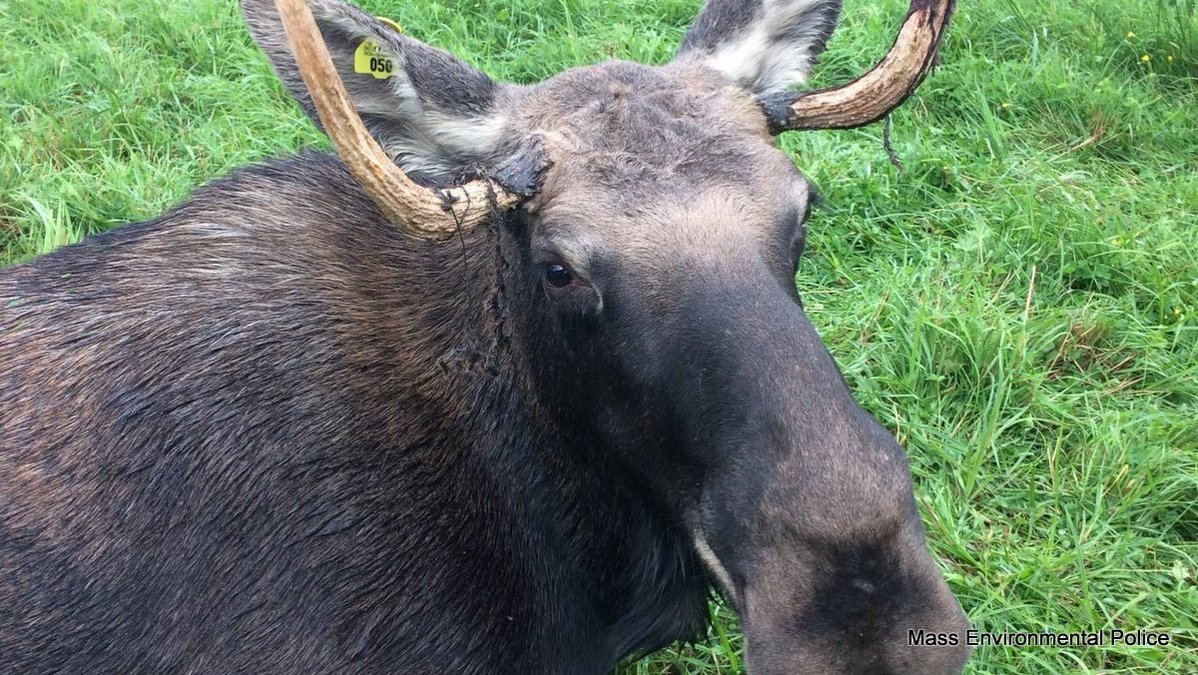
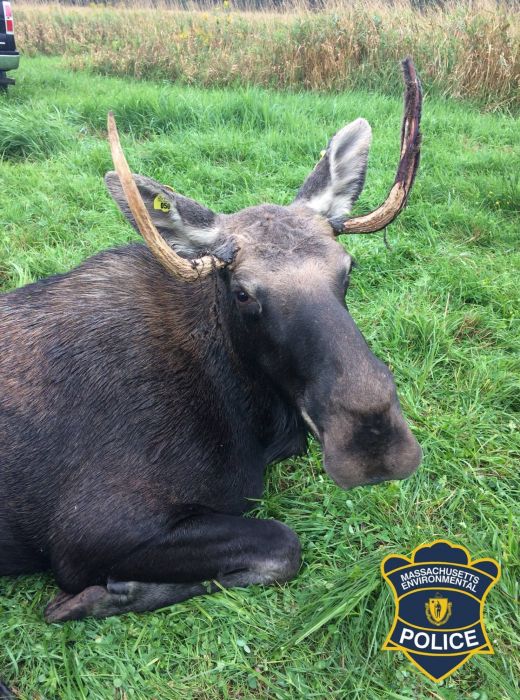
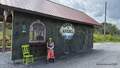
The young bull moose recovering from his relocation from Adams.
ADAMS, Mass. — Local emergency services and state environmental police officers removed a moose that was hanging around the Ashuwillticook Rail Trail in the downtown area.
According to a post on the Adams Alert Hose Company's Facebook page Monday morning, a moose was spotted making its way down the rail trail.
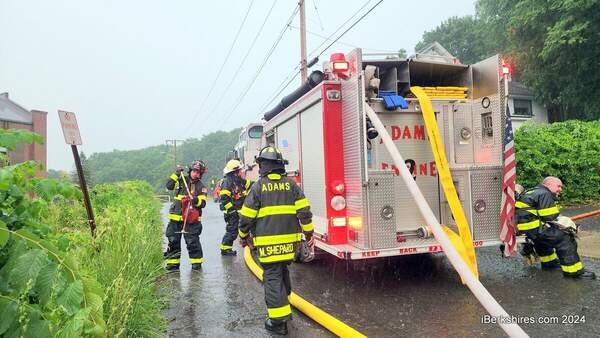
Firefighters and Highway Department and Adams Ambulance personnel helped state Environmental Police and MassWildlife officials and the town's animal control officer to immobilize the moose and move it from the bike trail off Albert Street.
From there a bucket loader was used to place the moose into a pickup truck for relocation.
"The moose will be taken to a safe location and hopefully live a long life," wrote the Alerts. "Thank you to all who assisted."
Moose are known to highly sensitive to tranquilizing agents. According to environmental police, officers "specially trained in the chemical immobilization of animals were also on scene."
"The moose, a young bull weighing approximately 700 pounds, was subsequently transported to an undisclosed rural location where it was monitored until it fully recovered from the effects of the immobilization agent," said environmental police.
Photos surfaced on Facebook of the moose making its trek and Adams residents spotted it near Columbia Street. A second moose has been sighted along the trail in Cheshire.
According to information the state's Division of Fisheries and Wildlife webpage, moose will sometimes follow waterways or forest paths to more densely populated areas.
The website states that you should not approach or pursue a moose. This will only stress the animal and could cause it to bolt into traffic or into people.
It is recommended that you contact the MassWidllife District Office at 413-684-1646 or the Environmental Police at 413-367-0011 and leave the moose alone.
If you would like to contribute information on this article, contact us at info@iberkshires.com.
Your Comments
iBerkshires.com welcomes critical, respectful dialogue. Name-calling, personal attacks, libel, slander or foul language is not allowed. All comments are reviewed before posting and will be deleted or edited as necessary.
No Comments
State, Local Leaders Celebrate Funding Boost For Ashuwillticook Rail Trail Extension
By Sabrina DammsiBerkshires Staff
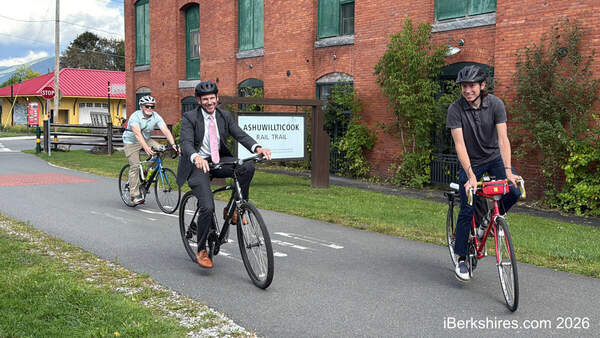
ADAMS, Mass. — State officials and local leaders kicked up their kickstands and took a ride along the final stretch of the Ashuwillticook Rail Trail on Thursday to celebrate new investments in rural communities.
Federal Funds and Infrastructure Office (FFIO) Director Quentin Palfrey joined local leaders, including State Rep. John Barrett III and Berkshire Regional Planning Commission (BRPC) Executive Director Laura Brennan, in Adams to highlight the newest round of FFIO funding. The grant will provide BRPC with $64,700 in state funds to help advance the Ashuwillticook Rail Trail expansion.
"When Governor Healey came into office, one of her big day-one commitments was to make sure that Massachusetts was fighting for every dollar possible coming out of Washington," Palfrey said, speaking about FFIO, a program created in 2023 to help the state aggressively pursue and coordinate federal funding opportunities.
This builds on a $17.3 million federal award secured last year for the project, dubbed the A2A project, which supports the design of a 9.3-mile shared-use path connecting the existing Ashuwillticook Rail Trail to the Williamstown Mohican Path.
"One of the things that she emphasized to me when we set up the Federal Funds and Infrastructure Office was that we need to make sure that these resources not only come into Massachusetts, but benefit all of Massachusetts," Palfrey added.
The additional $64,700 will allow BRPC to gather information about transportation needs in northern Berkshire County to help inform the design of the trail expansion. BRPC will partner with Williams College and Luminary Evaluation, LLC to use the University of Michigan's Transportation Security Index (TSI).
Brennan said BRPC will deploy a 16-question survey that will allow them "to research local and regional perspectives and surface the needs of our neighbors when it comes to transportation in the Berkshires."
"The best-case scenario would be if the survey turned up results that all needs are met and that everyone has access to the places and the things that they need to travel to – but we know that is not true," Brennan said. "We know that folks in Berkshire struggle to get to their place of employment, to be able to access important medical appointments, [and] other engagements. So, the transportation security index is going to help us really hone in on those specific needs, identify pockets of needs or areas where there is a strong concentration or depth of need."
She said FFIO's investment offers a "wonderful augmentation" to BRPC's current plans for the bike trail extension. It's also an investment that will make the region more competitive for other transportation opportunities.
"This is an incredibly multifaceted and valuable investment, and we deeply appreciate it," she said.
Barrett said these investments drive growth in the Berkshires.
"I've always found that if you're going to grow an area, you grow with what you have here to grow. You don't bring something in. We have a natural beauty. We have an environment that's second to none, and that's what we are going to grow on," he said.
Barrett said that in the First Berkshire District alone, 4,000 new people moved to the area.
"We're seeing that migration here. They're going to have activities. They're going to have jobs, and we're going to have a great educational system that goes with it with our two colleges that are here," he said.
Palfrey said it was clear during the initial creation of FFIO that federal funding often went to wealthier and more urban communities with larger planning departments and greater access to consultants. He added that FFIO helps reverse this trend and get projects in rural communities off the ground.
Adams Town Administrator Nicholas Caccamo recently announced that the town missed out on a $4 million U.S. Environmental Protection Agency Brownfields and Land Revitalization grant. click for more
BRPC was awarded an additional $64,700 that will allow them to gather information about transportation needs in northern Berkshire County. click for more
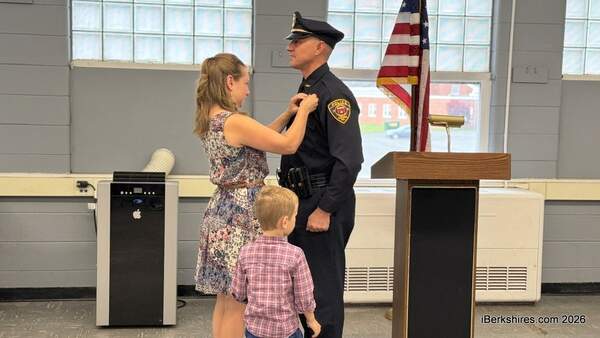
Matthew Wright, formerly a sergeant in the Adams Police Department, officially took his post on Tuesday, Sept. 8, and said he is excited to hit the ground running. click for more
The Fire Department's Engine 2 is suffering from rust and the Prudential Committee needs to decide if it should fixed or run until it can be replaced. click for more