Clarksburg Voters to Decide $1M Debt Exclusion Next Week

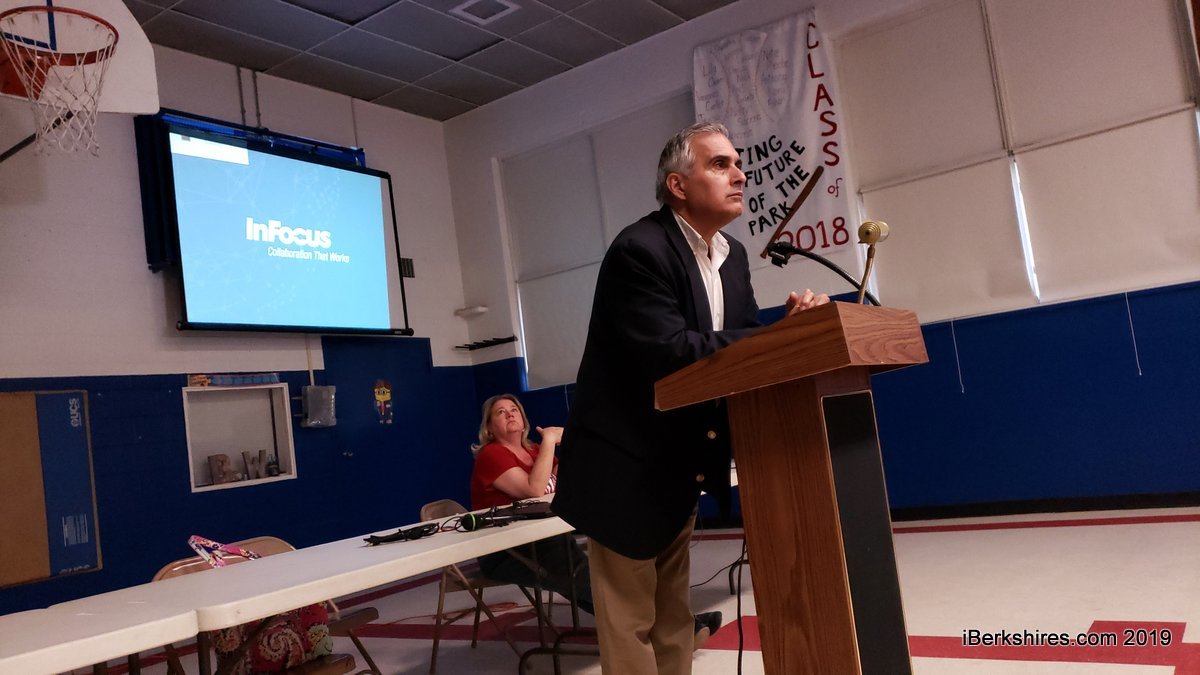
Select Board members Karin Robert and Ronald Boucher speak with residents after Tuesday's information session.
The question on the Proposition 2 1/2 debt exclusion will be on voted by ballot in next Tuesday's annual town election and the borrowing under the debt exclusion will be a warrant article at Wednesday's annual town meeting.
"We need to invest in our roads. We can't let things go. We can't put Band-Aids on things along the way," Select Board Chairman Ronald Boucher said. "We're at a crossroads, we need to invest in our town. ...
"You can see our roads are crumbling and our school needs help."
Officials on Tuesday night laid out the plans on how the funds would be spent — and their hopes that this will be the beginning of more long-term planning to address looming capital needs in the small town.
The information session at Clarksburg School drew dozens of residents who queried the cost to taxpayers, how the funds would be used and prioritized and why others needs — such as the pothole-ridden section of Middle Road — weren't on the list.
The borrowing of $1 million would be over a five-year period and would be excluded from Proposition 2 1/2, the state law that limits property tax increases to no more than 2.5 percent. That means the cost of the borrowing would be on top of the regular tax rate.
For fiscal 2020, that means a total projected tax rate of $17.81 per $1,000 assessed property value, or about $2.03 more than the anticipated tax rate of $15.78. The extra charge will decrease each year over the five years. with $1.98 in year two and $1.81 per $1,000 in year five.
The debt would fall off after five years and would not affect the tax rate permanently, like a Proposition 2 1/2 override would.
Boucher calculated that in the first year, the taxes on the average single-family home would go from $2,761 to $3,116.75, an increase of $355.76 in fiscal 2020. Or, said Boucher, it's $29.10 cents a month or 97 cents a day.
The borrowing would be split with $500,000 going to the school and $500,000 going to the roads and town buildings.
"The school is part of the town, it's a town building and we have a responsibility to that school," Boucher said. "We need to keep our children educators safe and secure. Today's a different kind of world. You know it, there's crazy people out there. So you also need to keep keep our students warm and safe."
The board has designated as a priority the following projects with estimated costs:
- $125,000 for an addition to the town garage
- $81,300 for an overlay on Henderson Road
- $22,000 for an overlay on School Street
- $20,200 for an overlay on Gleason Street
- $61,000 for a full-depth replacement of Daniels Road to Walker Street
- $107,103 for mill and fill on West Road to the old landfill
- $76,985 for a mill and fill on North Houghton Street
- $35,000 for new school entrance and security system
- $350,000 for a roof on the school
- $150,000 for Americans With Disabilities Act compliance, largely at the school
Boucher said the Department of Public Works garage was in severe need of an addition.
"We got brand-new equipment that sits outside because there's no room to put it inside," he said. "No room to work on anything in there. It's just not conducive to an efficient program."
The school department is seeking a grant for the entrance and security system but won't know for some time, and Boucher said he was going lower on the roof replacement cost although the most recent estimate he got was $500,000, a figure that's been quoted over the past year.
The town had hoped to get $500,000 that state Sen. Adam Hinds had placed in a state bond last year but he and state Rep. John Barrett III had not been optimistic about the funds being released. Boucher said he had spoken to Barrett earlier in the day and been told no funds were coming the town's way.
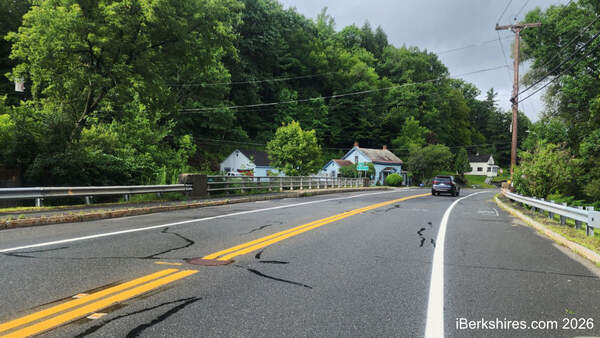
Residents wanted to know about Middle Road, which has deteriorated badly on its north end heading to Mausert's pond. Boucher said the estimate to do the road is $1.7 million — nearly double the requested borrowing. Highway Foreman Kyle Hurlbut later added that he had bid out to fix 1,500 feet and the bids had come in far above what the town had for road money.
So what we're going to have to do is we're going to have to go after some some free money from the government," Boucher said. "In the meantime, Kyle and his crew will fill those potholes to keep it as smooth as you possibly can."
Several residents questioned how road funds were used and if the Highway Department could do the work rather than bidding out, and why the DPW was mowing lawns rather than fixing roads.
Hurlbut said the town appropriates about $22,000 for road repairs and gets about $75,000 a year in Chapter 90 funds. Full replacement for a road runs about $1 million a mile, far above the town's less than $100,000 a year in road money.
"There used to be more grant money out there for roads and we used to get grant money on a more regular basis, so the roads were kept up a more consistently," said Select Board member Karin Robert. "It comes down to the state does is not giving you as much Chapter 90 money and the grants aren't there to be had. When you do apply for them, it's harder and harder to get one because towns like us are struggling and trying to get those grants."
Boucher said he had reached out to Sheriff Thomas Bowler about using the inmate work program to do some of the summer maintenance work so Hurlbut could focus on the roads.
Several people also questioned how the debt exclusion vote could affect the town's proposal to merge school districts with Stamford, Vt.
Superintendent John Franzoni noted that the merger study presented last week had outlined several recommendations whether or not the school districts joined together.
"The recommendation is that we have a capital improvement plan for school," he said.
The School Committee has been informed by its attorney that the replacement of the boilers this summer would trigger the need to comply with ADA.
"Because the building's not compliant with providing equity and a big focus of the new commissioner of education is equity and providing access to all students to every opportunity of school and right now, we can't do that," Franzoni said. "So it certainly is a need for our school. So I don't think we could ask Stamford to go into a collaboration with us that's going to be long term if we can't guarantee our building is going to be here long term, because it's not complying with the standards that we have to provide for safety for our students, our staff."
The conversation veered off at times on other roads, grant funding, and how much it would cost to close the school and tuition the students — questions that the Select Board could not completely answer that evening but said they would try to find out.
Boucher asked the voters to approve the debt exclusion and said the board will be looking for new and creative ways to bring in revenue, such as getting a municipal solar array on the closed landfill.
"I don't think we ever really had a plan in place, we just went day today," he said. "This debt exclusion borrowing is the first part of the plan. Does it solve it all? No. But it's going to give us the amount of ready cash to take care of the essential things we need to take care of in town."
Tags: debt exclusion, municipal borrowing, town meeting 2019,