image description
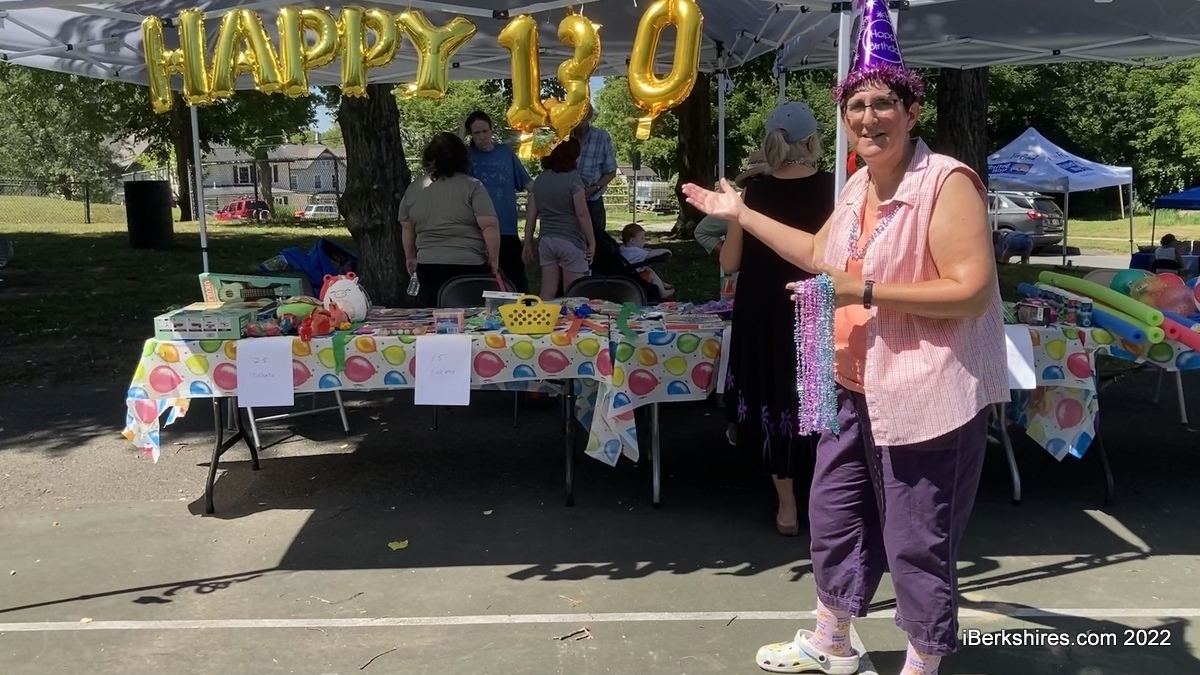
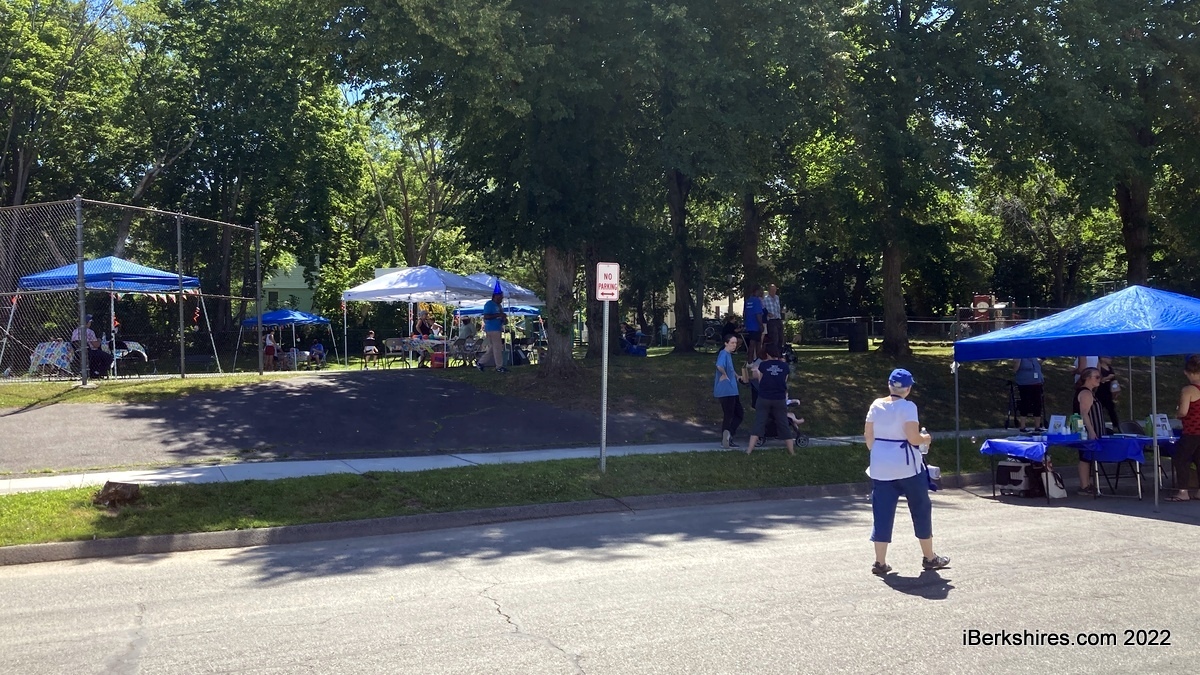
Pat Masoero, financial director of the Christian Center, shows some of the children's games and activities at the annual Community Day on Saturday.
image description
The celebration was located at Tucker Park and in front of the The Christian Center on Robbins Avenue. Part of the street was blocked off.

Christian Center Holds Community Day, Celebrates 130 Years

By Brittany PolitoiBerkshires Staff
Print Story | Email Story

The Civitan Club has been providing picnic food for the event for a number of years.

PITTSFIELD, Mass. — A portion of Robbins Avenue was filled with a celebration on Saturday as the Christian Center held its annual Community Day and marked 130 years as an organization.

"To be honest, for the last 130 years, the Christian Center has done essentially the same thing," Executive Director  Betsy Sherman said, explaining that the center offers food, clothing, paths to jobs, and referrals to housing with the goal of helping people have a more secure life.

It was founded in 1892 as the Epworth Mission by the Methodist Church and has been at its current location since 1906. Sherman explained that in the late 1800s, many immigrants came to the West Side looking for a better life.

They were in need of basic necessities, which led to the first iteration of the Christian Center.

"All of these people needed housing, they needed food, they needed clothing, they needed a place to live," Sherman said. "And that's what we've been doing."

The free celebration included kids' games and prizes, arts and crafts, a bouncy house, and food provided by the Civitan Club of the Berkshires. Community agencies including Berkshire United Way were also present at the event to offer information about their services.

The Civitan Club is an all-volunteer, non-profit, service organization and has been providing food at the event for a number of years. The menu included hamburgers, hot dogs, pasta salad, chips, and dessert all free of charge.


"Our mission is to analyze the community's needs and provide service volunteers to help organize and do whatever needs to be done," President Janet Smargie said.

At the end of the day, any leftovers is donated to the Christian Center or another similar organization.

Sherman said the center got a small grant to address safety issues in the house for women and children and is looking to do that work in the near future.

"We're thinking of combining that with the fire safety week in October to make a big push for fire safety in the fall and winter and around Halloween," she explained. "So these are some things we've been talking about and they'll firm up."

The Christian Center offers a food pantry Monday through Thursday from 10 to 1 and on Friday from 8 to noon; a clothing and housewares boutique on Monday, Tuesday, Thursday, and Friday from 9 to 1; a hot lunch Monday through Thursday from noon to 1 and a cold lunch on Friday from noon to 12:30 p.m.


Tags: anniversary,   
If you would like to contribute information on this article, contact us at info@iberkshires.com.

Pittsfield Man Creates Device to Clear Lakes of Algae Blooms

By Breanna SteeleiBerkshires Staff

Marc Bellora holds a jar of lake water, left, to compare to water cleaned by his Aqua Clarifier Water System.

PITTSFIELD, Mass. — Marc Bellora has high hopes for a device he's created to treat lakes from harmful algae blooms.

His patented water clarifier can physically remove captured material rather than letting the nutrient-rich material settle back into the lake, which occurs when herbicides are used.

"It's a long-term lake management tool that can be used to reduce legacy nutrients in lakes and ponds over time," he explained. "We built the prototype, this is a prototype. It does approximately 65 to 70 gallons per minute. It's very environmentally friendly. Can be used with air only, or we can use a low-dose potable polyaluminum chloride (PACL) or chemical on board that can help improve results."

The water clarifier barge is based on well-proven technology for water treatment, he said. "It's a self-contained, portable, mobile unit that removes algae blooms, nitrogen, phosphorus, and the associated nitrogen and phosphorus within lakes."

Bellora founded Clear Waterways Group with business partner Mark Simon. They built a prototype mobile unit and are still working out the kinks. It's taken Bellora about five years to bring the project to fruition as he is also a full-time Realtor.

He says the repurposed barge they use has a device that uses air to filter the water to separate harmful bacteria or uses a chemical at low doses. They are testing both to see how well each does at cleaning the water.

"They would do the same thing here, except they would spray it, and it blocks all that stuff together," Bellora said of the use of herbicides. "But then it drops to the bottom. So now all the nutrients that are attached in that plot go to the bottom and contribute to the legacy nutrients only to fuel next year's bloom. Ours removes it."

He said just using air alone has removed 70 to 90 percent of harmful algae where he has been operating on the south end of Pontoosuc Lake.

"Essentially, we take in the bad stuff, we take in the lake water. We separate the good stuff from the bad stuff. Clean water goes back into the lake, and the bad stuff can either be composted, or it can be taken to the wastewater treatment plant, which is what we're doing here," he said. 

Bellora explained that tiny air bubbles attach to particles in the water, making them buoyant so they rise and can be removed. The unit can operate with air alone, or with a low dose of potable polyaluminum chloride.

PACL helps through flocculation: it gathers small particles into larger clumps that are easier for air bubbles to capture. He said this can help remove dissolved nutrients that air alone may not capture as effectively. 

Bellora said he was inspired to build something like this after noticing the lakes he enjoys being shut down because of algae blooms. 

The city issued a health advisory for Pontoosuc in August, warning residents not to swim or come in contact with the lake water because of an algae bloom. The cyanobacteria can cause skin irritations, vomiting and diarrhea and nerve or liver problems. 

Bellora previously worked for a company that used traditional dissolved air flotation (DAF) systems to treat water. In that role, he traveled around the country to work at paper mills and food-processing plants.

That experience gave him a practical understanding of DAF, and while flying between jobs, he would see green ponds and wonder whether the technology could be adapted to treat lakes. 

View Full Story

More Pittsfield Stories