image description
The building's first artwork, created by local artist Ricky Darell Barton, is displayed in the lobby of 21 Park St. and is part of the building's 'Maus-ART' program.
image description
Gavin Stenson, son of owners Stephen and Holly Stenson, revealed the inset archway, where both the art and the restored stained-glass window can be seen.

Adams' Mausert Block Filling Space with Local Art
By Brian RhodesiBerkshires Staff
Print Story | Email Story
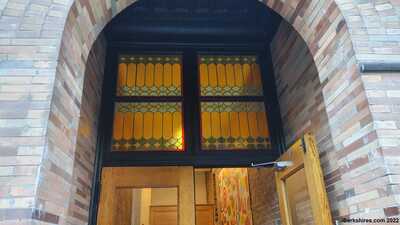
Artist Benne Perkins restored the original stained-glass windows in the entrance archway.
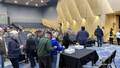
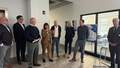
ADAMS, Mass. — Nearly 30 people gathered outside of the Mausert Block apartments on Thursday, as the owners unveiled the first of more than 30 commissioned local art pieces to be displayed in the building.
 
Mausert Block owners Holly and Stephen Stenson said the artworks, as part of the building's "Maus-ART" program, will be on display once the project is complete. The work, done with help from the Adams Arts Advisory Board, will be put in the building's common spaces for residents to see.
 
"We have 31 pieces of art, and this is one," Stephen Stenson said. "So we have 30 to go." 
 
The first artwork, created by local artist Ricky Darell Barton, is displayed in the lobby of 21 Park St. and is from a series of works called "Robot Paintings." 
 
"By weaving these elements together as I feel them, and thus through luck and chance, images actually create themselves in the painting," Barton says on a plaque, posted next to the piece. "This is why I call them 'Robot Paintings'; even robotic faces, along with many other things, appear long after the works are completed."  
 
The artist moved from Washington, D.C., to the Berkshires a few years ago. His work has also been displayed at Real Eyes Gallery. 
 
In addition to the first artwork displayed, artist Benne Perkins restored the original stained-glass windows in the entrance archway. Only one window remained when the Stenson's purchased the property. 
 
"He took that, and he made us four brand-new ones that are as close as possible to the original," Holly Stenson said.  
 
The 1901 building has served several purposes in town throughout its history, and may be best-known as the location of an F.W. Woolworth five-and-dime store for more than 60 years. The Stensons have been working on restoring the property since they purchased it in 2011. 
 
The 10-apartment building, when finished, will also house retail and restaurant space on the ground floor. Earlier this year, the building received two awards from Preservation Massachusetts. 
 
Mausert Block is one of several structures on Park Street, including Miss Adams Diner, Adams Theater and the Firehouse Cafe, that has reopened or seen renovation this year. William Kolis, the owner of the Firehouse Cafe, said he is excited to see these businesses revitalized in Adams. 
 
"It's taken a long time, but now we've gotten it done. And it's going to be a tremendous edition, second only to getting the theater up and running," he said. "... There's been an incredible energy that's been brought here." 


Tags: art exhibit,   Mausert Block,   
If you would like to contribute information on this article, contact us at info@iberkshires.com.

Cheshire Looks to AG's Office for Blighted Property Help

By Breanna SteeleiBerkshires Staff

CHESHIRE, Mass. — The Select Board heard a presentation last week from the state's Neighborhood Renewal Division program that could help rehabilitate two properties condemned by the Board of Health.

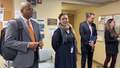
Janice Fahey, assistant attorney general for the division, explained program and what it means at last Tuesday's meeting.

"Our mission is to work with cities and towns in order to ensure safer neighborhoods by working with cities and towns to rehabilitate and bring them into compliance with the state sanitary code and to create safe, habitable homes," Fahey said.

At the March 17 meeting, Town Administrator Jennifer Morse said 200 School St. and 73 West Mountain Road were condemned by the Board of Health and a request was sent to the Attorney General's Office Division of Receivership Programs.

The program, active since 1995, has expanded to work with 169 municipal partners and 205 active properties, with 54 active cases in litigation. It has brought $714,000 into city and town coffers through tax and fee recoveries. The process involves identifying properties, conducting inspections, issuing orders to correct violations, and potentially appointing receivers if owners are uncooperative. 

Fahey said the division works with the local board of health to do a title search on who owns the property.

"If the owner is cooperative, then we will just work with them to bring the property up to the sanitary code. And it's uncooperative, we may file a receivership petition. So when first of all, who is a receiver? A receiver can be anyone who has knowledge and capacity to work with a property and bring it up to the sanitary code," she said.

Fahey said the cost to fix property cannot exceed the cost of its  market value as the receiver has to get paid.

"This isn't something that is going to be making the receiver rich. It's kind of going to be something that just basically cleans up the property, gets it rehabbed, gets it back on the tax rolls, and hopefully a family moves in, and there has to be the receiver, has to have funding. Sometimes there are grants that we'll talk about later as well, but in the end there, they have to have some type of ability to get loans or. Fund a project and get insurance as well."

After being appointed by the court, the receiver will do an inspection and create a budget and scope of work. Once property is brought up to standard sanitary code, they ask the court for authority to foreclose on the property to recover what they spent. In some cases, instead of foreclosure, there may be a fair market value sale approved by the court.

Once the property is sold either through auction or sale the town will get paid municipal fees and the unpaid property taxes, then the receiver will get paid.

Fahey said it takes a lot of work and showed pictures of some properties rehabilitated throught the program that she described as a team effort.

"That involves everyone. It involves the city and town. It involves the receiver, certainly, and it takes a lot of people to put this together, and the time range is pretty significant, from a couple of months to a couple of years," she said. 

View Full Story

More Adams Stories