Cramped Dalton Fire Department Seeking Expansion Options
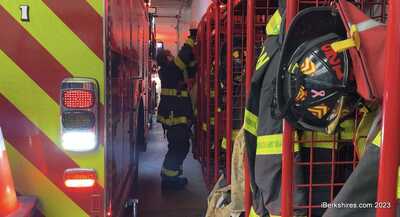 |
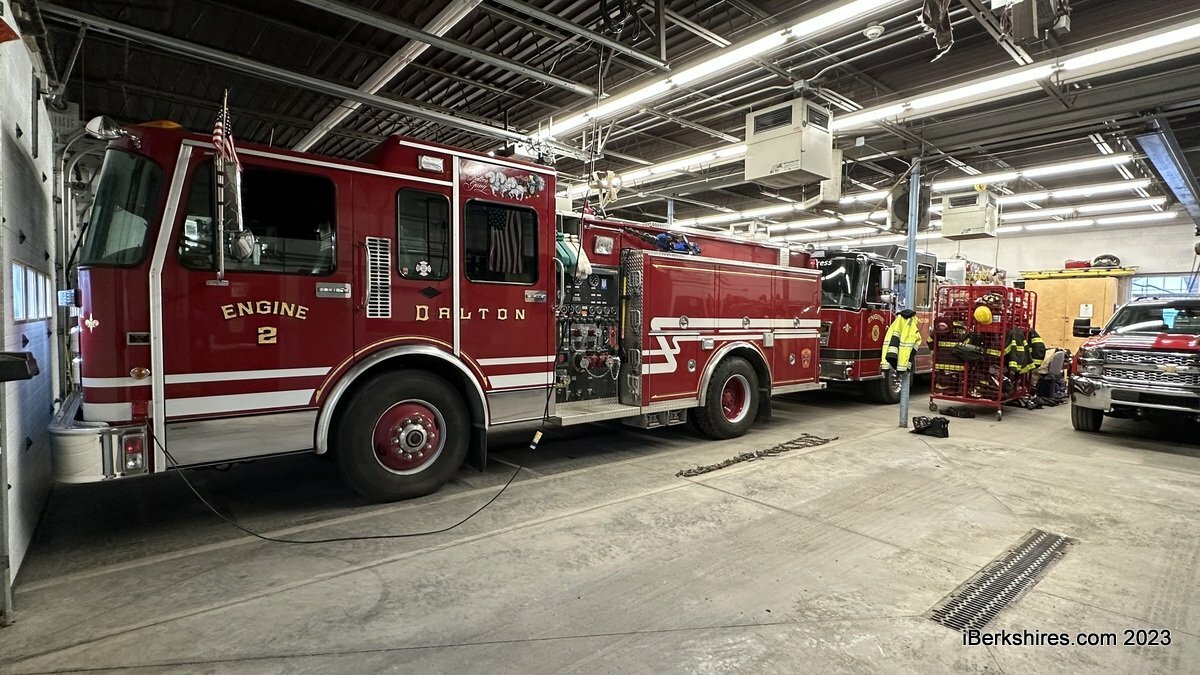
| A firefighter puts on gear at the changing area. It can be difficult for crews to move around the in the tight space. |
DALTON, Mass. — The Fire Department is running into the same problem as so many local departments — not enough space.
Not enough space for its fire trucks, not enough space for offices and training, not enough space for downtime areas, not enough space for all the equipment it needs.
Fire Chief James Peltier said a common question is whether the department really needs that many fire trucks, or ambulances because from the outside, everything looks fine.
"Everything looks good from the outside for the most part, until you walk in. It's not dirty. We keep it clean. We keep it up as good as we can. But there's things that are just wrong inside. Stuff doesn't fit," he said. "Fires don't wait so if you have the people, you need the fire trucks and we need to get them to the fire very quickly.
"If you need an ambulance and a rescue truck, because you're in a car accident, you don't want to have to wait for somebody else to bring theirs and you don't know if somebody else is available."
It is important that the department has the best resources, material, and staff because a fire triples in size every 30 seconds, the chief said.
The department wants to start a conversation with the community about its needs as it looks at options to expand.
Peltier said it deals with approximately 1,462 calls a year, and that it's trending up.
The fire station currently houses two engines, one ladder truck, one ambulance, one pickup truck and three other utility vehicles, in addition to office space, fire training space, and a locked Advanced Life Support closet on a third of an acre.
The two engines are squeezed front to back into one bay, with barely 4 or 5 inches to clear the door and the back of the building.
Between the two trucks is about a 14-inch gap to allow firefighters to get to other areas of the garage such as the ambulances, storage items, and utility vehicles.
About 10 years ago, the department added on a bay to house the ladder truck but it's run out of space to make any other additions.
The standard fire truck is 10 to 11.5 feet tall and 35 feet long. The station's trucks are less than 11 feet high not only to fit through the bay door but also in consideration of the South Street Railroad Bridge, which has only 11 feet of clearance, so getting a standard fire truck would not help the community, Peltier said.
Rather, what is most limiting to the department is the length of the building, he said.
The station holds training equipment, drums of firefighting foam concentrate, and other maintenance equipment. The vehicle exhaust system is old and has not been maintained for 20 years. The company that built it no longer exists and no one can be found to fix it. So sometimes firefighters end up breathing in carcinogens, the chief said.
Firefighters have to squeeze between each other in a limited space while suiting up next to a running fire truck.
The department has 23 on-call firefighters who are paid per call and nine full-time career firefighters, which includes paramedics and emergency medical technicians. Two full-time firefighters are in the station at all times to provide 24-hour coverage.
These issues are no one's fault, said Peltier, but sometimes public safety buildings are pushed to the back burner or forgotten. That's why he and Fire District officials feel it is important to make people aware of these conditions.
One option under discussion is purchasing the Dalton Garage with its three bays across from the current station.
This property is made up of three parcels along Main Street totaling 1.14 acres with an estimated value of $617,400, according to the town assessor, and owned by Essco Inc.
District officials are in communication with their auditor and Hill Engineering to determine if purchasing the garage is feasible, said Treasurer Melanie Roucoulet.
This cost does not include the renovation of the circa-1920 building to make it into a fire station.
The project is in the preliminary design phase; if it seems feasible, it will be presented to a Fire District meeting to determine if district voters would be willing to undertake the costs. The Fire and Water District is a seperate governing body from the town.
Peltier invites anyone to come down for a tour of the station so they can see the need.
"We'll show you it's not an easy fix. There's no easy way around this whole thing. Is it going to take years to fix this problem, more than likely. Even if somebody was to donate land right now. We're not moving in tomorrow. We're not moving in in a month. This is years," Peltier said.
"This is not something that's going to be, we blink our eyes and we're moving in tomorrow. So, that's why we're trying to take our time with a design so that it fits perfectly. Because we can't do this every five years. This is a 50-year, 100-year project."
The district is looking all options for the long term as it continues to look for ways to improve services.
In December, the Fire Department was licensed to provide paramedics coverage -- that's when the basic life support room was converted to advanced to meet the state licensing requirements. It could have two ambulances, as another ambulance service may be donating a vehicle its no longer using. Currently, it has one ambulance and the pickup that holds medical equipment.
"We can always treat them, we just might not be able to transport them," Peltier said. "Band-Aids are one thing but ongoing life-saving skills are not in the street."
If the ambulance donation comes to fruition, the pickup would be moved outside and all of the medical equipment moved to the second ambulance.
Peltier acknowledged that relocating will be an expensive undertaking that would span years so one of the challenges is also attempting to predict what would be needed in the future.
"Obviously we would like it to be quicker rather than later, but I understand the financial impact community and I respect that wholeheartedly," the chief said.
"It's just that it is needed. This isn't something that's going to go away. So the busier we get, unfortunately, the more that we're going to need."
Tags: fire station,