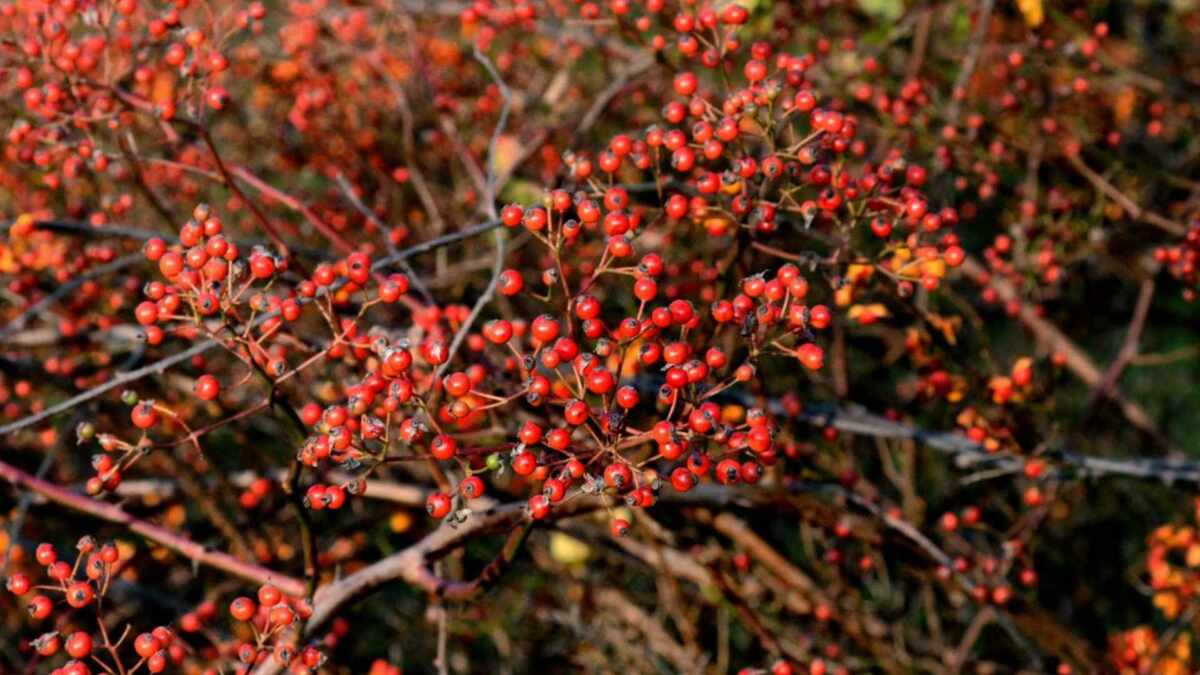
Avoid exotic, invasive plants like Oriental bittersweet and multiflora rose. These plants may have attractive berries, but they can cause severe damage to native plants, shrubs, and trees.
MassWildlife: Avoid decorating with invasive plants
During the holiday season, many people use plants to decorate their homes or businesses. If you wish to use plants in your decorations, be sure to select native species such as native pines, spruces, hemlock, American holly, mountain laurel, fir, or winterberry holly.
Avoid exotic, invasive plants like Oriental bittersweet (Celastrus orbiculatus) and multiflora rose (Rosa multiflora). These plants may have attractive berries, but they can cause severe damage to native plants, shrubs, and trees. Invasive plants can spread quickly in open fields, forests, wetlands, meadows, and backyards, crowding out native plants that provide valuable wildlife habitat. Oriental bittersweet can even kill mature trees. Cutting and moving these invasive plants to make wreaths or garland can spread their seeds even more. Birds may also feed on the fruits hung for decoration and further spread the digested but still-viable seeds. Both plants are extremely difficult to control; when cut, the remaining plant segment in the ground will re-sprout and grow quickly. It is illegal to import or sell bittersweet and Multiflora rose in any form (plants or cuttings) in Massachusetts.
Get tips to identify Oriental bittersweet and multiflora rose below or click here to learn more about invasive plants in Massachusetts.
Oriental Bittersweet
Identification: A climbing deciduous, woody vine that can grow up to 60 feet long and up to 6 inches in diameter. It can also grow along the ground spreading orange-colored roots. Young stems are brown with warty lenticels (raised pores); bark of older plants appears gray. New twig growth is smooth and green. Leaves are rounded and are narrower at the base. Small greenish flowers bloom from May to June. Yellow-orange capsules are produced from July to October. Later in the fall, the seed covering splits open to reveal red-orange seeds.
Threat: Oriental bittersweet grows fast and wraps around nearby shrubs or trees. Native woody plants can be shaded out, strangled, or uprooted. It can reproduce by seed or through root suckers.
Multiflora Rose
Identification: A deciduous shrub with arching and scrambling stems that may grow up to 10–15 feet tall. The stems are red to green with scattered, broad-based prickles. Each leaf has 5–11 elliptical leaflets with sharply serrated edges. After the flowers fade in late summer, rose hips (resembling leathery red berries) are left on the plant and remain throughout the winter.
Threat: Multiflora rose grows in dense thickets and quickly outcompetes other plants. It can completely dominate abandoned fields or pastures. Each plant can produce half a million seeds and these may remain viable in the soil for up to 20 years.
If you would like to contribute information on this article, contact us at info@iberkshires.com.
Your Comments
iBerkshires.com welcomes critical, respectful dialogue. Name-calling, personal attacks, libel, slander or foul language is not allowed. All comments are reviewed before posting and will be deleted or edited as necessary.
No Comments
Dalton Board Signs Off on Land Sale Over Residents' Objections
By Sabrina DammsiBerkshires Staff
Residents demanded the right to speak but the agenda did not include public comment. Amy Musante holds a sign saying the town now as '$20,000 less for a police station.'
DALTON, Mass. — The Select Board signed the sale on the last of what had been known as the Bardin property Monday even as a handful of residents demanded the right to speak against the action.
The quitclaim deed transfers the nine acres to Thomas and Esther Balardini, who purchased the two other parcels in Dalton. They were the third-highest bidders at $31,500. Despite this, the board awarded them the land in an effort to keep the property intact.
"It's going to be an ongoing battle but one I think that has to be fought [because of] the disregard for the taxpayers," said Dicken Crane, the high bidder at $51,510.
"If it was personal I would let it go, but this affects everyone and backing down is not in my nature."
Crane had appealed to the board to accept his bid during two previous meetings. He and others opposed to accepting the lower bid say it cost the town $20,000. After the meeting, Crane said he will be filing a lawsuit and has a citizen's petition for the next town meeting with over 100 signatures.
Three members of the board — Chair Robert Bishop Jr., John Boyle, and Marc Strout — attended the 10-minute meeting. Members Anthony Pagliarulo and Daniel Esko previously expressed their disapproval of the sale to the Balardinis.
Pagliarulo voted against the sale but did sign the purchase-and-sale agreement earlier this month. His reasoning was the explanation by the town attorney during an executive session that, unlike procurement, where the board is required to accept the lowest bid for services, it does have some discretion when it comes to accepting bids in this instance.
The Select Board signed the sale on the last of what had been known as the Bardin property Monday even as a handful of residents demanded the right to speak against the action. click for more
Police Chief Thomas Dawley will retire next month after 24 years with the Pittsfield Police Department, and the mayor will appoint his successor.
click for more
Last weekend, LaBeau raced in the Mount Zion Snocross National race in Ironwood, Mich., the first of eight races in the national circuit series.
click for more
Brown hopes to one day work in a lab, feeding their strong interest in scientific research and making a positive difference in the world.
click for more
Prior to the ribbon-cutting, public officials and community resource personnel were able to tour the two new permanent supported housing projects — West Housatonic Apartments and The First Street Apartments and Housing Resource Center.
click for more