New Finance Subcommittee Sees Pittsfield Q2 Financial Review
PITTSFIELD, Mass. — The city had collected just under half of its estimated local receipts and taxes at the fiscal year's midpoint.
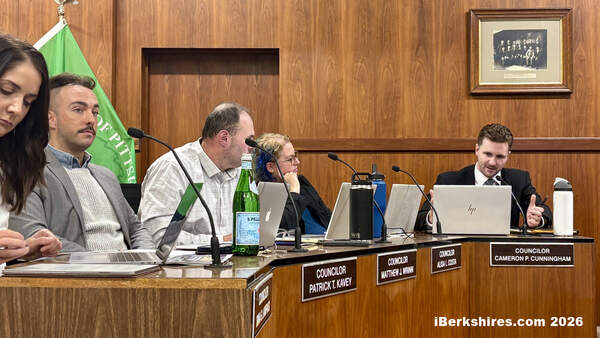
The Finance subcommittee last week was presented with a second-quarter review of fiscal 2024, which ended on Dec. 31.
About 46 percent of anticipated revenues had been collected — $43.7 million in property tax committments of an anticipated $94.7 million and $6.6 million of the $14.5 personal property commitments.
Third-quarter payments were due on Feb. 1.
Local receipts ranged from about 16 percent collection to more than 114 percent, totaling about $6 million, or about 44 percent, of the $13.7 million estimate for FY24.
"I think we will end up with actuals exceeding estimates," City Treasurer Matthew Kerwood said. "But again, we're going to miss in some categories."
Currently, the city's largest local receipts, motor vehicle excise tax, is trending lower because the largest commitment goes out in March. Of the estimated $5.5 million collection for motor vehicle excise tax, about $927,000 has been collected through the second quarter, representing about 17 percent.
Kerwood explained that this number can used to gauge trends in the economy.
"These are revenues that are collected primarily in the third and fourth quarter so once we do the third-quarter review, you'll see a dramatically different number," he said.
"And I've said this before, I use motor vehicle excise as a bellwether as to how the overall economy is doing because if this number is growing, that means people are buying cars. If this number doesn't grow, then people are not buying cars."
Hotel/motel receipts, which have rebounded since the pandemic, are totaling about $674,000 of the $900,000 estimate, or about 75 percent.
"It's an indicator that we have recovered primarily from COVID in that these numbers during COVID and right after COVID were dramatically down," Kerwood said. "We're seeing them come back so I've adjusted the estimates based on that."
About $510,000 of the estimated $920,000 in meals tax was collected by the second quarter, representing almost 56 percent.
The subcommittee had a long conversation about Ward 1 Councilor Kenneth Warren's petition to address concerns about the use of local cannabis revenue. He advocated for a method that can be better explained to taxpayers, saying he's hearing complaints that the current procedure if confusing.
Twenty-five percent of cannabis revenue goes into the public works stabilization account that was created in 2019, 25 percent goes to the stabilization fund, and 50 percent goes to the general fund.
Councilors did not support Warren's efforts.
About $256,000 of the $700,000 general fund estimate was collected by the end of the second quarter. This represents about 37 percent.
Kerwood believes that the city will come in short on this estimate. Last year, it was reported that oversaturation of the cannabis market is resulting in less-than-expected revenues, with 41 percent collected halfway through FY23.
Building permits are exceeding expectations with about $236,000, or nearly 67 percent, of the about $354,000 estimate for building permits.
The city had collected more than 114 percent of the $300,000 estimate for investment on earnings, totaling about $343,000. Kerwood attributed this to interest rates.
"We are currently in a good interest rate environment in order to make money off our money," he said, explaining that the estimate is up from $150,000 last year and that the metric is volatile based on the economy.
At the end of the second quarter, the stabilization fund was at around $5.6 million, with deposits of nearly $128,000 in cannabis revenues and about $83,000 in interest. The public works stabilization fund was more than $2.2 million with deposits of nearly $128,000 in cannabis revenues and about $23,000 in interest.
In mid-Decemberer, free cash was certified at about $8.2 million.
A dramatic metric for unemployment insurance triggered a response from councilors.
Of the $150,000 estimate, more than $234,000 has been been spent through the second quarter, representing 156 percent. About $236,000 is attributed to the School Department with more than $15,000 in credits.
"We get credits if we dispute a claim and we win," Kerwood explained. "We're still experiencing some fraud in unemployment."
Councilor at Large Earl Persip III said he continues to not understand how the city can have that amount of school unemployment when a majority of the city's job postings are for that department.
"I still haven't gotten an answer of why that happens," he said, adding that he doesn't even know why it is on this side of the budget.
Kerwood explained that under the net school spending agreement, it is reported on the city's expense sheet and that the schools are accounted for it based on what the city spends on their behalf.
"Hopefully this new administration puts all the school costs on the school side so we are actually showing what we're spending on students," Persip said. "And this is part of spending on students, unfortunately."
Kerwood also provided metrics for the water and sewer accounts.
The FY24 estimated revenues and approved budget for water is about $6.2 million and, as of Dec. 31, about $3.3 million or 52.8 percent has been collected. The estimated revenues and approved budget for sewer and wastewater is almost $12 million and about $4.7 million or 39.4 percent was collected through the second quarter.
Tags: fiscal 2024, pittsfield_budget,