Williamstown Decides to Clear Out Water Street Lot
 |
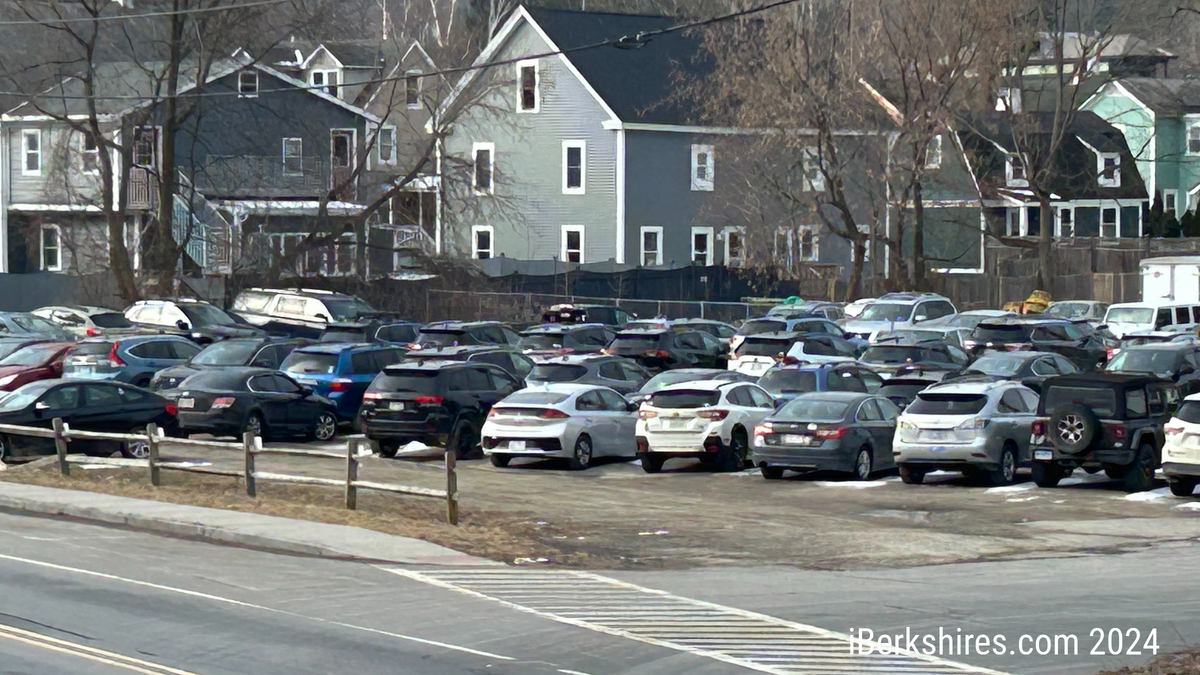
| Cars parked in the town-owned dirt lot on Water Street on Thursday morning. |
WILLIAMSTOWN, Mass. — A long-time de facto parking lot on Water Street will be closed to vehicles as of March 1, the town has announced.
The 1.27-acre dirt lot that was most recently the site of the town garage has been used to park cars for decades. But the town has never formally considered it a parking lot, and it is not paved, lined or regulated in any way.
The town manager Thursday said that concerns about liability at the site led to a decision to place barriers around the lot to block cars this winter and for the foreseeable future.
"Over the fall, we kept an eye on it, and what we were seeing was upward of 160 or 170 cars on any given day," Bob Menicocci said. "It got to the point where, because of its unregulated nature, the Police Department was getting calls for service saying, ‘I'm blocked in. Can you tow this car?' that kind of thing.
"It was becoming an untenable situation."
The town's observation of the lot found a high percentage of the cars belonged to people connected to Williams College, mainly students who used it for overnight parking. That conclusion is borne out by the way the lot tends to be a lot emptier during college breaks.
In the fall, the school's student newspaper ran an article describing the lot as, "a perfectly legal spot to stash a car, and thus, [where] it seems that College students have lucked into a free, convenient parking lot."
Given all that, the town reached out to Williams about turning the unregulated dirt lot into an actual parking lot.
"We talked to the college about it, said this is something your constituency is utilizing, and discussed the possibility of leasing it out so we could get into a better situation of liability and get it better regulated," Menicocci said. "They declined.
"So what we're going to do is cordon that off. Notices have gone out to the college community on that specifically."
The Williamstown Police Department Thursday led the town's effort for more general notification by posting an announcement of the closure on Facebook. Cars left in the lot on March 1 will be "towed at the owner's expense," according to the social media post.
"It's not set up for public use, so it's a liability to the town," Menicocci said. "We want to make sure something unfortunate doesn't happen."
It is hardly the first time the lot's utilization has made headlines.
Ten years ago, the town offered the site to developers as a location to build affordable housing.
One developer did submit a proposal that would have placed 25 affordable units at the Water Street site and an additional 60 on Cole Avenue; ultimately, the Select Board rejected that plan in favor of one that sought to put 46 units on Cole Avenue alone, a project that now is occupied as the 330 Cole Ave. development.
Since then, the Water Street lot frequently has been mentioned in town hall meetings as a potential site for development – either as residential, commercial or "mixed-use."
Menicocci Thursday morning said while there is an immediate need to address issues with how the site is being used, next month's closure also is one step in a process to determine the "highest and best use" for the lot.
"If it was to serve a useful purpose [as a parking lot], we would certainly entertain it," he said. "That was part of our effort to reach out to the college. They're the most logical user of it, whether for overflow for special events or staff/student parking."
But Menicocci wants a wider conversation that considers multiple possible uses of the lot, including, potentially, by private developers who could buy the property from the town. He mentioned that the town's recently completed comprehensive plan process talked specifically about addressing underutilized property in town.
"Water Street has great potential, and that's one of the key things we want to see from a planning perspective," Menicocci said. "Are there things we can do to enhance interest in development or redevelopment in that area?
"Creating a link to Spring Street as a retail/housing area – that [site] can be an asset to drive some interest and work in that area."
In the near term, Menicocci left the door open to temporary use of what's commonly referred to as the "Town Garage lot" for special occasions, like July 4, when the municipal lot on Spring Street loses some of its parking spaces for activity related to the town's annual parade.
"It remains an available resource," he said of the Water Street lot. "Our concerns around liability would remain, but if we need it, we can always open it up."
Tags: parking,