Solar Carports Approved for Greylock Glen Outdoor Center
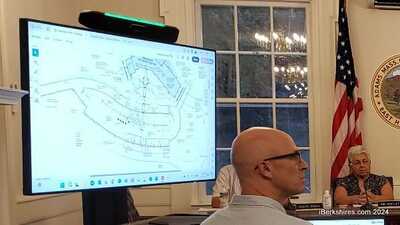 |
| Andreas Schmid of Solect Energy presents plans to the Selectmen. The location of the carports can be seen on the lower left of the screen. |
ADAMS, Mass. — The Greylock Glen Outdoor Center will be getting its power from solar carports in the parking lot.
The Selectmen last month approved the design and siting of the 148-kilowatt solar array.
"We're attempting to do this without any investment essentially from the town, that is the goal of this," said Town Administrator Jay Green. "We're looking for an organization that can front the capital cost to install the solar."
Solar had always been part of the conversation around the outdoor center but as a separate construction from the building itself. It has included a cost benefit analysis to determine if solar was worth investing in.
The town paid for an impact study of $11,100 by National Grid, required before the utility would give interconnection approval. The request for proposals was issued by PowerOptions of Boston, former state entity turned private not-for-profit that procures energy services nonprofit organizations and governmental entities.
"The [town] is a PowerOptions member and so ultimately, can choose to move forward under the provisions of the letter of intent and per the agreement between PowerOptions and Solect Energy as the winner of the solar RFP put out by PowerOptions a couple of years ago," Andreas Schmid of Solect Energy, in a presentation to the board on Sept. 18.
"In terms of the panel capacity, things are a little flexible, so we could add a few more panels or take a few more panels out, as long as that AC system size."
Schmid said the modeling for the outdoor center was anticipated at 120,000-kilowatt hours a year, but that did not include the electric vehicle chargers that were installed.
"So when cars start coming and plugging in, you're going to have a lot higher consumption than 120,000 kilowatt hours a year," he said. "So we went with a slightly larger system at 148 kilowatts, instead of 120. This system will produce just under around 180,000 kilowatt hours a year. ...
"If you're consuming more than that, no problem, if you're consuming less than that, you have an overage, that overage can be sent to other town accounts."
The initial design had been to place the carports in the first row of parking as a T-canopies. But these required "a lot" of footings and the geotechnical study found a high water table and sandy soil requiring a 20-foot depth. The extra footings would put installation above the 25 cents kWh Power Purchase Agreement.
Schmid thought the alternative design presented would work better. It would be installed on the outer parking area overhanging the embankment and the swale and require fewer footings.
"The high side of this canopy would be on this side [the center side], so that cars parking under here have an unobstructed view of the Outdoor Center and not behind it, which really is the intent of the architect's design," he said. "So when you're pulling into the parking area here and you're looking at the Outdoor Center, the Outdoor Center kind of mimics the shape of the mountain, which is beautiful, and you don't want that view obstructed."
A third alternative would have two rows of four footings that would overlap the drive into the lots. Even though it would be accessible for buses, members thought this too confining and distracting for drivers.
Selectman Joseph Nowak had repeatedly questioned why solar had not been applied to the roof.
Schmid said while the center had been planned as a net-zero building, the architect had been focused on the aesthetics rather than how much solar could fit on the roof.
"I think he did a great job in that goal. And his idea was to put parking canopies up to make up for the difference in what could not be fit on the roof," he said. "We found that the roof could only take about 30 or 40 kilowatts. It would take 120 to cover all the needs of the Outdoor Center, not accounting for car charging. So we agree with Bill McClay in that all of the solar should be put in the parking lot because it keeps the aesthetic of the building."
There was the potential to add solar on another canopy or some on the roof in the future, if the town so desired, he said.
Solect Energy will build, operate and maintain the system for 25 years, at which time the town can purchase the array, extend the contract or have it removed. The letter of intent calls for 25 cents per kWh.
"What we get back is the federal tax credit, which helps us pay for the system, and we get back the incentives from the state that are paid by the kilowatt hour," Schmid said.
National Grid charges 13.1 cents per KWh for delivery plus the Adams aggregated supply rate of over 13 cents makes the current total cost of electricity at the Outdoor Center almost 27 cents, so the savings could be significant at the fixed 25 cent rate, especially as electricity costs increase over time, according to Solect.
Solect has been installing canopies across the state, including at the Worcester public schools and State Police Headquarters.
"We're covering a lot of parking lots, which is great," he said. "It's better than putting solar on a valuable farmland in Massachusetts."
Tags: Greylock Glen, solar array,