Williamstown Planning Board Moves Forward With Mixed-Use Proposal
WILLIAMSTOWN, Mass. — The Planning Board last week decided to move forward with an initiative to encourage mixed-use development, even though it is not quite sure how that initiative will be manifested in the zoning bylaw.
Cory Campbell presented his colleagues with a 90-page report outlining how a "form-based" code could help spur development in the town's Limited Business and Planned Business zones.
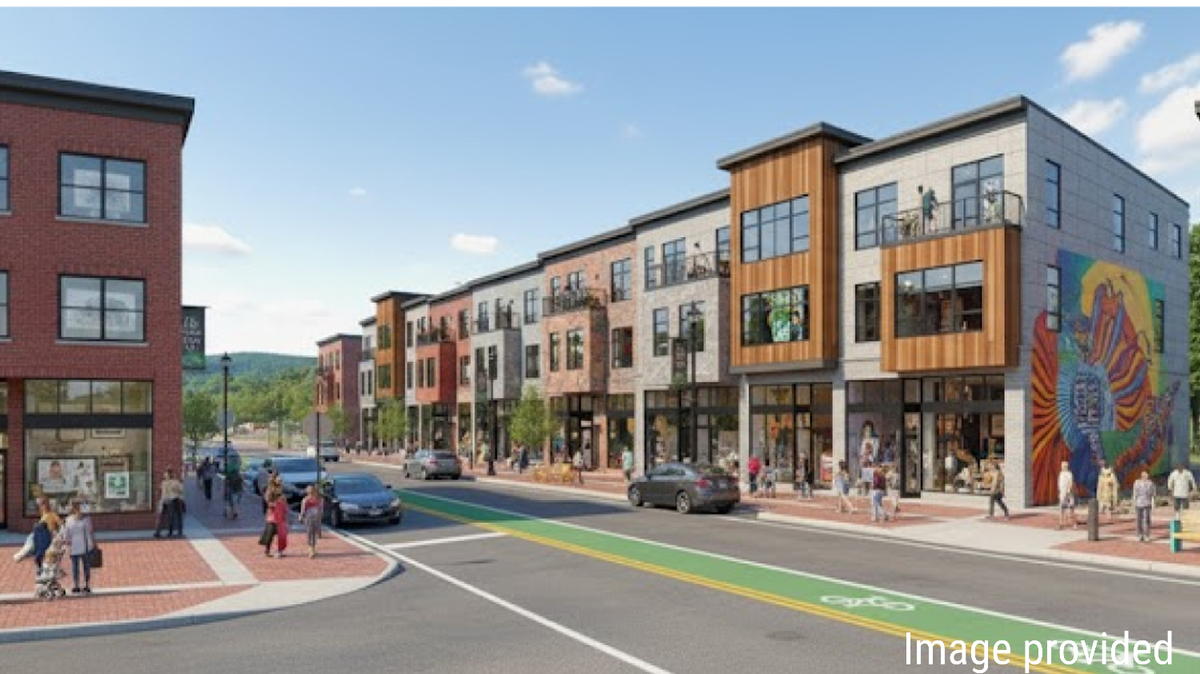
Campbell, who has been advocating for enabling mixed-use development since he was elected to the board in 2023, shared a proposal that would "encourage a mix of housing types and commercial opportunities, walkable experiences and wealth-building activities for residents."
His report suggested requiring a minimum height of three stories with the ground floor dedicated to commercial use and the second and third floors dedicated to multifamily residential or office space in the Limited Business and Planned Business zones.
Those zones are made up of a non-contiguous group of eight areas strewn throughout the town's General Residence district, ranging from a Planned Business area near the Vermont border on Route 7 (Simonds Road) to a Limited Business area near the line with North Adams on Route 2 (Main Street).
The largest part of any of the districts in question is a segment of the Planned Business Zone that runs along both sides of Main Street from the intersection with Adams Road to the west to just west of Luce Road to the east.
One question that came up at the board's Wednesday meeting: Should town meeting be asked to address all eight areas at once or should the form-based zoning be phased in over time, either by addressing just Limited Business or Planned Business or creating overlay districts that institute the changes in specific areas of each zoning district.
"There are a million ways to implement the concept," Community Development Director Andrew Groff told the board. "Either wholesale, all at once, or over time. The first thing to see is … are you going to get buy-in from the Finance Committee and Select Board? That's a lot of community opinion leaders. That's a step forward."
It was clear from the hour-long conversation at the Planning Board level that all five members want to keep pursuing the idea, even if there was less agreement on some of the specifics — like whether developers should be required to have commercial development at the ground floor or have the option to build residential-only projects as part of what Campbell conceived as "mixed-use" regime.
Kenneth Kuttner and Roger Lawrence each argued that requiring a commercial component to projects would unnecessarily constrain potential developers. Campbell said he was concerned about, "getting away from the, I think, originally intended purpose of the zone for business use."
Campbell said he was satisfied that the project had enough support to continue refining his work and bringing it back to the board, which ultimately would need to devise a zoning bylaw amendment proposal to send to town meeting.
In the short term, he said he would work on a frequently asked questions document that could be used in public outreach and look for an opportunity to address the Fin Comm and Select Board to discuss the potential zoning change, which, Groff noted, could help address the lack of growth in the tax base that both committees have bemoaned.
"If you're excited about something, you are willing to make, I think, a commitment to build on that idea or refine it," Campbell said. "That's what I was looking for from the board. We got bogged down [on Wednesday] in some details and what-ifs and hypotheticals, and that's OK, but I wanted that bigger picture ... before I decided whether to make that investment.
"How much work is the board willing to take on with this initiative and not have it fall to two people?"
The rest of the board said they were willing to be part of a public outreach campaign, joining Campbell and Samantha Page, who has been collaborating with Campbell on the project between board meetings.
In other business on Wednesday, the Planning Board discussed a couple of other ongoing initiatives: one to rewrite the town's subdivision regulations and another to create an overlay district to guide new construction by Williams College, which is, for the most part, part of the General Residence district.
On the latter front, Groff told the planners that he had recently started to change his thinking about how to approach the issue of campus zoning. Specifically, Groff said that rather than create large overlay blocks as the board has discussed in the past, he is thinking more about a targeted approach that focuses on specific streets where the campus butts up against neighborhoods.
"One of the sticking points we had was, ‘Where do you draw the lines [for an overlay]?' " Groff said. "This could allow us to not have to make those definitions. I feel like we've made a lot of progress and maybe our thought processes have changed."
Groff and Page have been meeting with officials from the college to discuss a land-use bylaw that would satisfy the needs of the town and its largest employer.
All five of the board members have areas of focus when it comes to redoing the subdivision regulations, which, unlike zoning bylaws, are a creation of the Planning Board and can be amended by that elected body, rather than sending proposals to town meeting.
The town is working with Berkshire Regional Planning Commission to modernize the subdivision regs.
Kuttner and Lawrence presented a framework for new developments that they suggested would simplify and rationalize how development standards would be applied to projects differing in scope and location.
Kuttner showed his colleagues a proposed grid that would categorize residential developments into three groups based on size: micro (with up to four plots of land), mini (for five to eight plots) and major (for developments with more than eight lots).
Each of those three development types would then have standards designated based on whether they are in the town's General Residence or Rural Residence districts. For example, a "mini" development in GR might require sidewalks on one side of the street while the same scale development in RR might not require sidewalks, according to a chart Kuttner showed for demonstration purposes.
The board agreed with the concept of creating the six different classes for subdivisions (three in RR and three in GR), and Groff said he shared the idea with Cornelius Hoss of BRPC, who thought it was "a great idea."
"This is the kind of framework where we can start plugging [standards] in," Groff said, referring to things like stormwater management and road specifications.
"What I'm hearing is mostly tossing the existing Chapter 170 because it's overcomplicated and starting from scratch with this simple, thoughtful approach that is representative of the built environment in Williamstown."
Tags: mixed use, Planning Board, zoning,