Third Crew of Wildland Firefighters Help Battle Minnesota Fires
Print Story | Email Story
CARLISLE — Governor Maura Healey announced that Massachusetts is sending a third crew of specially trained wildland firefighters to northern Minnesota to help fight ongoing fires in the region. 
 
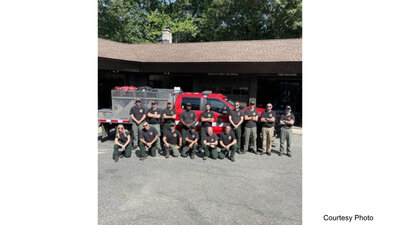
The 15-person team includes firefighters from the Massachusetts Department of Conservation and Recreation (DCR) and Massachusetts Department of Fish and Game's (DFG) Division of Fisheries and Wildlife (MassWildlife). Massachusetts has already deployed two crews, to assist with the fires in Minnesota, and several firefighters from the first crew are volunteering to return for a second deployment.
 
"I'm incredibly proud of our Massachusetts firefighters, including several who are volunteering to head back to Minnesota for a second time," said Governor Maura Healey. "They are leaving their families and putting themselves in harm's way to help communities that need them. We're grateful for their service and wish them a safe deployment." 
 
Five large wildfires continue to burn across the Boundary Waters region of northern Minnesota, including the Bear Trap Fire, which extends into Ontario, Canada. Together, the July Lighting Fires span more than 65,000 acres and have drawn more than 750 personnel as part of a coordinated response. 
 
The Massachusetts team includes 11-person wildland suppression crew and a four-person engine team, all of who meet federal wildland firefighting standards. During the approximately 14-day deployment, the crew may build fire breaks, secure fire perimeters, contain fires and protect structures. All members have completed federal wildland firefighting training and passed required physical fitness testing.
 
"Massachusetts' firefighters are again lending support to our partners in other states," said Energy and Environmental Affairs Secretary Rebecca Tepper. "Drought and dry conditions are worsening fire risk across the country. Some areas are in need of more capacity as they combat wildfires at a much bigger scale. These trends speak to how climate change puts strain on our first responders. We stand with them and are ready to send our support to communities in need."
 
Since 1985, DCR's Bureau of Forest Fire Control and Forestry, in partnership with U.S. Forest Service and the Northeast Forest Fire Protection Commission, has been sending crews to fight fires across North America. In recent years Massachusetts firefighting personnel have been deployed to multiple wildfires, including fires in Montana, Idaho, California, Oregon, Arizona, as well as Canada. Last year, DCR and DFG sent a 20-person crew to Fairbanks, Alaska,, for a two-week deployment. In each case, Massachusetts firefighters are able to apply the unique skills they have learned in service at home and acquire new techniques and expertise they can bring back to address future fires. 
 
In the fall of 2025, Chief Fire Warden Dave Celino and the DCR wildland firefighters received the Fire Marshall's award at the 36th annual  Firefighter of the Year awards in recognition of the experience, expertise and firefighting resources they contributed to state's efforts to combat the historic fires that burned 4,000 acres across Massachusetts during the 2024 wildfire season. 
The responding Massachusetts firefighters are:?
 

If you would like to contribute information on this article, contact us at info@iberkshires.com.

Pittsfield Man Creates Device to Clear Lakes of Algae Blooms

By Breanna SteeleiBerkshires Staff

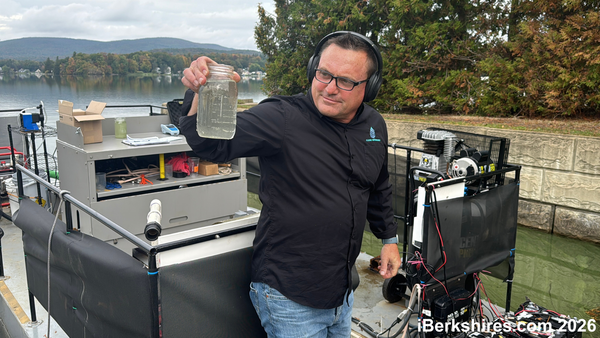
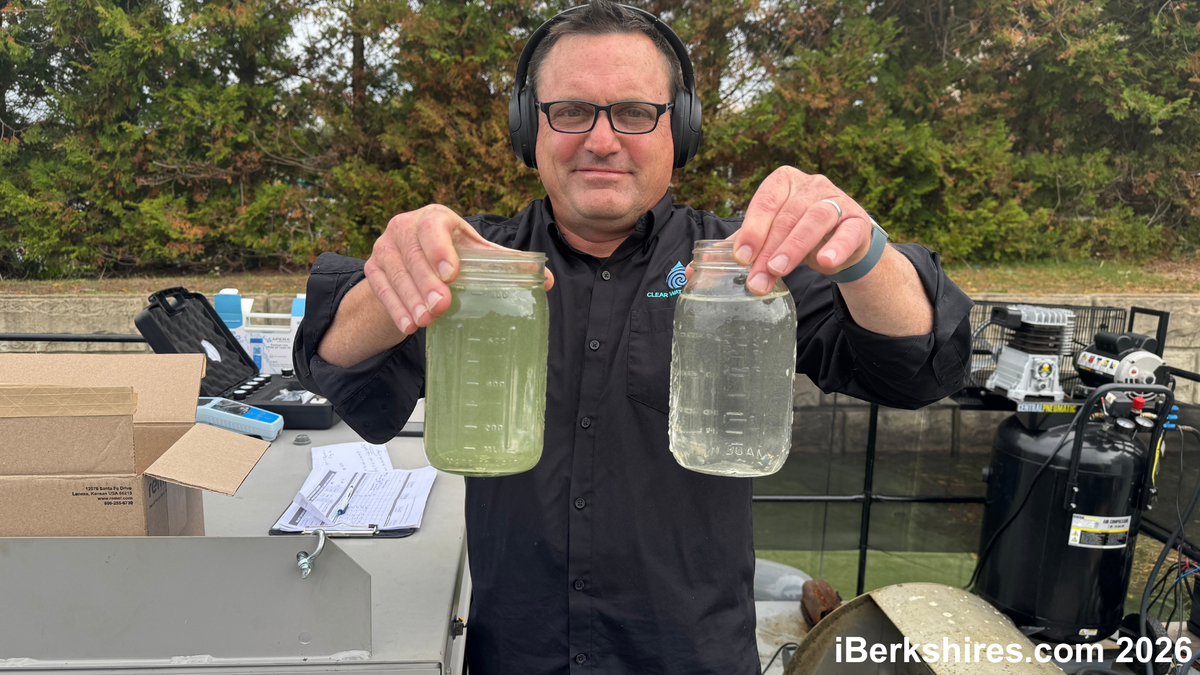
Marc Bellora holds a jar of lake water, left, to compare to water cleaned by his Aqua Clarifier Water System.

PITTSFIELD, Mass. — Marc Bellora has high hopes for a device he's created to treat lakes from harmful algae blooms.

His patented water clarifier can physically remove captured material rather than letting the nutrient-rich material settle back into the lake, which occurs when herbicides are used.

"It's a long-term lake management tool that can be used to reduce legacy nutrients in lakes and ponds over time," he explained. "We built the prototype, this is a prototype. It does approximately 65 to 70 gallons per minute. It's very environmentally friendly. Can be used with air only, or we can use a low-dose potable polyaluminum chloride (PACL) or chemical on board that can help improve results."

The water clarifier barge is based on well-proven technology for water treatment, he said. "It's a self-contained, portable, mobile unit that removes algae blooms, nitrogen, phosphorus, and the associated nitrogen and phosphorus within lakes."

Bellora founded Clear Waterways Group with business partner Mark Simon. They built a prototype mobile unit and are still working out the kinks. It's taken Bellora about five years to bring the project to fruition as he is also a full-time Realtor.

He says the repurposed barge they use has a device that uses air to filter the water to separate harmful bacteria or uses a chemical at low doses. They are testing both to see how well each does at cleaning the water.

"They would do the same thing here, except they would spray it, and it blocks all that stuff together," Bellora said of the use of herbicides. "But then it drops to the bottom. So now all the nutrients that are attached in that plot go to the bottom and contribute to the legacy nutrients only to fuel next year's bloom. Ours removes it."

He said just using air alone has removed 70 to 90 percent of harmful algae where he has been operating on the south end of Pontoosuc Lake.

"Essentially, we take in the bad stuff, we take in the lake water. We separate the good stuff from the bad stuff. Clean water goes back into the lake, and the bad stuff can either be composted, or it can be taken to the wastewater treatment plant, which is what we're doing here," he said. 

Bellora explained that tiny air bubbles attach to particles in the water, making them buoyant so they rise and can be removed. The unit can operate with air alone, or with a low dose of potable polyaluminum chloride.

PACL helps through flocculation: it gathers small particles into larger clumps that are easier for air bubbles to capture. He said this can help remove dissolved nutrients that air alone may not capture as effectively. 

Bellora said he was inspired to build something like this after noticing the lakes he enjoys being shut down because of algae blooms. 

The city issued a health advisory for Pontoosuc in August, warning residents not to swim or come in contact with the lake water because of an algae bloom. The cyanobacteria can cause skin irritations, vomiting and diarrhea and nerve or liver problems. 

Bellora previously worked for a company that used traditional dissolved air flotation (DAF) systems to treat water. In that role, he traveled around the country to work at paper mills and food-processing plants.

That experience gave him a practical understanding of DAF, and while flying between jobs, he would see green ponds and wonder whether the technology could be adapted to treat lakes. 

View Full Story

More Pittsfield Stories