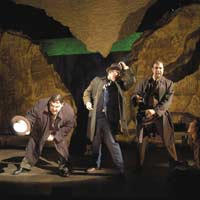
Reporters ’scoop the poop’ in “Floyd Collins.†From left to right are Jonathan Kay, Neal Mortimer and Sal Delmonte. (Photo by Kevin Sprague)
“Floyd Collins,†music and lyrics by Adam Guettel, book by Tina Landau, additional lyrics by Tina Landau, directed by Jared Coseglia. Berkshire Theatre Festival, The Unicorn Theatre, Stockbridge, through July 3.
STOCKBRIDGE — Of the 1996 Playwrights Horizon production, New York magazine critic John Simon wrote that “Floyd Collins†was “the original and daring musical of our day, concerned with saying something in words and music, not merely bringing in da noise or paying the rent.†Referring to overrated shows like “Bring in ‘Da Noise, Bring in “Da Funk†and “Rent,†Simon was, as usual, right. Indeed, the current dean of American theater critics was rather prophetic regarding the decade that closed without much ado in the area of musicals about ideas.
Seeing “Floyd Collins†today in the full-blooded production being given it in the Berkshire Theatre Festival’s Unicorn Theatre, one is struck with its timelessness and relevance to the ever-receding American dream.
The often dissonant musical is based on the true story of Floyd Collins, a 38-year-old spelunker who crawled into a sinkhole that he hoped would lead to a majestic passage that would link all of the caves in his part of rural Kentucky. Collins reasoned that such a discovery would lead to fame and financial success through the tourist attraction that would follow. Little did he know that mere days after he became trapped over 125 feet underground in the winter of 1925, he would become the attraction as between 10,000 to 30,000 people journeyed to the site of his entrapment. While Collins, whose foot was caught in a small cave-in, was periodically visited by a cub reporter, Skeets Miller, a veritable carnival assembled aboveground for 18 days.
The story was the basis for Billy Wilder’s acerbic film, “The Big Carnival,†which starred Kirk Douglas as the reporter who brought fame to himself and Collins. The film, told from the point-of-view of the reporter, was a brilliant satire on greed, the media and unreflective consumerism. Jettisoning that perspective, Adam Guettel and Tina Landau tell the story from that of the trapped Collins. It becomes an alternately rousing and rueful consideration of the literal depths to which a man will crawl to grasp his moment of fame and piece of the American dream. It is a paean to the durability of the spirit of the dispossessed, the people who envision more than their workaday lives provide.
What first seizes your imagination at the BTF is Mimi Lien’s impressionistically impressive set depicting the lean subterranean passageway that will entrap Collins. Abetted by Matthew E. Adelson’s sly lighting, Lien invites our participation in Collins’ condition on a nearly visceral level. The music, sound design and acting complete the effect.
From the outset, as Collins sings three songs accompanied by musical director Linda Dowdell’s versatile keyboard and director Jared Coseglia’s marvelous echo effects and sound design, we are swiftly transported to the underground world that Collins loved. We share in his joy of inhabiting a place never trespassed on by another human. And in Dalane Mason’s fully committed performance as Collins, we feel the rapture of a man on the verge of self-realization. In that trio of songs, Mason exultantly sings to and with himself and communicates with an immediacy and simplicity that are disarming.
When, finally, Collins becomes wedged in the passage so that even his arms are deprived of movement, the effect is deeply empathic due to Mason’s earlier free and soaring movements (some choreographed by the estimable Julian Barnett).
Cosegila has assembled a strong cast to support Mason, and the excellent designer, Marija Djordjevic, has costumed them in earth tones with rich veins of mineral deposits — the effect is that they have sprouted from the ground like outcropping rocks. Chief amongst the talented young cast are Rachael Bell, whose voice rings clear as her surname, slightly daft, and Colby Chambers, who makes Skeets Miller’s journey both dramatic and heartfelt. Given Chambers’ resonance, one wonders if there is another musical to be mined from this story or, perhaps, the Wilder film. A captivating, if vocally muddied, rendition of “Is That Remarkable?†sung and danced by three reporters also prompts this notion. As well, the plight of the rescuers attains an interest that almost rivals that of Collins.
Occasionally lyrics are inarticulate, but this is a vast improvement over the noisily engaging but indecipherable work Coseglia wrought from last year’s “Tommy†in the Unicorn. Coseglia has also done admirable work in his staging by spelunking every stair and cranny of the quirkily engaging theater.
Guettel’s music is not as infectious as that of his grandfather, Richard Rodgers, and audiences are unlikely to leave “Floyd Collins†humming the tunes that are diverse enough to seem disparate. But there is an earnest concern here about the human condition that underscores the best of Rodgers.
Ralph Hammann is The Advocate’s chief theater critic.
If you would like to contribute information on this article, contact us at info@iberkshires.com.
Your Comments
iBerkshires.com welcomes critical, respectful dialogue. Name-calling, personal attacks, libel, slander or foul language is not allowed. All comments are reviewed before posting and will be deleted or edited as necessary.
No Comments
North Berkshire Educational Study Updating Communities
By Breanna Steele & Tammy DanielsiBerkshires Staff
CHESHIRE, Mass. — The steering committee for a regional study on secondary education is getting the word out to participating communities and asking for input.
The goal of the study is to focus on Grades 6 through 12 to understand current conditions across districts, hear people on their educational priorities, analyze strengths, opportunities, and challenges, and identify opportunities for future collaboration.
Steering Committee Chair Erin Milne, also a member of the Hoosac Valley Regional School Committee, introduced the study and why it was needed.
"We've been talking for decades about how the Northern Berkshire school communities can better collaborate with one another, rather than necessarily duplicating services," she told he Cheshire board. "And over time, it's become more and more of a pressing issue as our enrollment has been going down, but costs have been going up."
Hoosac Valley, North Adams, Mount Greylock Regional, Clarksburg, Savoy and Florida are participating in the study. A combination of declining population and rising costs are putting pressure on the districts, but the study will also look at educational opportunities that could come from collaboration.
In North Adams, Superintendent of Schools Timothy Callahan noted that "the reality is that in the North Adams Public Schools, our graduating class is now closer to what Lenox used to have as a graduating class 20 years ago ... So those are the realities, and what can we sustain, and what are the educational opportunities for our young people? Those are the questions that we're asking."
The Cooperative Hoosac Valley football program will resume football related activities on Monday, Sept. 28, after being on “pause” for the past nine days. click for more
Hoosac Valley High School has postponed this weekend’s football games following a reported alleged hazing incident involving a large number of football players, the athletic director announced Friday afternoon. click for more
The increase is because of a 9.12 percent hike in the levy based on the budget and fiscal articles approved for FY27 at May's annual town meeting. click for more
The mission of the Nonprofit Center of the Berkshires is to facilitate growth for charitable organizations through shared resources, affordable services, and creative collaborations. click for more
Talk about strangers in the night. There's lots of social intercourse between Frankie and Johnny. There's also lots of sexual intercourse. click for more