Chief Executive Optimistic of State's Economic Outlook
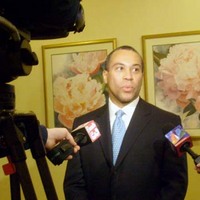 |
"Things are not going well right now in the U.S. economy. In an economy built on consumption, consumers are feeling uncomfortable," the governor told a packed room at the Crowne Plaza on Monday morning. "Massachusetts is holding its own, and I want you to know that."
Some 400 representatives of business, finance, education and publishing filled the tables at the chamber breakfast to hear the governor speak to their concerns about manufacturing and the economy. So many showed up that more tables had to be brought into the hall to accommodate the overflow.
March has been declared "Manufacturing Month" in Massachusetts and the administration of Patrick and Lt. Gov. Timothy Murray has been holding forums across the state to gather input on the needs of local manufacturers. After Patrick's address, a forum, lead by Gregory Bialecki, undersecretary of business development, with Labor Secretary Suzanne Bump, Philip Giudice, commissioner of the Division of Energy Resources, and Jack Healey of the Massachusetts Manufacturing Extension Partnership was attended by about three dozen people.
Healey, speaking later at the forum, said while manufacturing jobs have been shed, production and exports are up and manufacturing co ntinues to be No. 2 in the state with a $25 billion payroll.
The governor said job growth is up in health, education and technology sectors, and that unemployment is lower than a year ago, and lower than the national rate.
While the "bubble has burst in the overheated real estate," oil remains high and gasoline may approach $4 a gallon, the state continues to perform better than the national economy on all fronts, he said.
Soft Landing
The state isn't recession-proof, Patrick said, but is better armed to stave off an economic downturn than in the past, when the last three recessions hit hard and lasted long.
The governor spoke of efforts to capitalize on the creative economy on both the cultural and technological fronts, and the bond bills he is urging the Legislature to approve as investments to stimulate the business climate.
"We'll working with local leadership to identify the kinds of investments we can make in the next 90 days that will make a difference in inspiring economic activity," Patrick said.
Taking a shot at the previous Republican administrations, the Democrat said the state's economy has improved "considerably over the four years of the preceding administration."
"We were left a legacy of chronic neglect and find ourselves with a crumbling infrastructure and a backlog of capital needs."
Patrick said that infrastructure needs billions, pointing to the $4.8 billion transportation bond bill that the Legislature took up last week. He said he was prepared to sign his $1 billion, 10-year life science bill and a higher education bill that would revamp state college and university campuses.
He also touted efforts to ramp up the state's tourism sector, partly by promoting ethnic fairs across the state and attracting overseas tourists. Direct flights from Boston's Logan Airport to China will be a reality within the next year.
Those initiatives will create both temporary and permanent jobs, but it's the state's investment in life sciences and education that will really pay off, he said.
One job in the health field means 3.6 jobs in indirect services - suppliers, vendors etc. - or, according to a Northeastern University study, a multiplication of five, said Patrick.
He also touted the state's efforts to streamline permitting, cut excise taxes for smaller businesses, provide health care for all, freezing unemployment rates and restructuring the education department.
But for middle-class taxpayers "one paycheck away, one serious illness away, one layoff away" from distress, the future is fearful; the state government must do what it can, he said, through partnerships, education and collaborative efforts.
"It is the agenda of this administration to create a broad culture of opportunity, that is our charge," said Patrick.