Dalton Stroke Survivor Walks For Awareness
 |
DALTON, Mass. — It was 2 in the morning when Tanya Wasielewski was awakened by a shaking bed and strange sounds.
It was her husband, David, who was repeatedly hitting himself in the head and saying, "It hurts, it hurts."
It took five emergency medical technicians and two Dalton police officers almost an hour to get David, who was still seizing, restrained and into an ambulance.
It was a stroke — a life-changing event that would leave David partially paralyzed.
A 48-year-old who exercised regularly, David didn't think he was at risk for a stroke. He had regular physicals and normal blood pressure and cholesterol levels.
"Life was going along fine, all of a sudden this happened one day," said David.
David, Tanya and their young son Jacob moved to the area eight years ago from San Diego. David's stroke in 2004 caused an outpouring from the community — a support network they didn't realize they had.
"You don't know who your friends are until something like this happens," said David.
Friends, family, co-workers and community members have all helped. By the time David returned home from the hospital, friends had already built him a wheelchair ramp.
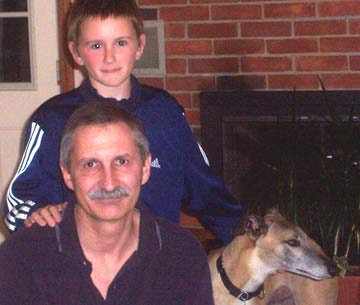
Submitted photo
David and son Jacob at home. |
Tanya's co-workers at Berkshire Life Insurance Co. of America offered to watch Jacob, cook dinner or do anything else the family needed.
"It was amazing the support I got," said David.
His stroke was caused by a carotid dissection, in which weakened walls of the carotid artery shear off and cause an interruption of blood flow to the brain. In many cases the dissection is caused by trauma, but in some, as in David's case, there is no known direct cause.
"It was just bad luck," his neurologist, Dr. Alexander Kloman, told him.
David said he didn't recognize the signs he was having a stroke. In fact, the doctors had missed the symptoms. He went to the hospital with an excruciating headache the day before his stroke. Since David is a migraine sufferer, it was assumed he was having a migraine and he was sent home with pain medication. He had the stroke that night.
2008 Berkshire County Heart Walk
But David doesn't blame the hospital. Instead, the stroke survivor and his wife have been helping raise awareness of strokes: his story is featured by Berkshire Health Systems and they support the Berkshire County Heart Walk.
The family will be attending the Heart Walk, to be held on Sunday, Sept. 28, for the fourth year; David's first walk was just six months after his stroke.
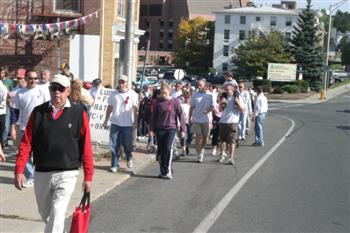
iBerkshires file
Heart Walk participants make their way up North Street in Pittsfield last year |
|
Berkshire County
Heart Walk 2008
|
|
Sunday, Sept. 28
Wahconah Park, Pittsfield Walk steps off at 10 a.m. To participate in the walk: click here |
"Every year, he gets a little bit farther," said Tanya.
The walk, which had more than 500 participants last year, is approximately 3.2 miles long through downtown Pittsfield with a one-mile survivor's walk. People meet at Wahconah Park, where booths will be set up along with an "awareness tent." Heart healthy foods, cookbooks, exercise programs and people to take blood pressure will be available.
"It's a way for the community to have fun," said David.
Tanya said the goal of the Heart Walk is not only to raise money but, more importantly, to create awareness of heart disease. She wants to increase knowledge of the warning signs for stroke and heart attack. Along with an excruciating headache the day before his stroke, David had dropped an object and couldn't pick it up with his left hand. He also heard a whooshing sound in his ear — caused by blood that was re-routed from the closed-off artery.
"Hind sight is 20/20," said Tanya, who also wants to educate people about the factors that contribute to heart disease, such as diet, weight, and exercise.
David added, "It's not just something that happens to old people, anyone can be affected."
Life After A Stroke
The Dalton native was active before his stroke, traveling three times a month for his business consulting job. He was also a member of the Ski Patrol, played volleyball and exercised on his treadmill daily.
"It just turns everything upside down," said Tanya.
The stroke left David disabled with his left side paralyzed, a condition known as hemiplegia, and has had loss of sensation and motor control. He described the feeling as being on Novocain all the time and said the effects of the stroke are extremely fatiguing.
Tanya said her husband has come very far compared to where he started. He needed a wheelchair for the first six months after the stroke, along with physical therapy two to three times a week.
"Your brain kind of re-routes for what it has lost," said David, who has also had a push from his wife to do things for himself. "You need to have a good coach and caregiver."
David started to become active again by participating in sports. All Out Adventures assisted him with finding alternative means of exercising. Using a custom-built recumbent tricycle that he controls with his right hand, David has completed in the Farmer's Challenge — a triathlon to raise awareness for people with disabilities.
Additionally, David feels grateful to have disability insurance through his work that covered his medical bills — that the family has estimated at $200,000 — and pays him 70 percent of his lost income.
"I don't know how people get through with disability and Social Security [alone]," said David.
Tanya said Berkshire Life representatives have used David's story as an example in their sales pitches for disability insurance.
The Wasielewskis praised Berkshire Medical Center for its stroke critical-care unit. Tanya called the staff "extremely compassionate" and said the hospital's stroke certification played a big role in the care that David received.
David has given back by creating a peer visitors program for stroke survivors. The group helps people manage their lives after suffering a stroke and also meets with hospital administrators to improve programs.
"You'd be amazed at what you can do," said David, and added that he is "a stroke survivor, not a victim."
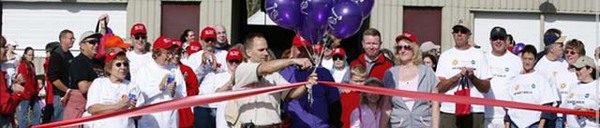
Top, Heart Walk Chairman John Bissell of Greylock Credit Union cuts the ribbon to kick off last year's walk. Courtesy, Berkshire County Heart Walk.