State Puts Forward Plan for Ashmere Dam
HINSDALE, Mass. — Only one subject is up for discussion at a joint meeting of the conservation commissions of Peru and Hinsdale, and it won't be where Lake Ashmere has gone.State officials will go before a joint meeting of Peru and Hinsdale conservation commissions tonight, May 5, in their quest to repair the Lake Ashmere dam, a structure deemed a "high hazard" by the commonwealth. Because of its high risk of failure designation, the state also has special jurisdiction over the dam, which some believe the cause of a severe drawdown that occurred last month after this spring's heavy melt.
The 1,525-foot-long, 32-foot high earthen dam was earlier classified by the Department of Conservation and Recreation's Office of Dam Safety as potentially high hazard, purportedly one of the worst 10 in the state, said Michael Frederick of Hinsdale, chairman of both commissions.
The DCR owns the lake, which straddles both towns, and some surrounding property.
Frederick said the dam, even during dry spells in summer, is consistently moist to the touch.
"Well, there's seepage. I've been there in August, after we haven't had rain for weeks, and the ground's a little moist, or a little soupy, let's say, and you can see where wetlands ... have crept in there over the years," he said.
Ashmere is bisected by Route 143 and has a north side and south side; the dam is located at its most southern end.
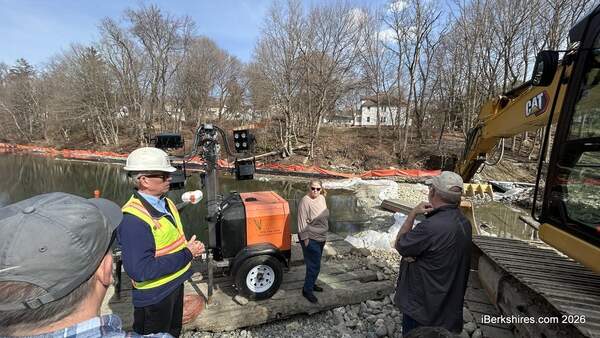
DCR offered up a remedial repair plan, which, Frederick said, will double the footprint of the existing structure. Engineers hired by the state have designed the new dam, and their plan passed muster with the Executive Office of Energy and Environmental Affairs on Feb. 27. See below for plans or click here.
The dam will expand south toward the woods, a unique balsam fir and spruce wetland ecosystem, said Frederick. The plan is to raise the dam by 1 to 1.5 feet; create a more stable slope with a seepage collection system; replace riprap with larger stones and filtered bedding; make the dam uniformly 14 feet wide at its crest; improve the outflow pipe and spillway; create and maintain a 20-foot buffer zone; and to improve the access road, which the Hinsdale Conservation Commission has ruled against. The project would also make the outflows into Bennett Brook more consistent, which it is not currently, according to the DCR.
Because the footprint of the dam will double, the state is looking to reclaim land elsewhere to recreate affected wetlands. One such site eyed for reclamation is 6.94 acres below the dam, valued at $30,000. The site would be purchased, conserved through a deed restriction and then cultivated with "bordering wetlands vegetation," according to the Massachusetts Environmental Protection Act decision.
The cost for reclamation will be about $111,000 to replant the proposed the area. Frederick said both commissions are behind the idea, as is the Army Corps of Engineers.
He didn't know the cost of the project or its timeline for completion.
"This is one of the questions right now, and one of the things I've asked for at our meeting Tuesday night is an actual construction schedule. They originally thought that they would have all of the permits in hand by this April 1, and then be able to commence work. Without the permits, they couldn't commence work. Because of this change, we're not sure what a new construction schedule would look like," said Frederick.
The 300-acre lake and surrounding area has been deemed an area of critical environmental concern, or ACEC, said Frederick, which also includes the Hinsdale flats watershed and Housatonic River.
The state filed a notice of intent with both conservation commissions. The DCR has received permission from the Hinsdale Conservation Commission for an annual drawdown of three feet; a request for a six-foot drawdown in the fall to perform the work has not been given by either town.
A lake's resource area extends beyond the lake proper, Frederick said, to the shore and to the connecting brooks and streams, he said, and all of these areas can be affected by a drawdown.
Under any circumstances, the lake must be refilled by April 30, said Frederick.
"you need to do it in an orderly fashion. As a result of that, the amphibian wildlife, the fish, the frogs, the turtles, the snakes, the salamanders, whatever else is living there, has a chance to move, so it's not like pulling the plug out of your bath tub," he said.
The project also requires a laundry list of state and federal permits, including: a Clean Water Act Water Quality Certificate, a section 401; a Clean Water Act 404 permit, which covers wetland protection, from the Army Corps of Engineers; oversight from the state Endangered Species Act; an EPA National Pollutant Discharge Elimination System General Permit; and a Chapter 253 Dam Safety Permit from DCR.
The towns will both have to issue orders of conditions for the project to commence. Monitoring will be executed by state and federal agencies.
The joint meeting of the conservation commissions is tonight at 6 at Hinsdale Town Hall.
Contact Noah Hoffenberg at hoff1013@gmail.com.
Lake Ashmere Dam project