Capuano Pitches to Western Mass. Voters
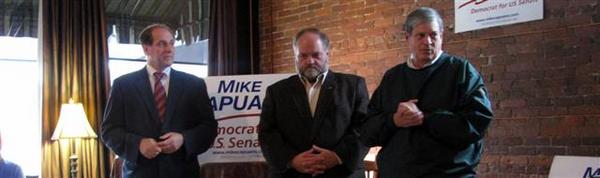
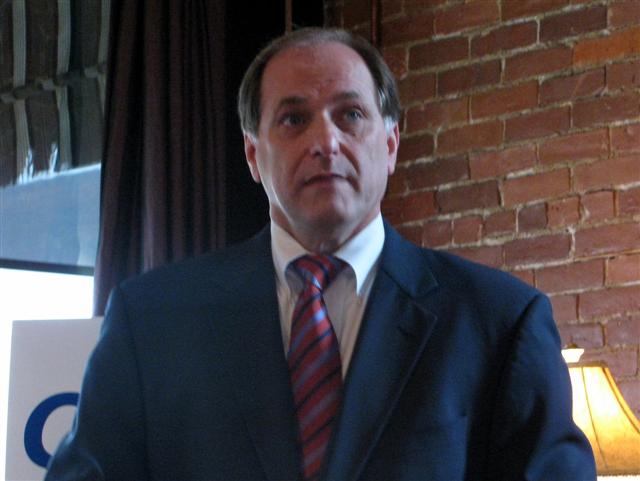 U.S. Rep. Michael Capuano, D-Somerville, made a whirlwind tour of Western Mass. on Saturday. Top, state Rep. Daniel Bosley and Mayor John Barrett III introduce him at Taylor's Restaurant. |
The six-term U.S. representative from Somerville is in a four-way race for the Democratic nomination for Senate and trying to rev up name recognition on the far side of the state. It's tough going considering the front-runner to replace the late Sen. Edward Kennedy is Berkshires native Martha Coakley, the state's attorney general.
But the plain-spoken Capuano was in Coakley's hometown on Saturday stressing his experience, honesty and working-class roots (he lives in a duplex) to the dozen or so people at Taylor's Restaurant.
Flanked by longtime friends and supporters state Rep. Daniel Bosley and Mayor John Barrett III, the dapper Capuano urged voters to look at his record before marking their ballots in the Dec. 8 primary.
"Don't listen to what I say, look at what I've done," he said, pointing to his vote against the Iraq War, a record of protecting the homeless and tenants, going after credit card companies and bringing in millions in transportation funding to the state. "My record is a good indicator of where I'll go."
It's no secret that Western Mass. residents are wary of eastern promises. Capuano's from Somerville but his congressional district contains nearly 70 percent of the state's capital. He tried to make links between the densely populated Somerville in the shadow of Boston and the far-flung North Adams, both blue-collar cities.
"Even right next to Boston, we know it's easy to be forgotten," said Capuano, who spent eight years as Somerville mayor, and is credited in part for cleaning up the crime-ridden, gritty postindustrial city once known as a headquarters for the Winter Hill gang.
 Capuano is vying against front-runner Martha Coakley for the late Ted Kennedy's Senate seat. Find out more at mikecapuano.com. |
Barrett said Capuano has the executive and legislative acumen needed in a senator. "I'm passionate about Mike Capuano because he knows the problems out here."
While barely touching on the race for mayor here, Capuano questioned why anyone would ignore experience to hire someone who wasn't qualified in a riposte that could as easily be applied to Barrett as to himself.
"Would you hire an electrician who didn't have the qualifications? Would you hire a doctor without those qualifications?" said Capuano. "Maybe, if you had no other choice."
His visit came a day after Coakley endorsed mayoral challenger Richard Alcombright (U.S. Sen. John Kerry endorsed Barrett on Sunday).
Both Barrett, the state's longest-serving mayor, and Bosley were cool to Coakley's Senate run, remarking on the attorney general's fishing for endorsements with Kennedy barely in the ground; Bosley called it "tacky" in a comment to The Berkshire Eagle.
A replacement for the so-called "lion of the Senate" should be weighed carefully, said Bosley.
"It can't be decided on geography or where somebody's from, it can't be decided on friendships, it can't be decided on all the different things that drive us to choose someone," he said. "This is very serious we need to put the best person in that job. ... It's important to have someone who tells you the truth."
In wide-ranging discussion, Capuano explained his votes against the Iraq War ("I need to be convinced that I would be willing to send my own child.") and No Child Left Behind ("I'd never vote for an unfunded mandate.").
He's also of the mind that it's time to get out of Afghanistan, since the mission was to rid the country of al-Qaida. With fewer than 100 al-Qaida members believed left in that chaotic nation, "I would say mission accomplished ... If the mission has changed to bring democracy to Afghanistan, I'll vote no and let the people decide."
He said the president hasn't moved fast enough on LGBT issues such as "don't ask, don't tell" and the Defense of Marriage Act in response to a question. "I don't know that we'll have the votes [to overturn] but we'll try."
Capuano said he's also not happy with the cap-and-trade bill, preferring a straight carbon tax to cut out the middleman, but added sometimes compromise is necessary.
The same goes for the 2,000-page health insurance reform bill to be debated in the House this week that includes both good and bad, he said. "No one gets to vote on anything perfect."
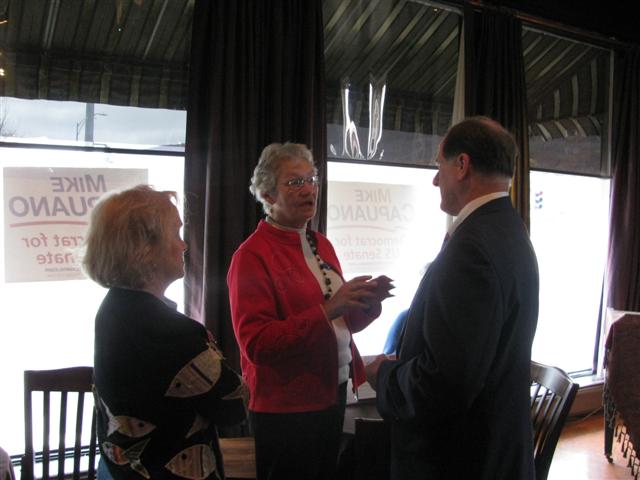 Capuano speaks with voters before heading to Pittsfield. He also stopped in Greenfield and Easthampton and his 'Open Mike' stop will be broadcast on Northern Berkshire Community TV. |
Capuano already holds one Kennedy seat — the 8th Mass. District that sent John F. Kennedy to Congress and was last held by Joseph P. Kennedy Jr.
Who inherits the Kennedy Senate seat will likely be determined by the Dec. 8 Democratic primary between Capuano, Coakley, City-Year founder Alan Khazei and Celtics co-owner Stephen Pagliuca. Republicans state Sen. Scott Brown of Wrentham and Jack E. Robinson are also running. The general election is Jan. 19.
Capuano has been holding forth in diners, living rooms and meeting halls, trying to overcome Coakley's statewide recognition — and catch up to the AG's tonier events that have raised her more than $2 million. ("This is the nicest restaurant we've been in," said one of his enthusiastic campaign volunteers.)
"Public financing to me would be a godsend and very good for the country," said Capuano, who's so far raised just over a million. "There are no special interest groups for people who live in two-family homes."
Still, the congressman known for his pugnacious manner is sprinting has hard as he can in the 35 days he has left.
"I've never given up on anything in my whole life and I never will."