Berkshire Wind Project Transforms Air Into Energy
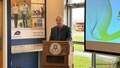
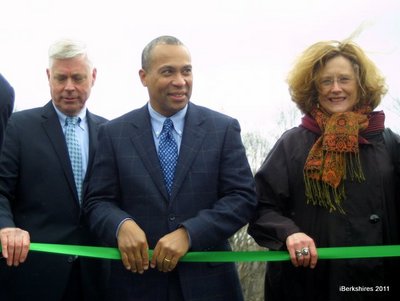 Environmental Secretary Richard K. Sullivan, Gov. Deval Patrick and Meredith Cochran get ready to cut a green ribbon to dedicate the Berkshire Wind Project on Brodie Mountain. More photos here. |
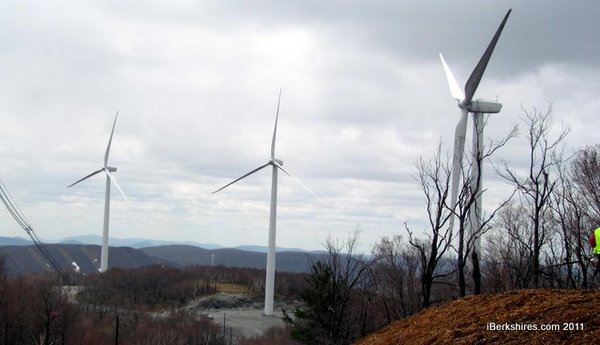
The Berkshire Wind Power Project of 10 GE wind-turbines along the Taconic ridgeline between Routes 7 and 43 will generate enough energy to power 6,000 homes.
It's a long way from the single coal stove that heated the family farm decades ago, said Meredith Cochran, who owns part of the land on which the wind turbines were built.
"All the way from 19th-century charcoal to 21st-century wind, the farm still remains an income- producing farm," said Cochran, as the turbine on the highest point on Brodie Mountain swung more than 200 feet above her. She spoke of her parents' commitment to the environment and the organic practices she and her husband had continued. "My parents would have loved it, utilizing new technologies with an existing resource — wind. New products to support the farm and help diminish our country's dependency on corporate energy sources."
The project began in 1998 as a private venture but moved in fits and starts as it was bogged down by funding problems and appeals by environmentalists; the Massachusetts Municipal Wholesale Electric Co., a public utility serving municipal utilities in 14 towns and cities, bought the assets in 2008. After a eight-month setback because of a federal lawsuit by adjoining Silverleaf Resorts Inc., which is building condominiums on the former Brodie ski area, the newly created Berkshire Wind Power Cooperative Corp. issued a $65 million bond in 2010 to complete the 15 megawatt project.
Only one turbine was spinning on Thursday but the other nine are expected to come online by the end of the month, inching the state closer to Gov. Deval Patrick's goal of 2,000 megawatts of wind and 150 Mw of solar energy being produced in the state. Brodie is considered a prime inland location for wind power, rating 6 on a scale of 7 with a 40 percent capacity.
 "I'm excited about this project; I'm excited about what it portends for the future," said Patrick, who spoke during an oddly calm break in the blustery air. "There are opportunities here for us to show a whole new level of environmental stewardship, opportunities here for us to generate our own power and to free ourselves not just from the dependence on foreign oil and gas but from the price spikes that are an inherent part of that market."
Richard K. Sullivan, secretary of Executive Office of Energy and Environmental Affairs, said the state spends more than $20 billion every year in energy and 80 percent, or $18 billion, not only goes outside the state, it goes outside the country. Projects such as Berkshire Wind are creating a home-grown market for energy needs, he said, adding that Patrick was the only governor with "the vision to put energy and environment in the same secretariat, understanding that good clean energy decisions were also good environmental decisions."
Later, Patrick reiterated a point made by Sullivan on the 65 percent in job growth in green energy over the last few years. "Because we have made a point of cultivating that industry and it's an industry that makes a lot of sense in Massachusetts because of the concentration of brainpower and our tradition of innovation and invention," he said. "It builds on technology and technicial capability that we have here right now."
Berkshire Wind is currently the largest completed wind project. Two others, both private, have also been years in development and have had difficulty overcoming zoning, permitting, appeals and lawsuits. The Minuteman Project is at a standstill over wetlands permitting and buyers for its power; Hoosac Wind in Florida and Monroe has begun construction after seven years and, when completed, will be double the size of Berkshire Wind.
Patrick said it was important to pass a wind power siting bill currently in the Legislature. "We need the wind siting bill ... you know they said this project is 13 years in the making. It shouldn't take 13 years — that adds to costs. It means we are that much longer in breaking ourselves of dependency on oil and gas and we need alternatives," he said. "We can have wind siting reform that respects local interests and local control and that's what we're trying to get."
 Cochran, whose family was battered by lawsuits and calls for boycotts of their Christmas tree farm, said landowners should have a "predictable and reasonable number of permitting and hoops and hurdles."
 The towns of Lanesborough and Hancock were very supportive of the project, said Ronald C. DeCurzio, chief executive officer of MMWEC, but added that being a public concern had advantages in permitting and pushing through projects of this nature.
"Public power does have the ability to act quickly, to get financing quickly, and they are on the forefront of reducing our carbon footprint," he said. Two of the participating municipalities, Hull and Leverett, began pursuing wind power as early as 1985.
Sullivan asked Lanesborough and Hancock to continue to lead the way by showing renewable energy "can be developed safely and responsibly."