Local Veterinarian Launches Puppy-Finding Website
 |
But the "puppy" phase of life only lasts for a few weeks and that's why pet consumers need to be careful about selecting a companion, said longtime veterinarian Lorna Grande, a coordinator for the local Human/Animal Violence Education Network (HAVEN).
"Let's face it, when you're buying a puppy you're really buying a dog," Grande said in a phone interview. "When you buy a puppy from a breeder you have to ask yourself, 'What am I paying for?' You're paying for somebody to minimize the risk of health and behavioral problems in the breed that you choose. You're not paying someone for a cute puppy."
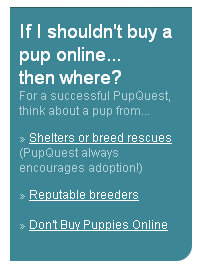
In an effort to keep the public informed about buying purebred puppies (and to hopefully keep breeders honest) Grande recently launched PupQuest.org. The website is full of information about breeders nationwide and health screenings, provides access to several links including the ASPCA, hosts a community blog, and perhaps most important of all, identifies red flags for potential dog buyers.
"I think that the No. 1 recommendation I have is to never buy a puppy sight unseen," she said. "Reputable breeders would never send a puppy to a stranger. They want to know as much about you as you do about them."
This is true of Lisa Sauer, owner of Fernside Border Terriers in Stockbridge, who has been a dog breeder for 11 years. According to her, potential buyers contact her online through a breeder referral page then she arranges a meeting with that person. Sending a puppy to an unknown buyer is out of the question.
"I ask them to come meet me personally before I will sell them a puppy," she said. "That way I can assess if they will be good dog owners and which puppy will be the best match for them. I think most people are just happy when I say they will make a good home for one of my puppies. Most people who contact me have done tons of research on my breed before they contact me. I always insist of face-to-face meetings so that immediately weeds out the serious from the ones that haven’t given much thought to why they want my breed."
Researching a breed and a breeder are key components to a successful dog match, according to Grande. Unfortunately, she said, not everyone does their research and for the most part dog buyers are still in the dark about how and where many puppies are raised.
"I think we've made some progress. Most people know not to buy a puppy from the pet store any more," she said. "The Internet has changed everything, though. It has made it worse for dogs and puppies. It allows shady breeders direct access to the consumer. A greedy dog breeder can have a conversation with anyone online and pretend to be something that they're not. It's frustrating to watch a society that is so naive. A little bit of education can go a long way."
In addition to not buying a puppy online, Grande also recommends that dog buyers become familiar with the disadvantages not only of puppy mills, but also of puppy farms. Buying a puppy from a farm, she said, is just as problematic and inhumane as getting one out of a mill.
 "Dogs are not livestock," she said. "It's dangerous to raise dogs in an environment where they have no contact with people. Even if it is a state-of-the-art facility, it is still an inappropriate way to raise a dog. You want a happy, well-socialized puppy that has been raised with people."
Sauer takes her role as a breeder very seriously, especially when it comes to the initial raising of her puppies.
"I do this because it is the thing I love most in the world to do," she said. "It was never anything I had planned to do, I just fell into it because I loved the sport of showing and I love the breed so much. It is a huge amount of work, though, and I spend nearly all of my time cleaning up after, caring for or competing my dogs. All my puppies are raised in my bedroom [until four weeks old] and then in my living room until they go to their homes.
"I have to say this is true of all my border terrier friends. All puppies are properly vaccinated and dewormed and have had at least one, sometimes two veterinary checkup prior to their going to their new homes," said Sauer. "We state in our puppy contracts that for any reason in any time of the dog’s life we will take it back if it doesn’t work out. All puppies are properly registered and none, unless mutually agreed upon by the new owner and the breeder, will be used for breeding. If they are without prior consent, none of the offspring will be registerable."
Sauer's stringency is her own. Thus far there are no state or federal regulations regarding dog breeding and online puppy sales, although Congress recently referred the Puppy Uniform Protection and Safety Act (H.R. 835) to the House subcommittee on Livestock, Dairy and Poultry for perusal and possible approval. Until such an act is approved, however, Grande will continue to post, link and crusade on PupQuest.
"This is my contribution and the response has been great," she said. "I'm an animal shelter person and, to be honest, I want everyone to adopt. There are too many dogs in shelters right now. Yet, a lot of people insist on getting a puppy and if they are going to go that route, for their sake and the dog's sake, they need to know what they're getting into."
Tags: dogs, puppies,