image description
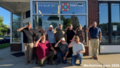
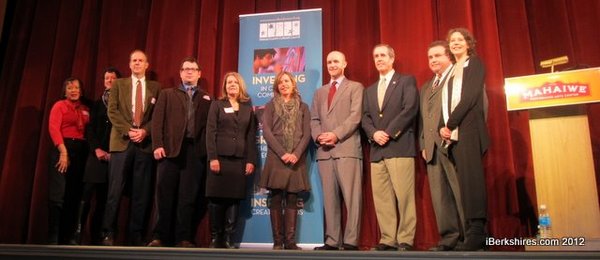
Representatives from the six Berkshire venues receiving grants pose with state officials and representatives from the Mass. Cultural Council and MassDevelopment.

Cultural Grants Are Investment in Berkshire Economy
By Tammy DanielsiBerkshires Staff
Print Story | Email Story

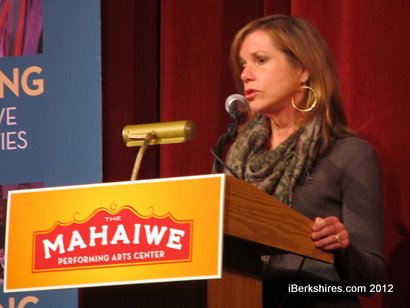
MCC Executive Director Anita Walker said Massachusetts has a responsibility to maintain its cultural heritage. 'There are so many firsts here.'
GREAT BARRINGTON, Mass. — The backstage investment of more than $8 million so far in the region's cultural venues is strengthening its economy and sustaining some its most important historical and artistic buildings. 

The latest round of Massachusetts Cultural Facilities Fund grants to the Berkshires over the past few months — to the tune of $1.45 million — was marked on Friday at the Mahaiwe Performing Arts Center, the recipient of a $100,000 matching state grant for safety improvements, sound and lighting equipment, painting, and woodwork and chimney repairs. Other grants were awarded for roof repairs, HVAC, space expansion, septic tanks, fire alarms and paving.

That kind of work isn't the "sexiest of projects," said Anita Walker, executive director of the Massachusetts Cultural Council, but it's essential for long-term viability. "We really have a collective responsibility to take care of these awesome treasures in Massachusetts — for us, for our citizens, for our visitors."

Just as important, the investment is paying back through the creation of jobs and as a catalyst for fund raising.

"This program has already created more than 11,000 construction jobs in Massachusetts," said Walker. "After the work is done another ... 700 or 800 permanent jobs have been created in association with these new projects. This is the gift that keeps on giving."

The 5-year-old fund, administered by the council in collaboration with the MassDevelopment, is backed by a $50 million bond authorization. So far, $44 million in matching grants have been awarded; this latest round totals $7 million in statewide. Gov. Deval Patrick has announced another $5 million appropriation, bringing available funds to $5 million for each of the next two years. 

"These grants are the lifelines for keeping these doors open and the lights on," said state Rep. William "Smitty" Pignatelli, D-Lenox, chairman of the Cultural Caucus. While some county residents may not appreciate the investment, "they are cultivating that next generation of moviegoers, theatergoers, opera takers.

"I think they created the creative economy in the Berkshires ... it's the driving economic engine of Berkshire County."

Chesterwood Museum, Stockbridge
$250,00
Edith Wharton Restoration, Lenox
$137,000
Mahaiwe Center, Great Barrington
$100,000
Samuel Harrison Society, Pittsfield

$63,000
Clark Art Institute, Williamstown
$250,000
Williamstown Theatre Festival

$53,000
The Mahaiwe, a century-old restored theater, brings in 40,000 people a year — half from outside the county — to attend its eclectic mix of performances. Beryl Jolly, executive director, said the theater provides Great Barrington with both economic stability and access to a rich cultural environment. 

"We believe that healthy arts and culture mean a better quality of life and a stronger community."

Walker said more than a $1 billion in deferred maintenance at cultural organizations was identified in a statewide study. And maintenance is ongoing — fix the roof and the plumbing goes. These are the most difficult dollars to raise for nonprofit organizations.

"When you're trying to raise money in a capital campaign, donors get a lot more excited about the shiny new building or the new addition or the new educational wing," she said."It's hard to put a plaque on the plumbing."

Facilities grants can jump-start fundraising. The highly competitive grants are an assurance the state is behind a project, and that gives donors confidence, said Walker. While the grants require an even match, every state dollar can generate up to $38 in matching funds.

Nuts and bolts funding could also jump-start projects that are stuck, like the Mohawk Theater in North Adams. "These kind of grants make it seem possible," said Jonathan Secor, of Massachusetts College of Liberal Arts' Berkshire Cultural Resource Center.

The Berkshires have been cashing in, so to speak, on the facilities grants. State Sen. Benjamin B. Downing, D-Pittsfield, estimated the rural region is getting eight times what it should based on per capita figures. That's because cultural leaders have "effectively made the case that this is the right place to put the state's dollars."

"We know it puts people to work fixing up our facilities," he said. "But we also know it's about sustainable community development in the long run."


Tags: creative economy,   cultural grants,   Mahaiwe,   MCC,   

If you would like to contribute information on this article, contact us at info@iberkshires.com.

Social Service Organizations Highlight Challenges, Successes at Poverty Talk

By Brittany PolitoiBerkshires Staff

Dr. Jennifer Michaels of the Brien Center demonstrates how to use Narcan. Easy access to the drug has cut overdose deaths in the county by nearly half. 

PITTSFIELD, Mass. — Recent actions at the federal level are making it harder for people to climb out of poverty.

Brad Gordon, executive director of Upside413, said he felt like he was doing a disservice by not recognizing national challenges and how they draw a direct line from choices being made by the Trump administration and the challenges the United States is facing. 

"They more generally impact people's ability to work their way out of poverty, and that's really, that's really the overarching dynamic," he said. 

"Poverty is incredibly corrosive, and it impacts all the topics that we'll talk about today." 

His comments came during a conversation on poverty hosted by Berkshire Community Action Council. Eight local service agency leaders detailed how they are supporting people during the current housing and affordability crisis, and the Berkshire state delegation spoke to their own efforts.

The event held on March 27 at the Berkshire Athenaeum included a working lunch and encouraged public feedback. 

"All of this information that we're going to gather today from both you and the panelists is going to drive our next three-year strategic plan," explained Deborah Leonczyk, BCAC's executive director. 

The conversation ranged from health care and housing production to financial literacy and child care.  Participating agencies included Upside 413, The Brien Center, The Food Bank of Western Massachusetts, MassHire Berkshire Career Center, Berkshire Regional Transit Authority, Greylock Federal Credit Union, Massachusetts College of Liberal Arts, and Child Care of the Berkshires. 

The federal choices Gordon spoke about included allocating $140 billion for the U.S. Immigration and Customs Enforcement, investing $38 billion to convert warehouses into detention centers, cutting $1 trillion from Medicaid over 10 years, a proposed 50 percent increase in the defense budget, and cutting federal funding for supportive housing programs. 

Gordon pointed to past comments about how the region can't build its way out of the housing crisis because of money. He withdrew that statement, explaining, "You know what? That's bullshit, actually."

"I'm going to be honest with you, that is absolute bullshit. I have just observed over the last year or so how we're spending our money and the amount of money that we're spending on the federal side, and I'm no longer saying in good conscience that we can't build our way out of this," he said. 

Upside 413 provided a "Housing Demand in Western Massachusetts" report that was done in collaboration with the University of Massachusetts at Amherst's Donahue Institute of Economic and Public Policy Research. It states that around 23,400 units are needed to meet current housing demand in Western Mass; 1,900 in Berkshire County in 2025. 

View Full Story

More Great Barrington Stories