Dalton Select Board Recommends Voting Against Article 1
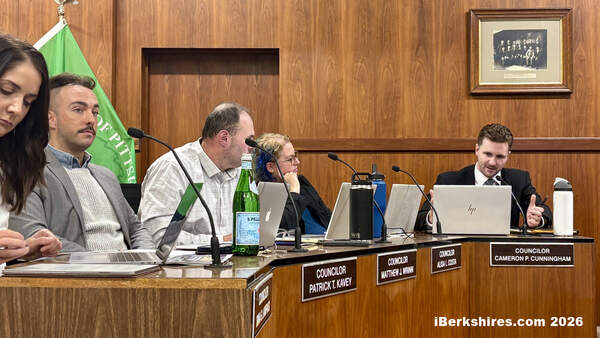
DALTON, Mass. — After a heated discussion concerning sidewalk repair options during last week's Select Board meeting, the board voted to not support Article 1 on the annual town meeting warrant.
The article proposes amending the town's bylaws to mandate the use of concrete for all future sidewalks.
The decision narrowly passed 3-2, with board members Dan Esko, Robert Bishop and John Boyle voting not to recommend the article and Joseph Diver and Marc Strout for a recommendation.
Board members in favor of not recommending the article cited reasons such as not wanting to limit the town's options when addressing sidewalks in disrepair, which has been a hot topic recently due to the number of sidewalks within the town that need to be addressed.
Although Diver made the motion not to recommend the citizen's petition, he later changed his mind and voted against his motion, agreeing with Strout that the decision should lay in the hands of the residents.
"I personally believe that it should be put in the hands of the residents and not for the five of us to make that decision and that's why I actually think this is a good petition to put up there. Let the residents make that decision," Strout said.
The changing of the town bylaw is not the only article concerning sidewalks voters will vote on during the May 6 town meeting.
The other article proposes purchasing a sidewalk and road paver for $64,000 so sidewalks can be paved or repaired quicker and for less money using asphalt.
Multiple residents attended the Select Board meeting to express their concerns surrounding using a blacktop for future sidewalks.
The sidewalk situation has turned into a bit of a mess, Department of Public Works Superintendent Edward "Bud" Hall said during the meeting.
"I never intended to not have concrete sidewalks in town. I like concrete sidewalks. I have no problem with them," he said.
However, the town has many sections that need to be repaired, and $11,000 will only give the town 400 feet of concrete sidewalks at best.
If there could be some stretches paved with asphalt, the town could repair more sidewalks, which would be "great." Not only that, but the paver would also allow him to fix up roads with 6-foot patches, he said.
Strout also noted that there are other uses for the paver aside from just sidewalks such as roads and emergency sidewalk repairs.
Todd Logan, the petitioner for Article 1, reiterated what he has been emphasizing during multiple meetings in town — that concrete sidewalks should be the standard.
Logan said concrete is the preferred sidewalk material by state agencies and the federal Americans with Disabilities Act.
The ADA Committee members voted to support Article 1 during its meeting last Tuesday because it is consistent with state ADA regulations.
Logan said most of the sidewalks in Dalton are concrete, not asphalt, and that making concrete the standard aims to create clearer guidelines that are consistent with state practices and "preserve and expand the existing classic New England character."
Although asphalt is cheaper in the short term, Logan argued that concrete sidewalks will save the town money in the long term and are more environmentally sustainable.
According to the state Department of Transportation, based on 2023 actual project costs and "historical trends in pavement materials prices," concrete sidewalks would save the town "as much as 35 percent in sidewalk costs over the next 25 to 50 years," Logan said.
One of the concerns Select Board members raised during their meeting lastt Monday is the high need for sidewalk and road repairs, but there is a lack of funding to address all of these needs.
One of the proposed projects Article 1 would limit is installing sidewalks on Orchard Road once its reconstruction is complete, board member Robert Bishop said.
The town received a $1 million MassWorks grant for the Orchard Road reconstruction thanks to the work by Hall, Select Board member John Boyle said.
The funding will cover the cost of addressing the drainage problems on the highly traveled street.
Once the construction is complete, there should be money left over but it is "undecided at this time," Boyle said.
When the construction is complete, Hall hopes to use the remaining funds to put an asphalt sidewalk on Orchard Road. If there is not enough money left then they will have to go back to the town to request money, Boyle said.
This initiative was recently proposed by Hall after outcry from residents, emphasizing that it is often used as a connector to Route 9 and by some students who attend Wahconah Regional High School.
Boyle also emphasized that if this article passes it would increase the cost of installing sidewalks on the street.
One potential funding solution that Logan is in the process of developing is a stabilization fund would be funded annually with $30,000 and noted that this could be accomplished with a future petition.
Boyle also mentioned the need to increase the town's sidewalk repair budget, whether it's with $15,000, $20,0000 or $30,000.
Logan also argued that this petition does not prohibit the use of asphalt when necessary and the town can seek a variance for projects such as Orchard Road.
"Our Highway Department can use asphalt for emergency repairs, as well as request an exception, or variance from the town to use asphalt for situations where concrete does not make sense," he said.
"In such situations, the public can attend those meeting to hear the proposal and be part of the discussion. From what I understand about the upcoming Orchard Road project, that might be a good project for such a discussion."
Although Esko supported the idea of concrete sidewalks "as a general aspiration" and can see the long-term benefits he expressed concerns about limiting the highway departments ability to make decisions that asphalt might work better for certain sections and situations.
"I don't want to have a bylaw that limits our ability to do that. I don't believe that having to go through a special permit process, asking the DPW to go through a special permit process to install an asphalt sidewalk, I think that's onerous and cumbersome and unnecessary," Esko said.
"While I do support concrete sidewalks I'm not so sure that I support the um petition to mandate it."
Just like a number of Select Board members, multiple residents during the meeting emphasized the need for more funding to cover the cost of repairing a number of sidewalk that are in "disrepair" and "crumbling."
The town has not truly discussed in a strategic level how much the town wants to spend on sidewalks, Vice Chair Dan Esko said.
The town does not need to provide sidewalks to all areas in town but there would be a lot more walkers if sidewalks are good sidewalks for people to walk on, resident Judith Sharp said.
One of the reasons she moved to Dalton 12 years was the "very walkable center of town [and] part of the reason for that is the concrete."
There are a number of areas in town where the sidewalks are crumbling and although she can walk on them a number of people can't, Sharp said.
The proposal to purchase a sidewalk paver was made in good faith to save taxpayers money and to provide a service, resident Antonio Pagliarulo said.
Pagliarulo said he was present when the proposal to purchase a sidewalk paver was presented and what he though of was the economic principle comparative advantage, "which boils down to, you should do what you're good at."
"... I don't think Dalton should be in the business of laying out major stretches of sidewalk, asphalt or concrete, it should be subbed out."
Pagliarulo said he spoke to several professionals, including a retired state inspector, a general contractor, and a paving contractor, whose remarks led him to the conclusion sidewalks should be subbed out and made with concrete.
Tags: sidewalks,