image description
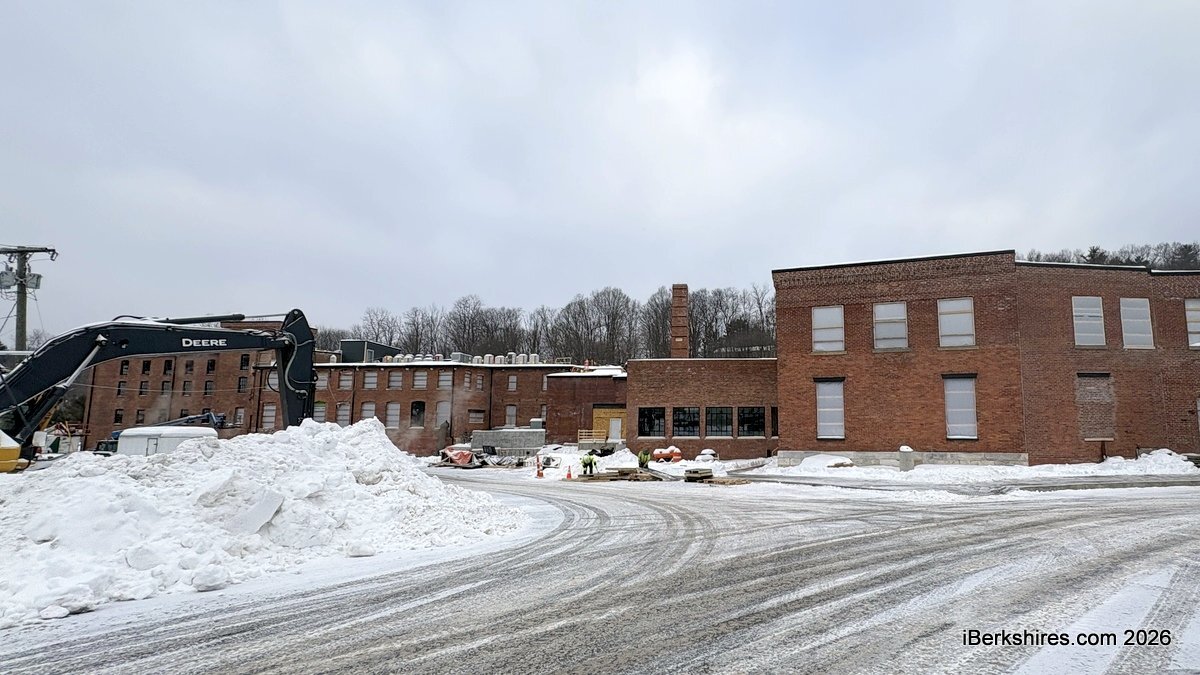
The first residential units in the renovated Eagle Mills will be ready for move in this spring. The project will include more than 200 units, the majority considered affordable for the area.
image description
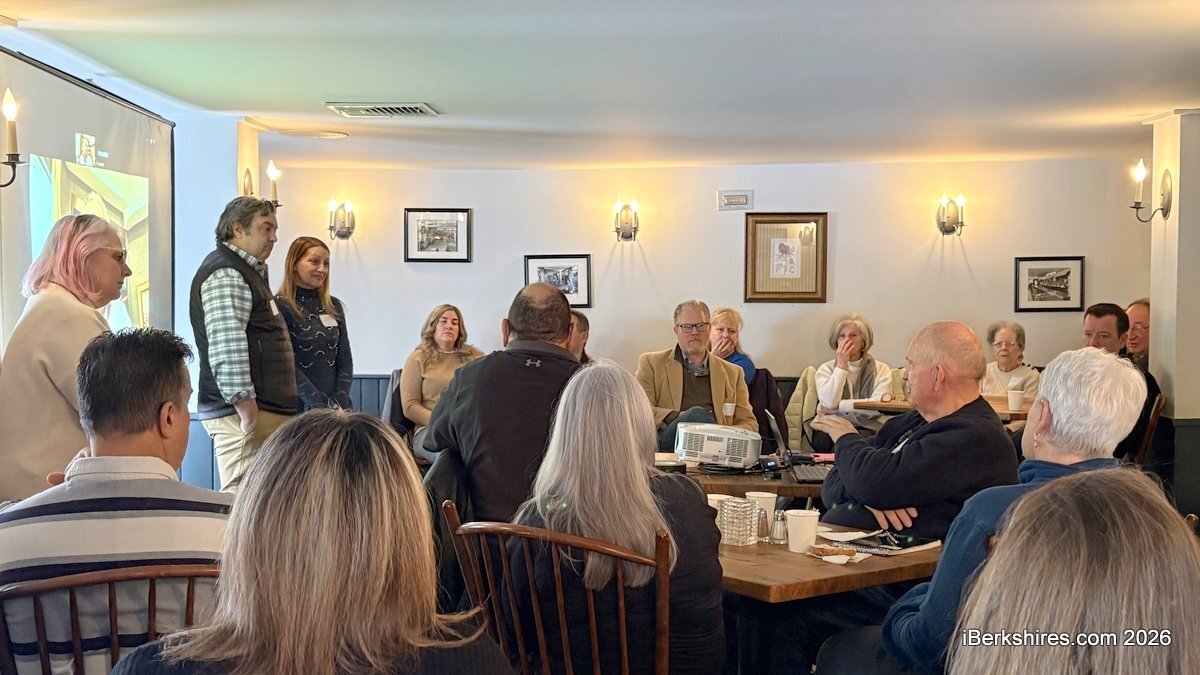
Representatives from Hearthway, a nonprofit affordable housing administrator, fills in the chamber on the status of first 56 affordable units.

First Eagle Mill Units in Lee to Open in Springtime
By Brittany PolitoiBerkshires Staff
Print Story | Email Story

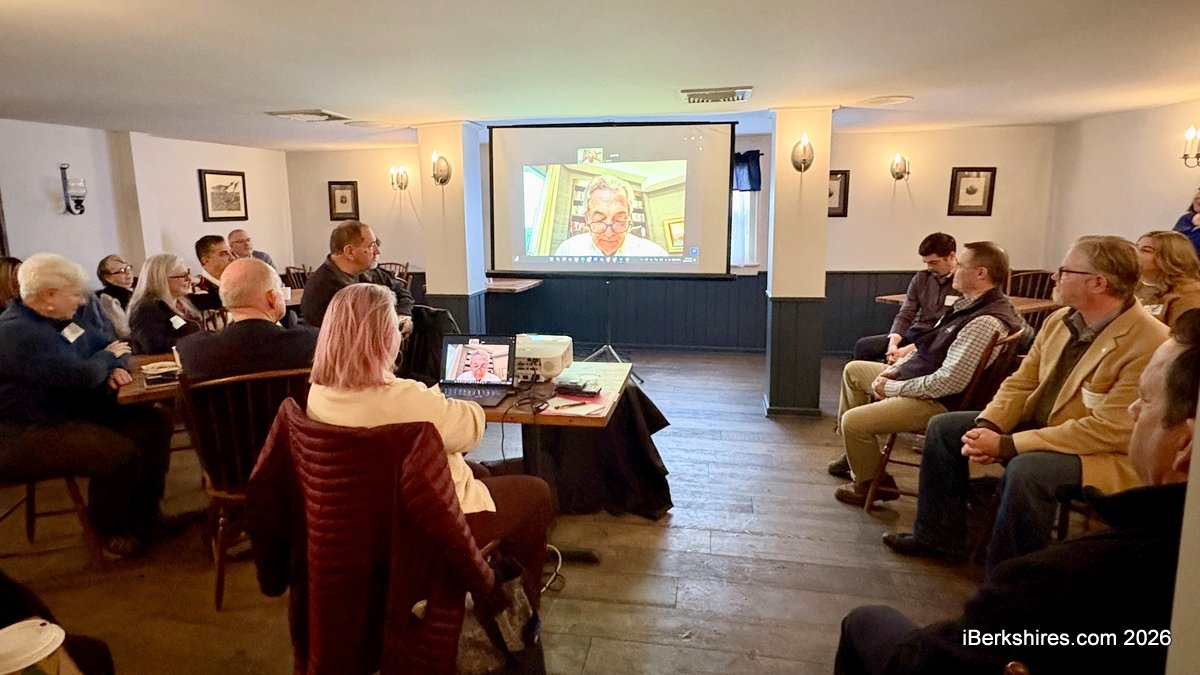
Eagle Mills developer Jeffrey Cohen updates the Lee Chamber of Commerce as the project's phases, and the amount of heavy lifting to get it to this point. 

LEE, Mass. — More than 50 affordable units are expected to come online at the Eagle Mill this spring.

This is the first of several planned development phases at the former paper mill that dates back to the early 1800s, totaling more than 200 units. The Lee Chamber of Commerce hosted an information session on the project during its Business Breakfast last Wednesday. 

"We are here because we have a really big project that's happened for a very long time here in Lee, that, for myself, has provided a real sense of hope, and has has really defined this community as one of the few in the Berkshires that's really looking forward, as opposed to just being sort of stuck in the past," Chamber member Erik Williams said. 

The estimated $60 million development broke ground in 2021 after nearly a decade of planning and permitting. Hundreds of workers once filed into the 8-acre complex, producing up to 165 tons of paper a week. The last mill on the property closed in 2008.


Hearthway is accepting applications for 56 affordable apartments called "The Lofts at Eagle Mill" with expected occupancy in May. The housing nonprofit was also approved for 45 additional units of new construction on the site. 

Jeffrey Cohen of Eagle Mill Redevelopment LLC said the project dates back to 2012, when a purchase contract was signed for the West Center Street property. The developers didn't have to close on the property until renovation plans were approved in 2017, and the mill was sold for $700,000. 

It seemed like a great deal for the structure and eight acres on the Housatonic River, Cohen explained, but he wasn't aware of the complex pre-development costs, state, and local approvals it would entail.  Seven individually owned homes adjacent to the property were also acquired and demolished for parking and site access. 

"If I knew today what I knew then, I'm not sure we'd be sitting here," he said, joining the breakfast remotely over Zoom. 

Cohen praised the town's government, explaining that the redesigns and critiques "Could not have been done in a friendlier way, in a more helpful way," and the two Massachusetts governors serving during the project's tenure. The Eagle Mill redevelopment is supported by state and federal grants, as well as low-income housing tax credits. 


Matt Kropke, Hearthway's director of real estate development, said the 56 units are staged for a May 6 completion.  

He explained that these are "probably one of the biggest mixes of income we've been able to accomplish in a long time," thanks to MassHousing's Workforce Housing Initiative. Twenty units will be rented to people earning 80 percent of the area median income, eight units will be for people learning 30 percent of the AMI, and everything in between will be for people earning 50 percent of the AMI. 

"We also have applied for very similar program for low-income housing tax credits for phase two, which is the flat piece of land north of that building. It's going to be new construction," Kropke reported about the additional 44 units. 

"…That one has been approved. So we're now in that, where we kind of bring that one to a financial closing, which we expect would be in the fall. Once that happens, we can start construction on that portion." 

Applicants will be put into a lottery that will be drawn in February. One bedrooms range from about $1,200 to $1,600, two bedrooms from about $1,700 to $1,900, and a three-bedroom between $1,900 and $2,100, reported Kristin Coyne, the director of portfolio operations for Hearthway. 

Cohen explained that there are five phases of the mill's development: Hearthway's 56 units that are soon coming online, Hearthway's additional 44 units of new construction, 35 units and 4,000 feet of retail and commercial space that would be applied for around 2027, 10,000 square feet of retail space in the former machine shop, and possible market-rate townhouses. 

Two acres of property across the street is under contract for a 69-unit affordable housing building by a different developer. 


Tags: affordable housing,   eagle mills,   mill reuse,   redevelopment,   
If you would like to contribute information on this article, contact us at info@iberkshires.com.

Sheffield Craftsman Offering Workshops on Windsor Chairs

By Breanna SteeleiBerkshires Staff

Andrew Jack uses hand tools in his wood working shop. 

SHEFFIELD, Mass. — A new workshop is bringing woodworking classes and handmade items.

Andrew Jack specializes in Windsor chairs and has been making them for almost 20 years.

He recently opened a workshop at 292 South Main St. as a space for people to see his work and learn how to do it.

"This is sort of the next, or latest iteration of a business that I've kind of been limping along for a little while," he said. "I make Windsor chairs from scratch, and this is an effort to have a little bit more of a public-facing space, where people can see the chairs, talk about options, talking about commissions.

"I also am using it as a space to teach workshops, which for the last 10 years or so I've been trying to do out of my own personal workshop at home."

Jack graduated in 2008 from State University of New York at Purchase, and later met woodworker Curtis Buchanan, who inspired him.

"Right after I finished there, I was feeling a little lost. I wasn't sure how to make the next steps and afford a workspace. And the machine tooling that I was used to using in school." he said, "Right after I graduated, I crossed paths with a guy named Curtis Buchanan, and he was demonstrating making really refined Windsor chairs with not much more than some some flea market tools, and I saw that as a great, low overhead way to keep working with wood."

Jack moved into his workshop last month with help from his wife. He is renting the space from the owners of Magic Flute, who he says have been wonderful to work with.

"My wife actually noticed the 'for rent' sign out by the road, and she made the initial call to just see if we get some more information," he said. "It wasn't on my radar, because it felt like kind of a big leap, and sometimes that's how it's been in my life, where I just need other people to believe in me more than I do to, you know, really pull the trigger."

Jack does commissions and while most of his work is Windsor chairs, he also builds desks and tables, and does spoon carving. 

Windsor chairs are different because of the way their backs are attached into the seat instead of being a continuous leg and back frame.

"A lot of the designs that I make are on the traditional side, but I do some contemporary stuff as well. And so usually the legs are turned on a lathe and they have sort of a fancy baluster look to them, or they could be much more simple," he said. "But the solid seat that separates the undercarriage from the backrest and the arms and stuff is sort of one of the defining characteristics of a Windsor."

He hopes to help people learn the craft and says it's rewarding to see the finished product. In the future, he also hopes to host other instructors and add more designs for the workshop.

"The prime impact for the workshops is to give close instruction to people that are interested in working wood with hand tools or developing a new skill. Or seeing what's possible with proper guidance," Jack said. "Chairs are often considered some of the more difficult or complex woodworking endeavors, and maybe less so Windsor chairs, but there is a lot that goes into them, and being able to kind of demystify that, or guide people through the process is quite rewarding."

People can sign up for classes on his website; some classes are over a couple and others a couple of weekends.

"I offer a three-day class for, a much, much more simple, like perch, kind of stool, where most of the parts are kind of pre-made, and students can focus on the joinery that goes into it and the carving of the seat, again, all with hand tools. And then students will leave with their own chair," he said.

"The longer classes run similarly, although there's quite a bit more labor that goes into those. So I provide all the turned parts, legs and stretchers and posts and things, but students will do all the joinery and all the seat carving the assembly. And they'll split and shave and shape their own spindles, and any of the bent parts that go into the chair."

His gallery is open Wednesday through Sunday 10 a.m to 2 p.m., and Monday and Tuesday by appointment.

View Full Story

More South Berkshire Stories