North Adams Council OKs Borrowing for Conte Project
|
The City Council on Tuesday night authorized the mayor to borrow funding for the Conte School project. |
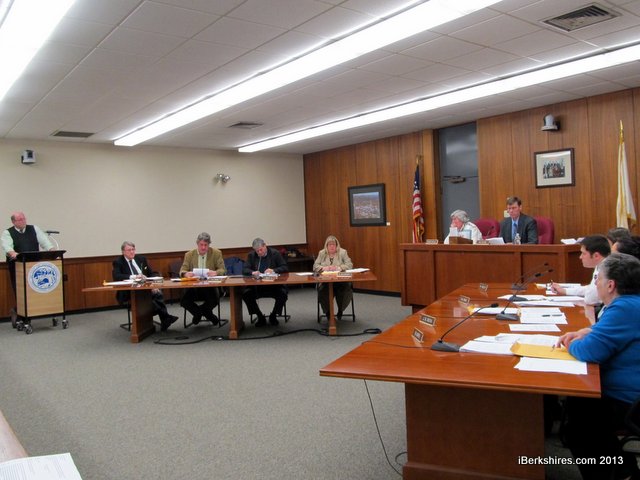
NORTH ADAMS, Mass. — The City Council on Tuesday authorized a nearly $29.7 million borrowing to renovate Conte Middle School into an elementary school.
The Massachusetts School Building Authority has approved 80 percent reimbursement for the project, bringing the city's cost down to $6.5 million.
The vote was 7-2, with Councilors Marie Harpin and John Barrett III voting against. The borrowing order requires a two-thirds vote.
The approval was met by cheers from a cadre of school administrators and School Committee members, and a boo from within the handful of meeting regulars.
"I think most everybody believes this community needs to grow, growth requires investment and it can come from outside the community and from inside," said Councilor Alan Marden. "Two of the other major factors are education and the quality of the work force. That's the job of this community. ... I believe in the Conte project, the mayor said we can afford it, I don't think we cannot afford not to do it."
Planning for the project began more than three years ago after the closure of Conte and the relocation of sixth and seventh grades to the three elementary schools and the eighth grade to Drury High School.
The project will continue the city's decision to split its educational framework into a Kindergarten-through-Grade 7 and Grade 8-through-12 structure. The School Building Committee had hoped to also renovate Greylock Elementary but a two-school option was rejected the Massachusetts School Building Authority.
Mayor Richard Alcombright said the debt could be absorbed into the budget, at $102,500 each the first two years on interest only and $370,000 annually over the balance.
"This is built within our 2 1/2 percent levy limit, so the numbers will be built into a budget," he said, adding that the city would still have to live within the constraints of local receipts, taxes and state aid.
In answer to questions from several councilors about the looming capital projects for sewer, public safety and Americans with Disabilities Act requirements, the mayor said he would be coming forward with a plan for addressing those issues that will require more borrowing.
He believed that most of the ADA issues, as ordered by the U.S. Department of Justice, could be addressed through Community Community Block Grant Funding. The public safety building would be the last, and most expensive, item on the list.
The time it will take to study and develop plans would push any public safety project out to 2018-2020, he said, adding that he would be updating the council on immediate plans at the next meetings. The city's long-term debt (at $1.7 million this year) is calculated to drop by $1 million at that point as other borrowing is paid off.
"We wouldn't do this if we thought there would be an override, if our numbers are accurate, and we believe they are accurate, we can absorb this," he said. "We don't see it as problematic."
Several in the audience were skeptical about the cost, or were opposed to Conte being the school renovated.
"Where are your priorities?" asked resident Mark Trottier, saying the city needed a new police and fire station, and work on the sewers. He urged holding off on the project. "I think we could go on for another four years."
Katherine Montgomery said a new school should be built on a different site, something more like what was done in Williamstown. Putting money into Conte would mean "we would be stuck with an inconvenient, unpopular school building."
But John Franzoni, assistant principal at Greylock and Sullivan, said the plan was a good one, and would give the children a play area the size of Sullivan and Greylock combined, as well as a gym and a modern building. "I hope that you will do what is the best for our student body," he said.
Barrett spoke at length about his disagreement with the plan, saying it had nothing to do with money and everything to do with best interests of the children's education. Frequently referring to a study he had authorized in 2007 by the New England School Development Council, he said the School Committee and mayor had failed to follow through with the study's recommendations, including developing a long-term facility plan.
"The NESDEC report offered several plans that weren't looked at," he said, adding that the city should be more concerned with the district's low Massachusetts Comprehensive Assessment System scores and lack of a curriculum coordinator (cut after the failure of last year's Proposition 2 1/2 override).
|
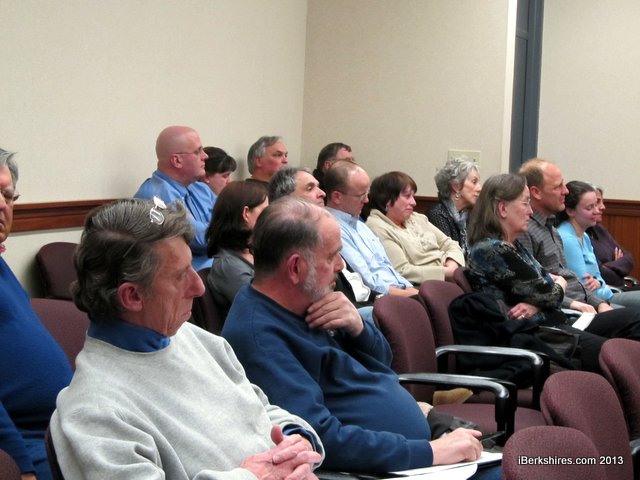
A contingent from the School Department attended; several residents spoke against the project. |
The report offered fixes for both Sullivan and Greylock elementary schools at a cost of about $21 million, said Barrett. (The plans drawn up by Margo Jones Architects put the costs to totally renovate Greylock and Sullivan at about $30 million each.)
Harpin's objections were over concerns for costs and the feedback she had received from people over the past weeks.
"They don't want to lose their neighborhood school," she said. "The people who are calling me and the people who are stopping me on the streets are against this school. I just can't see how the city can handle this."
Several other councilors said they had heard just the opposite. Councilor Lisa Blackmer, who had opposed the Conte choice because of safety concerns and the wishes of Sullivan parents to keep their school, said the feedback she had received changed her mind.
"I've listened to people. They're definitely two to one in favor of Conte," she said, thanking those who had approached or mailed her. "It may not be their first choice but they think now is the time to do it. I really think we need to go with this project."
Councilor David Bond said he had received the same comments, particularly from parents in the Conte neighborhood who are pleased with the choice.
"There are parents that had some real concerns," he said. "It's the best project we can put forward. We have spent years reviewing this project with professionals and the state has endorsed it."
Councilor Nancy Bullett also said she had spoken to parents who believed that Conte was their neighborhood school and noted that at one time, Drury High, St. Joseph's High and Notre Dame schools had all been open in that area.
"I think the timing is right," she said. "To wait another two or three years ... this is already approved for funding. ... the longer we wait the more money we'll have to use."
Councilor Keith Bona wondered why the city would want to spend $2 million to $3 million in Band-Aids on Sullivan, unlikely to be reimbursed, when it could get a brand-new school for $6.5 million right now.
The mayor answered a number of other questions that went over old ground on meetings and decision making, but said that wasn't the point of the order.
"I'm not hear to argue the project, I'm here to convince the council we can afford it," he said. "We ran the numbers, we've confirmed the numbers and we know we can make it work."
Barrett, however, urged the council to put the money to a public vote.
"The people do not want this and it will be defeated if it goes to the ballot box," he said.
Earlier in the day, the mayor also provided an opinion on the ownership of the property by City Solicitor John DeRosa. A number of people have questioned the city's rights over the property in relation to Nathan Drury's will, which bequested $3,000 to buy land and develop a school.
"It is our opinion that the City of North Adams has good and clear record title to the property, in fee simple absolute, and holds the property in trust, to 'perpetually maintain the same for educational purposes as contemplated by said will,'" DeRosa writes in the opinion.
DeRosa wrote that any issues with possible heirs of Nathan Drury — who never owned the land in question and who has no direct descendants — was taken care of when the Supreme Judicial Court decreed the surrender of the trust and all titles to the city in 1915.
Tags: borrowing, Conte School, school building, school project,