North Adams Council Finalizes Conte Borrowing
|
The City Council on Tuesday voted again to authorize borrowing for the Conte renovation but an opponent of the project is trying to get it before the voters. |
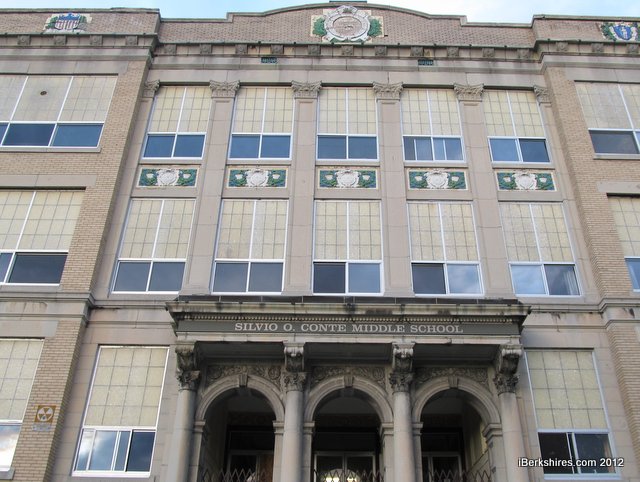
NORTH ADAMS, Mass. — The City Council on Tuesday confirmed a second reading of a $29.7 million borrowing order for the Conte School project but an opponent vowed to stop the plans.
The 7-2 vote at the special meeting was a repeat of the order's first reading on Jan. 22, with Councilors John Barrett III and Marie Harpin voting against.
The Massachusetts School Building Authority has approved 80 percent reimbursement for the project, bringing the city's cost down to $6.5 million.
Council gadfly Robert Cardimino said he would "knock on every door" in the city to get enough signatures to put the borrowing on the ballot.
"I think the voters are going to have the last word in this city," said Cardimino, who was a vocal opponent of 2011's Proposition 2 1/2 override attempt. "You're wrong on 2 1/2, you're going to be wrong on this school."
City Clerk Marilyn Gomeau said a ballot vote would require the signatures of at least 12 percent of the city's registered voters, or more than a thousand, submitted within 20 days. She and council President Michael Bloom said the city solicitor had opined that the borrowing could be petitioned to a ballot; some municipal loan borrowing cannot.
Gomeau estimated the cost of a special election — which would have to be borne solely by the city and cannot occur on the same day as the Senate special election April 30 — at $5,000 to $6,000, depending on the voting hours required.
Cardimino said his main concern was rising taxes. Mayor Richard Alcombright has said the debt could be absorbed into the budget, at $102,500 each the first two years on interest only and $370,000 annually over the balance. The city's long-term debt payments are expected to drop by $1 million by 2020 as other projects are paid off.
Barrett again brought up a 2008 school building capacity plan by the New England School Development Council that he said offered options for upgrading both Sullivan and Greylock schools for $22 million.
The report, according to the executive summary provided by Barrett, identified some of the same issues as the consultants engaged by the School Building Committee: schools in need of major upgrading or renovations, overcrowding because of lack of program space, and the need to develop long-term maintenance planning.
The summary points to four possible "mix and match" options resolving space and renovation issues. "All of the options are designed to serve as a catalyst for further analysis and discussion," it states.
Barrett said the report should have been provided to the School Building Committee since it also addressed academic components that "bricks and mortar" won't fix. "What's being missed in all of this is it's not going to solve all the problems in the school district," he said, adding that Greylock will end up having problems that "will make Sullivan look like the Taj Mahal."
Councilor Keith Bona, a member of the School Building Committee, agreed fixing Conte wouldn't solve all the problems but the MSBA had rejected the city's attempt to do two schools at once. The consultants had determined that Sullivan was the more problematic of the three schools and that Greylock was usable for more years at less cost.
"As a member of the School Building Committee, we were depending on the consultants. That's why we paid them $700,000," said Bona, noting that the plans also received input from educational consultants and the district's own educators.
Alcombright said he believed the NESDEC report had been submitted to the MSBA with one of the letters of interest but that the figures for renovations had not been validated by architects. He also questioned if the funds would be reimbursed.
Barrett responded that the money would be there "down the road" and the school system should be focusing on academics. "It was a rush deal in my mind to get this done."
Councilor Jennifer Breen said she thought the city's MCAS issues had more to do with poverty and parents, unrelated to the school building, and moved the question.
Building Committee member Ronald Superneau, who had originally supported the Sullivan option, said at the beginning of the meeting that "we put in a lot of effort and a lot of time over the last 3 1/2 years."
"The perfect school would have been a new school at Greylock and Sullivan," he said, but the best for the children turned out to be Conte. "We went through everything you could possibly go through. This wasn't a slap down, go ahead and do it."
Besides, Superneau, that state money "is taxes we already spent. It's ours. If we don't take it, someone else is going to take it."
Alcombright said the plan will now go to the School Committee.
Updated at 2:50 p.m. on Feb. 6, 2013, to correct a quote by Ronald Superneau.
Update: It was initially thought that the vote could not happen on the primary but the secretary of state has decided it can.
Tags: capital projects, Conte School, municipal borrowing, school project,