Community Leaders Debate Transportation Future At Forum
|
BRTA Administrator Gary Shepard, BCC President Ellen Kennedy and Chamber of Commerce President Michael Supranowicz held a roundtable discussion at the college on Monday. |
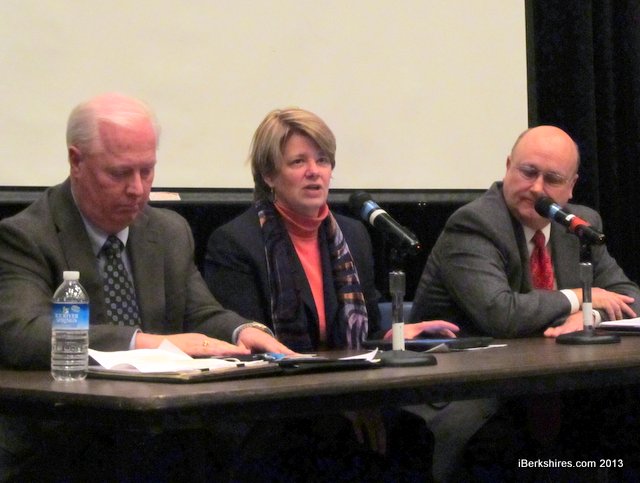
PITTSFIELD, Mass. — A proposed $100 million increase in state funding for the Berkshire Regional Transit Authority may not be such a boon.
BRTA Administrator Gary Shepard said on Monday that the increase doesn't include provisions to secure a reoccurring funding source and doesn't give the BRTA its own line item in the state budget.
While an increased focus on transportation funding is appreciated, it really only forward-funds the organization, a move that should have been done years ago, Shepard explained at a transportation forum on Monday at Berkshire Community College.
"The $100 million doesn't represent expansion, it represents forward funding. I can't look you in the eye and say I can do more with this. The $100 million just gets us up back to zero," Shepard said, explaining that the BRTA is retroactively funded each year.
Shepard wants the resources to expand services but this proposal is only one step toward it. Transportation funding is going to be a hot-button issue on Beacon Hill this upcoming session.
The Massachusetts Bay Transportation Authority is in need of help as it was two years ago, but in order to get the political support to save it, legislators are being asked to provide additional funding for the state's RTAs.
"The MBTA is a deep, dark hole of financial instability," said state Rep. Tricia Farley-Bouvier, D-Pittsfield. "People in the Berkshires shouldn't have to keep bailing out the T."
But Shepard said the conversation wouldn't be happening at all if the MBTA wasn't in trouble.
Farley-Bouvier has introduced a bill that would mandate more equity in public transportation funding, revamp the funding mechanisms and set goals for transportation, as well as making newer projects fit them.
"We are taking money set aside for capital costs and we are using that money to pay for operations," Farley-Bouvier said.
Further investment in public transportation in the "Gateway Cities" was identified as a key to the financial future for the entire state by MassInc, an independent research company.
"The places that have better public transportation have more people working," MassInc Executive Director Ben Forman said, and that's important to the economy statewide.
Forman said Gateway Cities need a "three-legged stool" to succeed: education for future workers, transformative redevelopment of historic buildings and transportation to get the workers to both school and work. Those are the keys to moving the Gateway Cities forward economically.
"It's the RTA piece that we think is overlooked," Forman said.
|
Ben Forman of MassINC. presented an array of reasons why public transportation is a huge boon for economic development. |
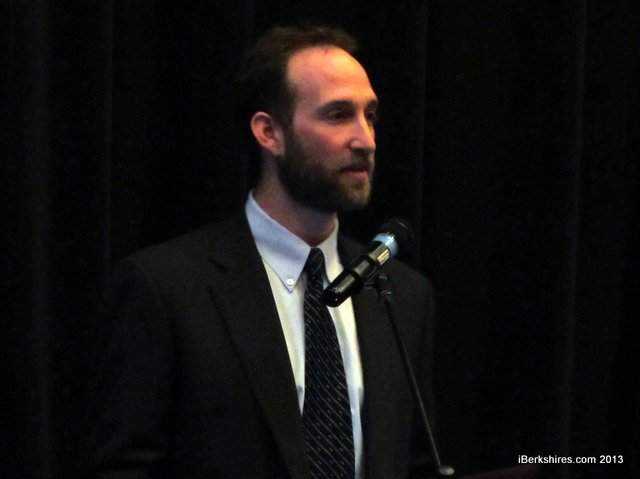
He used the proposed rail line from Pittsfield to New York City as a good addition to the transportation system but once the tourists get here, they'll be stuck in the county without adequate public transit. Plus, he said, public transportation makes it worthwhile for teens to work and buses can be part of the county's branding.
Chamber of Commerce President Michael Supranowicz said a survey conducted last year and found nearly every industry indicated increased public transportation would be a benefit.
"When the industry left, we turned into a service industry and we've got places open 24 hours now," Supranowicz said after recalling the days when stores would not be open on weekends or night.
Even the existing manufacturers said public transportation would help their business, Supranowicz said.
BCC President Ellen Kennedy said "you'd be amazed" at how many students rely on public transportation.
"People can't take classes at night if they rely on public transportation," Kennedy said, adding that if students wanted to, they wouldn't have even been able to attend the 4 p.m. forum if they relied on public transportation.
Both Kennedy and Supranowicz advocated for longer service hours, more routes and availability to more people.
In other transportation discussion, Mayor Daniel Bianchi advocated for a greater connection with upstate New York and more predictable Chapter 90 highway funds.
Tags: BRTA, public forum, transportation,