North Adams School Project Will Go to Ballot

By Tammy DanielsiBerkshires Staff
Print Story | Email Story

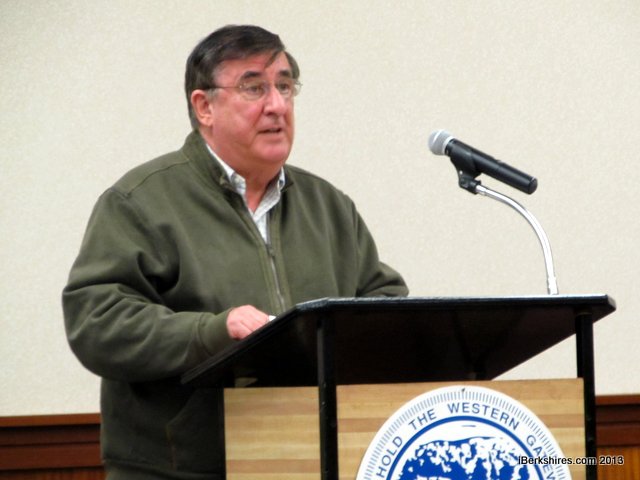
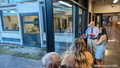
City Solicitor John DeRosa ran a red light getting to City Hall to help the council figure the voting process.

NORTH ADAMS, Mass. — The City Council tried to sidestep a vote Tuesday on rescinding authorization for bonding on the $30 million school project, leading to a hasty entrance by City Solicitor John DeRosa who'd been watching the deliberations on television.

In the end, the council did vote unanimously to uphold its decision on Conte — thus automatically sending the borrowing to a ballot vote — but not without some confusion getting there.

"We're in new territory here," said Council President Michael Bloom.

The reconsideration of the borrowing order, passed on Feb. 5, was forced by a citizens' petition filed two weeks ago with more than 1,300 verified signatures calling for the council to rescind the borrowing or send it to a ballot vote.

The city had gone through nearly three years of planning before settling on renovating the former middle school into an elementary school. The state School Building Authority approved the project in the fall with an 80 reimbursement, or about $23 million.

Bloom first called for a motion to adopt the order to rescind for discussion, but nobody wanted to touch it.

"Who'd like to make that motion ... anybody?" asked Bloom, waving the paper. He was greeted by silence.

Councilor John Barrett III wondered what the motion should be; Councilor Keith Bona then motioned to file, which was passed 6-2, with Bloom and Councilor Jennifer Breen voting no. Councilor Alan Marden was absent.

But then the question became whether they could set a date for an election on an order they hadn't actually voted on.

"We have to vote on rescinding it, up or down," said Councilor John Barrett III.

Bloom called a recess to call the city solicitor, who was already on his way to City Hall. He was in such a hurry, he was stopped by police for running a red light.

The solicitor's concern was that the council had filed the order rather than follow the process as required by the city charter.


"It is good to be conservative and do exactly what the statute says," DeRosa told the council. "If you want to start deviating from that I suppose you can, and we can make rulings along the way but I think that's really not the prudent approach."

DeRosa explained that the borrowing order had been stayed as soon as the petition had been certified. The council now had to vote to yes to rescind the borrowing, bring the entire process to an end, or vote no, sending it to a ballot vote.

Breen was unhappy that someone "can force us to put on the floor something we don't want to do." Bona asked if "by filing it, doesn't that basically say we're not in favor?"

"You all are free to vote one way or the other," DeRosa said. "Statutorily, to move it forward, you have to reconsider it.

"I think it is your duty reconsider it."

Bona at Bloom's request withdrew his motion to file and the council unanimously voted no on the order. Based on DeRosa's opinion, the council voted to hold the election on April 30, the same date of the U.S. Senate primary, saving the city some $6,000. The Conte question will be on a separate ballot.

Breen said she wanted to make clear to those who hadn't see the petition that its language was deceiving by listing the entire $29,692,594 for the project but not that the city's portion was $6.5 million.  

"I think we made a sound decision and I think it was vetted and I don't think we should throw $23 million away," she said.

Councilor Nancy Bullett said so much information on the project had been made available, the petition "just doesn't make sense to me. ... Please get more information before you go to the polls to vote."

The fact that some 1,400 people had signed the petition "showed that not all their questions had been answered," said Barrett, who had voted against borrowing for the project.


Tags: Conte School,   school project,   
If you would like to contribute information on this article, contact us at info@iberkshires.com.

Why the Massachusetts Art Community Is Worth Continued Investment

By James BirgeGuest Column
How do we quantify the value of art on society and culture? Even eye-popping figures, like the $100 million estimate for the jewels stolen from the Louvre, or the record auction last fall that saw a piece by Gustav Klimt sell for more than $236 million can't fully account for the value of the history, stories, and emotions behind the creations themselves. But beyond that, there is a measurable financial, cultural and social benefit of the arts that is often taken for granted. 

Closer to home, arts and cultural production in the Commonwealth of Massachusetts totals nearly $30 billion annually, representing more than 4 percent of the state's economic output, according to the Mass Cultural Council. All told, more than 130,000 jobs are spread across the commonwealth creating a vibrant and thriving artistic community for us all to enjoy. 

Despite the obvious impact, these figures are under threat. A recent survey by MassCreative compiled recent federal cuts to the National Endowment for the Arts, the National Endowment for the Humanities and the Institute of Museum and Library Services and identified 63 grants canceled and $4.2 million in grant funding rescinded across New England so far this year. 

The dollars, of course, are important. But they also only scratch the surface on what they bring to the community. Today, we risk losing part of the culture and identity many now take for granted. 

While others choose to look past these less tangible, but just as vital benefits, we're doing the opposite. Massachusetts College of Liberal Arts is all in to ensure the next generation retains their access to works of art, while also being empowered to create themselves. 

Last fall, MCLA officially broke ground on the new Campagna Kleefeld Center for Creativity in the Arts, which will serve as a new hub for the campus and the local community for arts programming. When complete in fall of 2027, our students will benefit, but so will all of Berkshire County and artists in the surrounding area. 

This exciting new facility is just one of the many forthcomings our region can enjoy in the coming years. Just a few miles away, anticipation builds for the Fall 2027 anticipated opening for the Williams College Museum of Art. Years in the making, the museum likewise grows from an enduring commitment to the arts, both in curriculum and in practice. Exciting times are also underway for the Clark Art Institute with the construction of a new facility to house a collection of 331 works of art, including paintings, sculptures, drawings and other works. Their wing is scheduled for completion in 2028. And listeners will no doubt enjoy the sounds and melodies from Mass MoCA Records, the latest endeavor to foster creativity and artistic pursuits through music launched in October as well. Of course, many are also awaiting the reopening of the Berkshire Museum anticipated this summer, after a tremendous renovation process to rejuvenate the experience for visitors. 

So much time, energy, and yes, dollars, have already been invested in taking these facilities from ideas and sketches and making them reality. But they represent much more than new buildings. They represent new opportunities to cultivate and accelerate the thriving arts community in Massachusetts and the northern Berkshires. 

Art, regardless of the medium, is a reflection of who we are, where we've been, and what we aspire to be. It can be inspired by hopes or fears and chronicle collective triumphs as well as tribulations. The goal of art is not only to document history, but to inspire those positioned to change it and to feel something new or even to provoke us to revisit our own assumptions or misconceptions. 

As unfathomable of a number as $30 billion can seem, boiling down the impact to any number inherently discounts the unknowable downstream effects our graduates will bring to the community and the broader world after they leave our institutions. Likewise, rescinding $4.2 million now removes a huge chunk of that growth potential.  

Justification for making these investments today when simply boiled down to dollars and cents still places us on solid ground strictly from a financial perspective that forgoes all of the intangible, but no less valuable, benefits as well.  

The arts are still worth our support. And our community will be richer for it. 

James Birge, PhD, is president of Massachusetts College of Liberal Arts in North Adams.  


View Full Story

More North Adams Stories