image description
image description
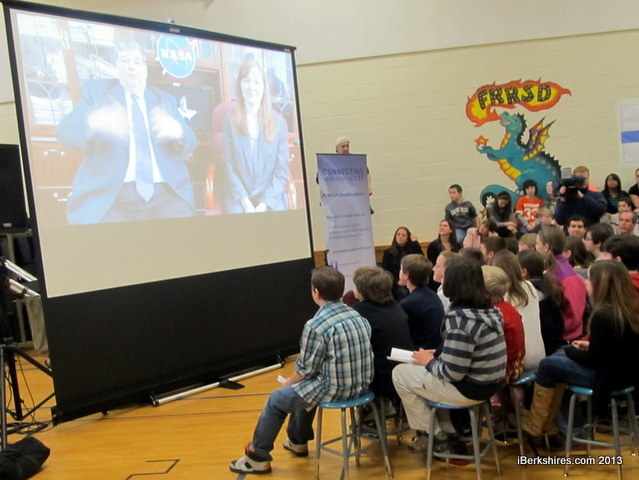
Students used Skype to connect with NASA's Goddard Space Center and other students from Colombia.
image description
image description

Governor Patrick Lights Up Fiber-Optic Network In Otis

By Andy McKeeveriBerkshires Staff
Print Story | Email Story

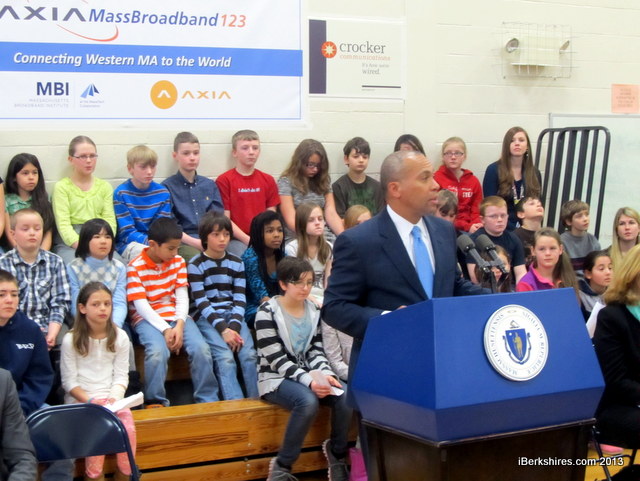
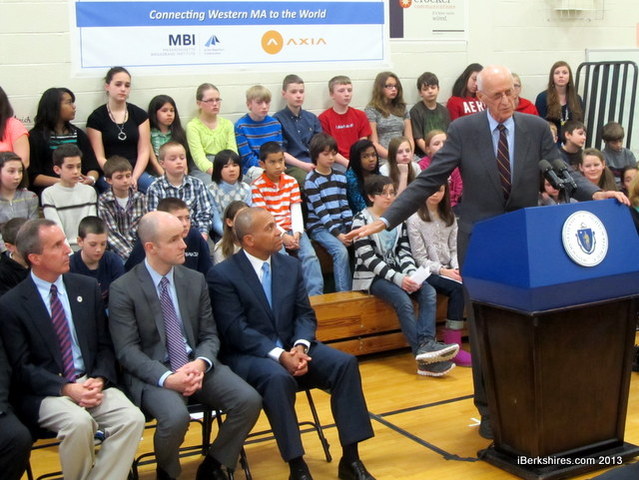
Gov. Deval Patrick celebrated the 'lighting up' of fiber optics in Otis on Thursday.

OTIS, Mass. — If a teacher pulled up a YouTube video for students at Farmington River Elementary School, every classroom's DSL connection bogged down. But now, the buffering, buffering, buffering is gone. 

The MassBroadband Institute has been installing fiber-optic cable across the state — connecting rural towns to high-speed Internet. The "middle mile" is 75 percent complete and the first section was lit up on Thursday at Farmington, one of 1,200 "anchor" sites in Western Massachusetts.
 
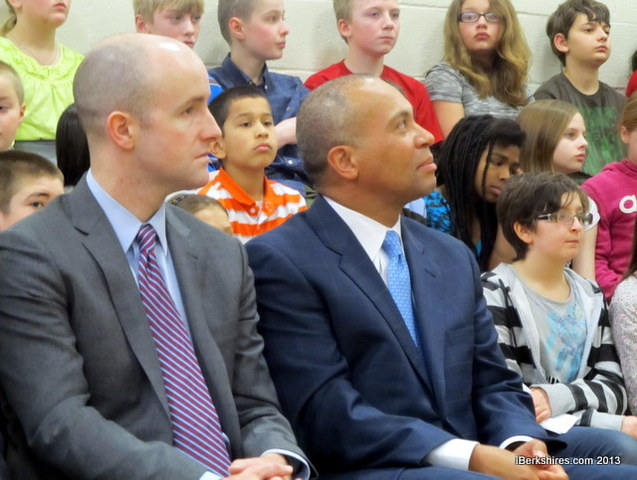
Gov. Deval Patrick and a host of elected officials crowded the school to celebrate the "lighting up" and the beginning of a network running across the state.
 
The final connections are expected to made by this summer.
 
The capabilities of the system was shown off by a Skype demonstration in which fifth-graders chatted with NASA and another class in Colombia.
 
"High-speed broadband is as necessary in this 21st century, global economy as roads and bridges. It is an educational necessity, a medical necessity, a public safety necessity, a commercial necessity and frankly a competitive necessity," Patrick said. "We can no more afford to have a community without access to broadband than we can afford to have a community without access to a good school or a safe road."
 
The state put aside $40 million in bonds in 2008 to start connecting Western Mass. to broadband and created MBI. In 2010, the federal government earmarked $45.3 million more in stimulus funds to continue the process. 
 
The first task was the "middle mile," or backbone of the network, which was laid across the region and connecting anchors such as schools and municipal buildings. MBI worked with utility companies to have access to 33,000 poles to lay the wire that will connect the 1,200 facilities in the western part of the state, said MBI Director Judy Dumont.
 
The process took a long time and included many partners. Former U.S. Rep. John Olver recapped the history to Berkshire Connect in 2006. It was in 2007 when Patrick stepped in and committed to making the investment, he said.
 
"We worked together to do big things. We aren't done with it, we've got more work to do and with the people in this room we are going to get it done," state Sen. Benjamin Downing said, adding that when it is done, all children will have the same access to information.
 

Related Stories

$25 Million Broadband Access Initiative Announced

Broadband Bill Becomes Law

Broadband Project Will Bring Connections, Jobs

Governor Promises Broadband to All Towns by 2013

Western Mass. Broadband Initiative Gets $72M Boost

Berkshires Fiber Network Means Growth, Innovation

The government had to step in because the private sector wouldn't bring the connections out there, said U.S. Rep. Richard Neal, but globalization "isn't going to retreat." Students need that access in order to be able to compete for jobs in the future, he said.
 
"This is a long-term investment. The private sector examined this from A to Z. If they could have done it with a reasonable margin of profit, they would have done it. They came to the conclusion that they couldn't do it. So the government filled the void," Neal said.
 
Before now, teachers would have to coordinate Internet usage because the entire school had a download speed of 2 MB per minute, school Technical Director Laurie Flower said. If two teachers were trying to show a video at once, the entire system would slow down.
 
The next step is to bring the wiring to individual homes. Patrick has submitted another bond bill for about $40 million to bring the fiber optics from the middle mile to homes. But in that process, private companies will take a larger role.
 
"Private companies take a bigger share of the last mile," Patrick said. "This middle mile brings that cost down so it makes it more attractive for private companies to come in."
 
Dumont expects that it would take at least three more years from when the funding is approved before that aspect is completed.
 
"We are not planning on doing the last mile on our own. We plan on bringing in the private sector," she said.

Tags: broadband,   Internet,   
If you would like to contribute information on this article, contact us at info@iberkshires.com.

Berkshire Towns Can Tap State Seasonal Communities Resources

BOSTON — Governor Maura Healey announced that 18 additional municipalities across Massachusetts have been designated as Seasonal Communities, opening up new tools, support and grant funding to help them manage seasonal housing pressures. 
 
Created as part of the historic Affordable Homes Act signed into law by Governor Healey in 2024, the Seasonal Communities designation was designed to recognize Massachusetts communities that experience substantial variation in seasonal employment and to create distinctive tools to address their unique housing needs. The law also established the Seasonal Communities Advisory Council (SCAC).  
 
The Affordable Homes Act identified several communities to automatically receive the designation, including:   
  • All municipalities in the counties of Dukes and Nantucket;   
  • All municipalities with over 35 percent seasonal housing units in Barnstable County; and   
  • All municipalities with more than 40 percent seasonal housing units in Berkshire County. 
  •  
To identify additional communities, the Executive Office of Housing and Livable Communities (HLC) reviewed available data, specifically focusing on cities and towns with high levels of short-term rentals and a high share of second- or vacation homes.
 
In Berkshire County, Egremont, Great Barrington, Lee, Lenox, New Marlborough, Richmond, Sandisfield, Sheffield, West Stockbridge and Williamstown have been designated. 
 
"Our seasonal communities are a vital part of Massachusetts' cultural and economic fabric, but they're also home to essential workers, families, seniors, and longtime residents who deserve a place to live year-round," said Governor Healey. "That's why we're committed to supporting these communities with innovative solutions like the Seasonal Communities designation to meet their unique needs, and I'm thrilled that we're offering this opportunity to 18 additional communities across the state. Everyone who calls these places home should be able to live, work and grow here, no matter the season." 
 
As with the statutorily identified communities, acceptance of the designation for municipalities is voluntary and requires a local legislative vote. HLC will open an application for newly eligible communities that haven't accepted the Seasonal Communities designation to request consideration. 
 
The Affordable Homes Act created several new tools for communities who accept the Seasonal Communities designation to be able to:  
  • Acquire deed restrictions to create or preserve year-round housing 
  • Develop housing with a preference for municipal workers, so that our public safety personnel, teachers, public works and town hall workers have a place to live 
  • Establish a Year-Round Housing Trust Fund to create and preserve affordable and attainable housing for year-round residents 
  • Create year-round housing for artists 
  • Allow seasonal communities to develop a comprehensive housing needs assessment 
  • Permit tiny homes to be built and used as year-round housing 
  • Permit year-round, attainable residential development on undersized lots 
  • Increase the property tax exemption for homes that are the owners' primary residence 
 
View Full Story

More Otis Stories