PERC Releases Advanced Manufacturing Study
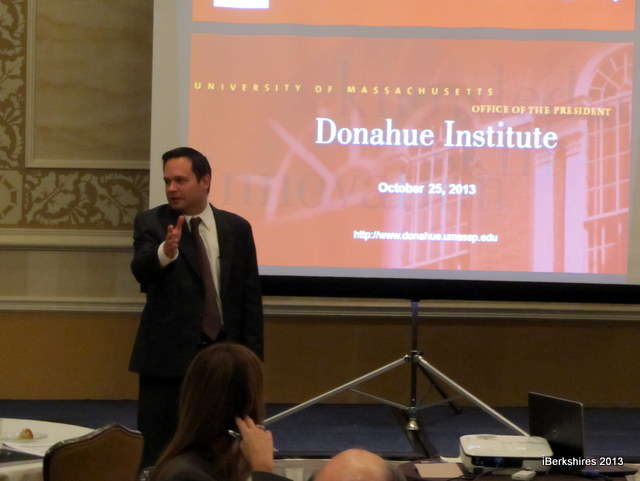 Daniel Hodge of the Donahue Institute presented the findings at a breakfast Friday at the Crowne Plaza. Daniel Hodge of the Donahue Institute presented the findings at a breakfast Friday at the Crowne Plaza. |
That paints a picture of manufacturing getting smaller and smarter with mass production being replaced by precision.
That was the conclusion of the Pittsfield Economic Revitalization Corp.'s study on advanced manufacturing in the Berkshires. Released Friday, the final assessment confirmed that educational, business and governmental leaders are on the right track toward building a future in a manufacturing economy.
But, it also confirmed that there is still a lot more to do.
"We didn't expect anything earth shattering with this report," PERC President Jay Anderson said. "While there have been different studies in the past, there was nothing that focused on advanced manufacturing."
The report identifies five main focuses civic leaders in the county should take to grow the amount of small and medium-sized manufacturing businesses: prioritize workforce training, complete and implement a plan for the William Stanley Business Park, expand the life science industry with the $6.5 million earmark from Massachusetts Life Sciences, improve connections to state-level initiatives and be proactive on infrastructure such as buildings and sites, telecommunications and water and sewer systems, and in offering tax incentives.
According to Daniel Hodge, director of economic and public policy research at the University of Massachusetts Donahue Institute, the manufacturing jobs in the county that survived the closing of General Electric were ones that focused on "niche" markets. Manufacturing is producing as much into the economy but at a different scale, he said.
"Manufacturing today is not your father's or your grandfather's shop anymore," Hodge said, adding that in the Berkshires today, manufacturing is the second highest contributor to wages. Statewide, manufacturing still represents 10 percent of all jobs and one of the top contributors to the state's gross domestic product.
In the Berkshires, there are 175 manufacturing outfits that can serve as the base for future growth, he said.
"There is a very diverse set of industry sectors in the Berkshires," Hodge said. "There are a lot of companies staying competitive and vital."
But, with an aging population, the goal is to train the younger generation for the highly skilled jobs. There will be an estimated 100,000 manufacturing jobs in the next 10 years statewide that will need to be filled, he said, and the educational system needs to create a pipeline into those jobs.
"We have to train people better and it starts with our school system," Anderson said.
William Mulholland, vice president for community education and workforce training at Berkshire Community College, said county leaders have been very proactive in making sure institutions can provide the proper education. Now, it is a matter of exposing young adults to manufacturing careers and showing that there is a future in it, he said.
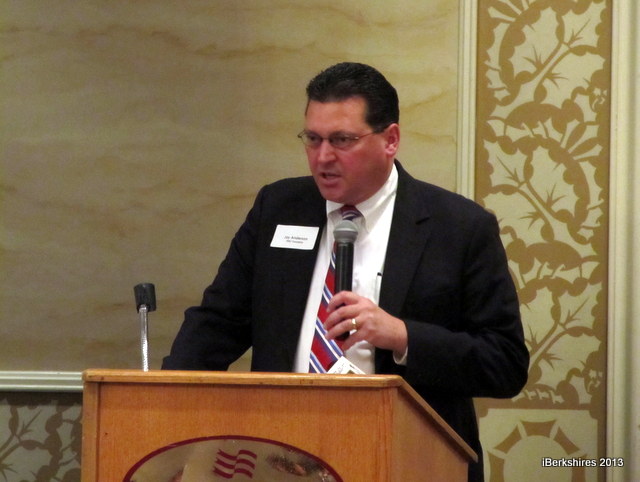 Jay Anderson, president of PERC, said the study was commissioned to focus specifically on advanced manufacturing. Jay Anderson, president of PERC, said the study was commissioned to focus specifically on advanced manufacturing. |
Meanwhile, state Rep. Tricia Farley-Bouvier, D-Pittsfield, said the design stages of a new Taconic High School is upcoming and she urged companies and economic development leaders to join in that process. She said it was critical that the economic and industry groups are part of that process.
As for infrastructure, Hodge said there is a perception that the county does not have any usable properties outside of the William Stanley Business Park. But, he continued, there are plenty all over the county and towns need to leverage grant money to market and to reduce the cost a business would need to relocate.
The county has very high energy costs, Hodge said, and county officials should find ways to reduce the cost of doing business.
Missing from the report was the transportation system, often cited as an impediment to attracting business to the Berkshires. Hodge said that in his interviews with manufacturers, access to highways was not presented as a challenge nor a benefit.
The report also says any connection with GlobalFoundries in Malta, N.Y., would be modest despite the proximity. Economic development leaders had hoped the chipmaker's massive investment across the border would spark tech startups here.
County officials say they have already begun to implement initiatives of job training and redevelopment of properties. This report builds on the steps already taken with a focus on advanced manufacturing.
"A lot of the pieces are starting to fall into place," Mayor Daniel Bianchi said. "It is just a matter of all of the organizations working together."
Anderson said the report will be given to economic agencies and municipalities and he hopes that it will get everyone "speaking the same language." The report sets the foundational understanding of the industry so those involved can take the next steps, he said.
Tags: economic report, economy, manufacturing, PERC, technology, workforce training,