Pittsfield Weighing Future School Project Options
|
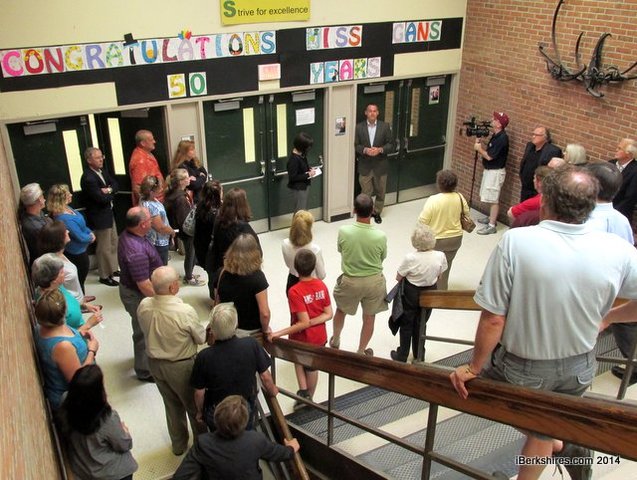
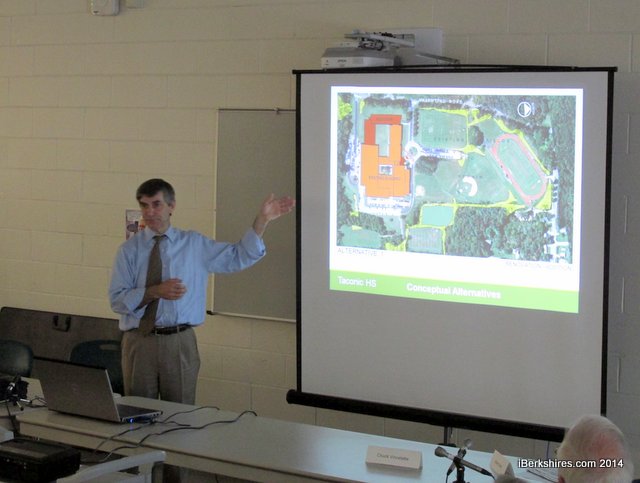
Carl Franceschi of DRA Architects outlined the three options to a crowd numbering more than 60. |
That is the message architects took away from the first of two public meetings regarding the school's future.
Drumney Rosane & Anderson Architects Inc. is nearing the end of a feasibility study and the city will soon need to make a decision on the next step — to renovate, to build new or to do a mix of both.
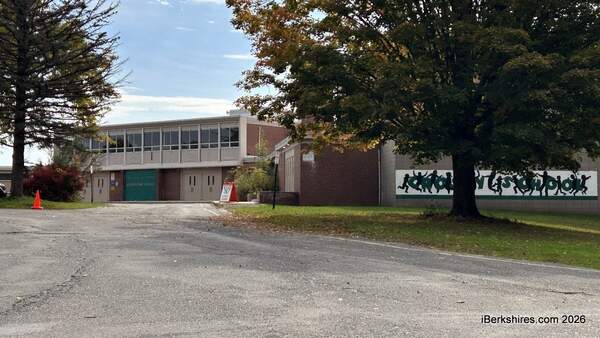
"It is not just the lowest price should win," said Carl Franceschi of DRA on Monday, when more than 60 residents toured Taconic and then discussed the options.
While construction costs have been estimated in the $60 million range for renovation and addition, $80 million range for partial demolition and addition, and the $85 million range to build a new school, there are many other factors that will need to be looked at, Franceschi said.
The city will receive 78 percent (which could later be bumped to 80 percent) of eligible construction costs incurred. But, not every aspect of the project will be eligible for reimbursement from the Massachusetts School Building Authority.
For example, a renovation project could call for the moving of students into temporary classrooms elsewhere on the property, which will be entirely the city's cost.
"They won't reimburse temporary costs, the moving and storage," Franceschi said.
Another example would be storage of the equipment in vocational labs; again, storage costs would fall on the city side. Asbestos abatement is another unreimbursed cost.
"Decisions haven't been made yet. It is an opportune time for input," Fransceschi said.
One of the major topics among those in attendance was how to continue educating the students during the project. A new build would displace the students for the least amount of time, the architects said, but there are ways to move the students into different wings during a renovation.
"We want to be very aware of the disruptions," Fransceschi said.
Another issue residents raised was the athletic areas. DRA Architect Scot Woodin led one of the multiple breakout groups discussing the project. Faced with the concerns of the playing fields, Woodin said that renovating the fields would not be reimbursed by the state.
|
Residents broke into small groups to discuss the project. |
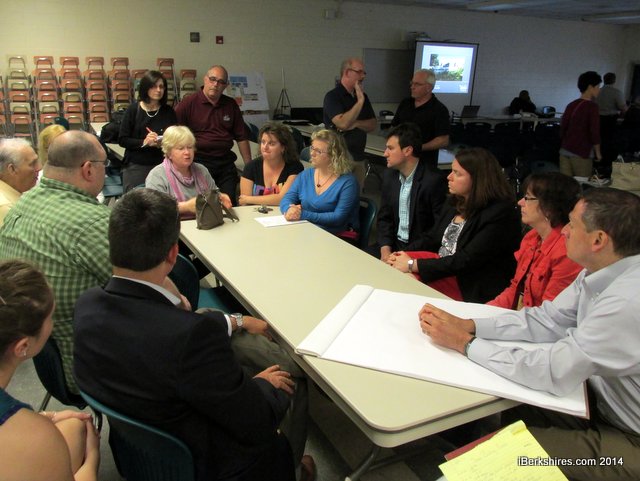
DRA Architect Vladimir Lyubetsky said residents in his group worried about ongoing maintenance costs that come with each option and that the building needs to be designed with a 21st century education in mind.
The city does still have the option of just doing repairs to the 44-year-old building. The architects say that would cost between $25 million and $45 million.
Woodin led the residents around the school before the meeting to show the condition. In a metal lab, Woodin said the equipment has been well-maintained but the infrastructure needs repair.
"All of the systems are at the end of their life cycle," Woodin said.
In the gym, the floor and ventilation system needs to be replaced, he said. The classrooms are dated. The ventilation system is too noisy. The science labs are too small. The windows have little insulation and the walls have none. The auditorium needs upgrades for handicapped accessibility, he said.
"The roof has been a struggle," Woodin said of constantly leaking pipes.
The architects will ultimately make a recommendation to the School Building Needs Commission at the end of July. That choice will then be submitted to the MSBA for approval. Construction of any kind is not expected until the spring of 2016.
The next public meeting to weigh in before the application submittal will be on July 21, when Fransceschi said "we'll be very close to a decision."
Monday's meeting attracted about 60 people, which Superintendent Jason McCandless said he was glad to see.