AutoZone Eyes Former Allendale Pizza Hut Location
By Andy McKeeveriBerkshires Staff
Print Story | Email Story
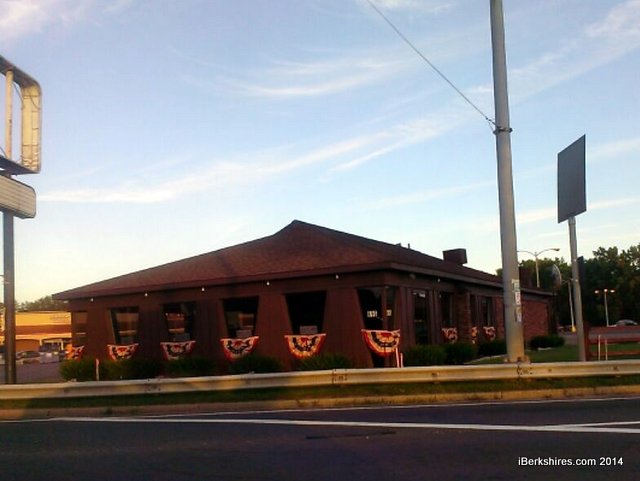
AutoZone hopes to tear down the former Pizza Hut and build a new store.
PITTSFIELD, Mass. — The Pizza Hut next to Kelly's Diner is set to be demolished and replaced with an AutoZone.
 
The automotive parts retailer received an exemption from parking requirements from the Community Development Board and is now looking to raze the vacant building in Allendale and replace it with a new store. 
 
According to Nathan Kirschner, from Langan Engineering, the company has spent the last month or so working with the property owner and abuttor in developing a plan they could all agree on.
 
On Tuesday, Mike Panek, president of Phoenix Realty that owns the plaza behind the property, and property owner Dan Kelly appeared before the board in support of the new store.
 
"It is exciting to see AutoZone come in here," Kelly said. "I feel like that is the last piece to the puzzle for that corner."
 
Kirschner said the company changed the hue of the colors to more earthy tones, increased the landscaping and reached agreements for access with Panek and then parking with Kelly.
 
"Kelly's Diner currently isn't open when Auto Zone hits its peak times," Kirschner said. "While there are 49 parking spaces on site, there is the opportunity to share parking spaces with the diner."
 
According to city zoning, the company would have needed 50 spots for the store and the layout calls for 22 spaces for the auto part's store and 27 spaces for the diner.
 
Kirschner said the plan also calls for three new trees and 105 additional plantings. The guardrails will be replaced with new curbing.
 
For Panek, the additional landscaping the company added to the plan in the last month alleviated his concerns. The company asked and received a continuance last month from the Community Development Board after Panek expressed concern. Panek had just recently finished a massive renovation to the plaza that includes HomeGoods, PetCo and T.J. Maxx.
 
"I was concerned with it as well. With four national tenants looking at this out of their front door, I was concerned with it," Panek said.
 
And ultimately, "this is actually an enhanced version of what we normally get," Panek said comparing the new plan to others he has seen.
 
Despite the improvements, Community Development Board member Floriana Fitzgerald asked if there was more the company could do to make the building's appearance unique instead of looking "like a rectangular box."
 
While the plan may seem to be supported, there could be an issue facing utilities. Kirschner said bringing utilities to the site could require work on Dalton Avenue, tying up traffic. He said the company is now doing "some more exploratory work" to see if it can be avoided.
 
In other business, D'Amours Big Y was given approval for a special permit for a gas station on the parcel in the rear of the West Street grocery store. James Scalise of SK Design outlined the plan — again — explaining that it conforms with the zoning.
 
The company needs the special permit because the West Street location falls into an Arts Overlay zone, which was implemented to help guide development of the downtown. 
 
Scalise said the store's plan achieves many of those goals and is actually better than what master plan has called for.

Tags: new business,   automotive,   demolition,   plaza,   
If you would like to contribute information on this article, contact us at info@iberkshires.com.

Berkshire Towns Can Tap State Seasonal Communities Resources

BOSTON — Governor Maura Healey announced that 18 additional municipalities across Massachusetts have been designated as Seasonal Communities, opening up new tools, support and grant funding to help them manage seasonal housing pressures. 
 
Created as part of the historic Affordable Homes Act signed into law by Governor Healey in 2024, the Seasonal Communities designation was designed to recognize Massachusetts communities that experience substantial variation in seasonal employment and to create distinctive tools to address their unique housing needs. The law also established the Seasonal Communities Advisory Council (SCAC).  
 
The Affordable Homes Act identified several communities to automatically receive the designation, including:   
  • All municipalities in the counties of Dukes and Nantucket;   
  • All municipalities with over 35 percent seasonal housing units in Barnstable County; and   
  • All municipalities with more than 40 percent seasonal housing units in Berkshire County. 
  •  
To identify additional communities, the Executive Office of Housing and Livable Communities (HLC) reviewed available data, specifically focusing on cities and towns with high levels of short-term rentals and a high share of second- or vacation homes.
 
In Berkshire County, Egremont, Great Barrington, Lee, Lenox, New Marlborough, Richmond, Sandisfield, Sheffield, West Stockbridge and Williamstown have been designated. 
 
"Our seasonal communities are a vital part of Massachusetts' cultural and economic fabric, but they're also home to essential workers, families, seniors, and longtime residents who deserve a place to live year-round," said Governor Healey. "That's why we're committed to supporting these communities with innovative solutions like the Seasonal Communities designation to meet their unique needs, and I'm thrilled that we're offering this opportunity to 18 additional communities across the state. Everyone who calls these places home should be able to live, work and grow here, no matter the season." 
 
As with the statutorily identified communities, acceptance of the designation for municipalities is voluntary and requires a local legislative vote. HLC will open an application for newly eligible communities that haven't accepted the Seasonal Communities designation to request consideration. 
 
The Affordable Homes Act created several new tools for communities who accept the Seasonal Communities designation to be able to:  
  • Acquire deed restrictions to create or preserve year-round housing 
  • Develop housing with a preference for municipal workers, so that our public safety personnel, teachers, public works and town hall workers have a place to live 
  • Establish a Year-Round Housing Trust Fund to create and preserve affordable and attainable housing for year-round residents 
  • Create year-round housing for artists 
  • Allow seasonal communities to develop a comprehensive housing needs assessment 
  • Permit tiny homes to be built and used as year-round housing 
  • Permit year-round, attainable residential development on undersized lots 
  • Increase the property tax exemption for homes that are the owners' primary residence 
 
View Full Story

More Pittsfield Stories