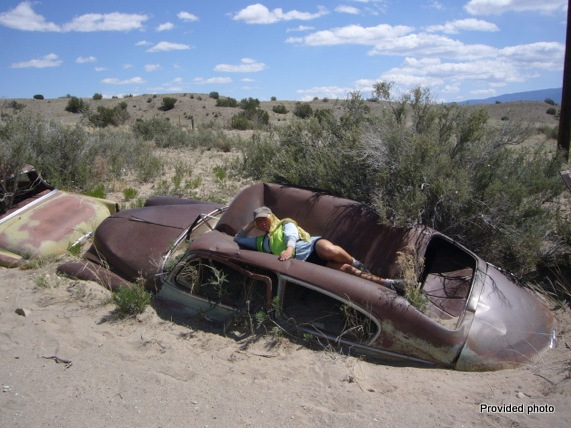
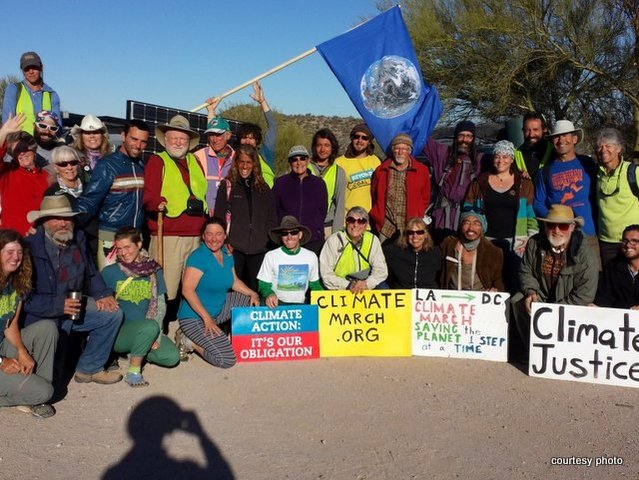
A group trying to bring awareness to climate change has been walking across the country, including Berkshire residents Shira Wohlberg and Tony Pisano.
WILLIAMSTOWN, Mass. — Shira Wohlberg cannot understand people who do not think drastic action is needed to save the environment.
And she does not have time to try.
"In our training at the beginning of the [Great March for Climate Action] ... they told us, don't waste your time with deniers," Wolberg said. "They're not worth your energy."
"Deniers," those who refuse to acknowledge the mounting evidence of global climate change, are not the target audience of the Great March, which Wohlberg and friend Tony Pisano joined earlier this summer.
But marchers are hoping to energize those who can be reached to build a grassroots effort to stem the tide of human activity that activists believe is contributing to everything from more frequent, severe tropical storms to drought in the American West to the melting of the polar ice cap.
They're big problems without easy solutions, but the marchers hope their trek across the contiguous United States will help build awareness of the need for big solutions.
Wohlberg joined the march at its inception in the Port of Los Angeles in March and made it as far as the border between Colorado and New Mexico before she had to return to Williamstown for work.
This month, she rejoined the march in Chicago and is joining the group as it takes a bus trip to New York City for this weekend's People's Climate March.
Wohlberg said she does not know what concrete changes will result from either the Great March or the People's March (which are not formally connected but obviously related to one another).
Another lesson learned in her orientation for the Great March: focusing on specific goals or expectations for the movement is counterproductive.
"We had a lot of activists come, and they say, 'People are going to want you to say, "This is the exact outcome and we'll fail or we won't fail," ' " she said. "And if people actually started paying attention to you, they want to say that you failed.
"Your job is to stick with what you believe in and do everything you can so you never get to that point where you say, 'I did nothing.' And you never know who you influence and who you interact with and what the ripple effects are."
Besides walking through the American Southwest this spring, Wohlberg puts her convictions into action on a daily basis, avoiding disposable packaging, seeing how little garbage she can generate on a month-to-month basis and collecting apples from roadside trees that otherwise would go to waste.
"If I see someone throw something away, I say, 'Well, part of this is made of metal,' " Pisano said. "Like a microwave oven, someone might throw it in a landfill, and you can take the oven apart and scrap the metal parts. You can recycle the plastic. Anything that has a plug on it, I'll at least cut the wire off and strip it. You spend all this energy taking copper out of the ground, and once you throw it in a landfill, it's never going to be recovered again."
Wohlberg and Pisano say it is frustrating living in a society where people wall themselves off from the natural world, closing the windows and turning on the air-conditioner when the temperature climbs out of the 70s or lighting up their homes like a Christmas tree at the first sign of dusk.
"There are so many things we can do [to conserve]," Wohlberg said. "That's the part that's so incredibly frustrating and disturbing. It's not impossible. We totally have the ability to do what we need to do and to love doing it.
"It's an adventure. I set little challenges for myself, and it's fun. I try to see how little electricity I can use. I walk around my house in the dark and train my feet to know where everything is and my hands to know where everything is."
Earlier this year, when Wohlberg's feet were trodding the highways and byways of the Southwest, she saw first hand the damage man is doing to the environment and the efforts of some people to right those wrongs.
"We walked along the Colorado River, the aqueduct, and you can see that the entire environment is 'desertified,' " she said. "It was probably desert to some extent anyway, but now what water there is is in this very confined space. It's fenced off, so animals can't get to it unless they're a lizard or a bird.
"And the water is going to the cities, where you know people are running the tap and washing their cars and in Arizona they're watering the golf courses. And here you see this environment that's supposed to receive the water, and it's all parched and dry and there are dust storms. And that's where the water is supposed to go."
Wohlberg was to some degree encouraged by the opportunity to see those sights with like-minded environmentalists and to to tell people working in isolation along the march's route that they are not alone.
"It feels like if you're paying attention — if you're not just listening to the mainstream media saying everything's impossible and you're ridiculous and stupid — if you're actually paying attention, there are so many different kinds of people and groups out there who know that something needs to be done," she said. "And they're not mutually exclusive. They all need to be done.
"It's this feeling like there's a cresting wave almost that needs enough momentum to get over that hill or enough accumulated energy and bodies and voices that we're going to break through. I feel like it's happening.
"But that's because I'm tuned in to that kind of thing."
If you would like to contribute information on this article, contact us at info@iberkshires.com.
Your Comments
iBerkshires.com welcomes critical, respectful dialogue. Name-calling, personal attacks, libel, slander or foul language is not allowed. All comments are reviewed before posting and will be deleted or edited as necessary.
No Comments
Puppets Teach Resilience at Lanesborough Elementary School
By Breanna SteeleiBerkshires Staff
The kids learned from puppets Ollie and a hermit crab.
LANESBOROUGH, Mass. — Vermont Family Network's Puppets in Education visited the elementary school recently to teach kids about being resilient.
Puppets in Education has been engaging with young students with interactive puppets for 45 years.
Classes filtered through the music class Thursday to learn about how to be resilient and kind, deal with change and anxiety, and more.
"This program is this beautiful blending of other programs we have, which is our anxiety program, our bullying prevention and friendship program, but is teaching children the power of yet and how to be able to feel empowered and strong when times are challenging and tough," said program manager Sarah Vogelsang-Card.
The kids got to engage with a "bounce back" song, move around, and listen to a hermit crab deal with the change of needing a new shell.
"A crab that is too small or too big for its shell, so trying to problem solve, having a plan A, B and C, because it's a really tough time," Vogelsang-Card said. "It's like moving, it's like divorce of parents, it's changing schools. It's things that children would be going through, even on a day to day basis, that are just things they need to be resilient, that they feel strong and they feel empowered to be able to make these choices for themselves."
The resiliency program is new and formatted little differently to each of the age groups.
"For the older kids. We age it up a bit, so we talk about harassment and bullying and even setting the scene with the beach is a little bit different kind of language, something that they feel like they can buy into," she said. "For the younger kids, it's a little bit more playful, and we don't touch about harassment. We just talk about making friends and being kind. So that's where we're learning as we're growing this program, is to find the different kinds of messaging that's appropriate for each development level."
This programming affirms themes that are already being discussed in the elementary school, said school psychologist Christy Viall. She thinks this is a fun way for the children to continue learning.
"We have programs here at the school called community building, and that's really good. So they go through all of these strategies already," she said. "But having that repetition is really important, and finding it in a different way, like the puppets coming in and sharing it with them is a fun way that they can really connect to, I think, and it might, get in a little more deeply for them.
Vogelsang-Card said its another space for them to be safe and discuss what's going on in their life. Some children are afraid because maybe their parents are getting divorced, or they're being bullied, but with the puppets, they might open up and disclose what's bothering them because they feel safe, even in a larger crowd.
"When we do sexual abuse awareness that program alone, over five years, we had 87 disclosures of abuse that were followed up and reported," she said. "And children feel safe with the puppets. It makes them feel valued, heard, and we hope that in our short time that we're together, that they at least leave knowing that they're not alone."
Bedard Brothers also gave the school five new puppets to use. Viall said the puppets are a great help for the students in her classroom, especially in the younger grades.
"Every year, I've been giving the puppets to the students. And I also have a few of the puppets in my classroom, and the students use them in small groups to practice out the strategies with each other, which is really helpful," she said. "Sometimes the older students, like sixth graders, will put on a puppet show. They'll come up with a whole theme and a whole little situation, and they'll act it out with the strategies for the younger students. It's really cute, they've done it with kindergarteners, and the kids really like it."
Vogelsang-Card said there are 130 schools in Vermont that are on the waiting list for them to come in. Lanesborough Elementary has been the only Massachusetts school they have visited, thanks to Bedard Brothers.
"These programs are so critical and life-changing for children in such a short amount of time, and we are the only program in the United States that does what we do, which is create this content in this enjoyable, fun, engaging way with oftentimes difficult subjects," she said. "Vermont is our home base, but we would love to be able to bring this to more schools, and we can't do this without the support of community, business funders or donors, and it really makes a difference for children."
The fourth-grade students were the first class to engage with the puppets and a lot of them really connected with the show.
"I learned to never give-up and if you have to move houses, be nervous, but it still helps," said William Larios.
"I learned to always add the word 'yet' at the end," said Sierra Kellogg, because even if she can't do something now, she will be able to at some point.
Samuel Casucci was struck by what one of the puppets talked about. "He said some people make fun of him if he dresses different, come from different place, brings home lunch, it doesn't matter," Samuel continued. "We're all kind of the same. We're all kind of different, like we have different hairstyles, different clothes. We're all the same because we're all human."
"I learned how to be more positive about myself and like, say, I can't do this yet, it's positive and helpful," said Liam Flaherty.
The students got to take home stickers at the end of the day with contact information of the organization.
Students got to showcase their art at the Clark Art Institute depicting their relationship with the Earth in the time of climate change. click for more
The 100th annual meeting will be held on March 10, 2027, the Community Chest's birthday (there will be cake, he promised) and a gala will be held at the Clark Art Institute on Sept. 25, 2027.
click for more