Mass MoCA Marks $25.4M State Funding, Names Artist Partners
 Gov. Deval Patrick announced $25.4 million in state money to help expand the Massachusetts Museum of Contemporary Art. Gov. Deval Patrick announced $25.4 million in state money to help expand the Massachusetts Museum of Contemporary Art. |
NORTH ADAMS, Mass. — Strategic planning for the "confluence campaign" at Massachusetts Museum of Contemporary Art began on a Saturday during a January blizzard.
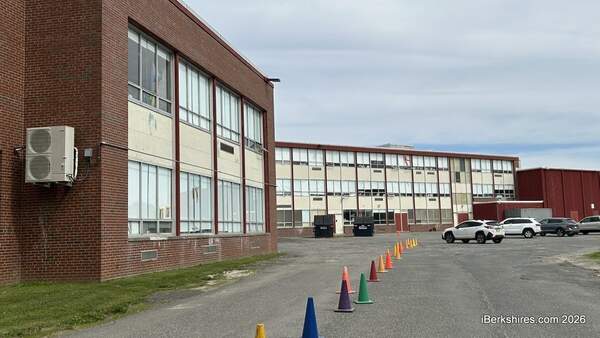
It didn't seem an auspicious start for the museum's ambitious Phase 3 to fill out nearly all of the massive former Sprague Electric campus, bring in a diverse collection of artists and programs, and forge a stronger physical connection with the surrounding community.
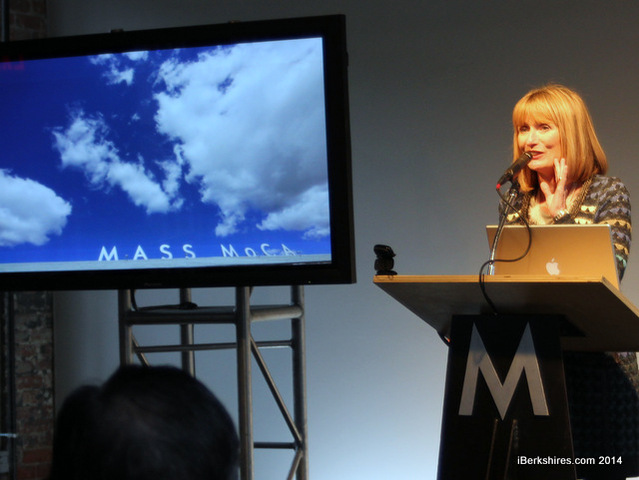
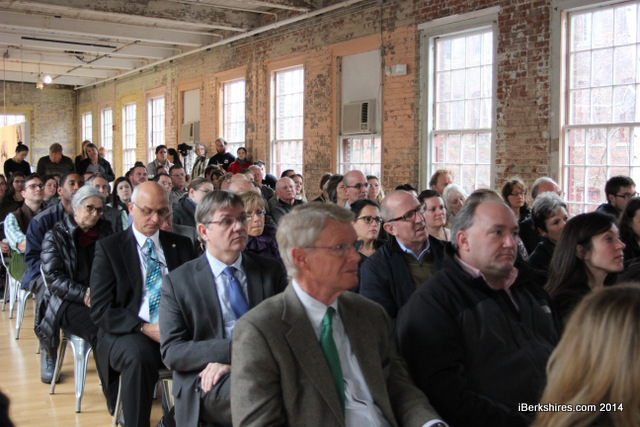
But amid a packed room with Gov. Deval Patrick in attendance, the confluence of art, architecture and community development was coming together.
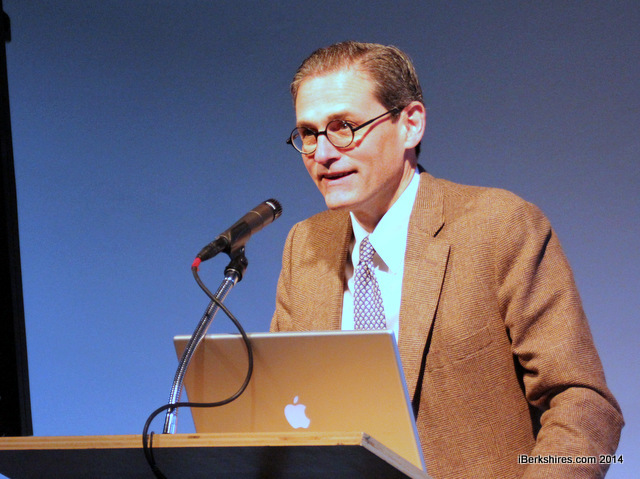
"This is pretty close to a miracle, except we tend to specialize in miracles at Mass MoCA," Hans Morris, chairman of the museum board, joked.
The event marked the official announcement by Patrick of some $25.4 million in the state's capital budget to help the museum nearly double in size.
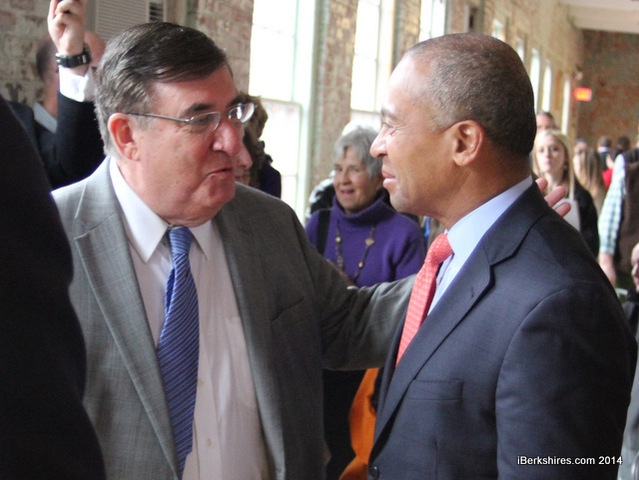
In likely his last visit to the museum as governor, Patrick said it was important that art be part of the community.
"It's for all of us to humanize ourselves, to complete us, to round us out, to make us full citizens and full human beings," he said. "And by the way, with 120,000 visitors already here at Mass MoCA, it's a pretty darn important economic engine as well."
The state's investment in the museum — likely the largest contemporary art museum in the world once Phase 3 is complete — began with $35 million in the 1990s to get it off the drawing board.
The governor expected the "team" at Mass MoCA "to make this investment the type that expands the audience to those who don't see themselves as appreciating the value and the impact of contemporary art as part of their own life. ...
"That would be a great civic contribution."
Morris said the campaign includes a goal of $30 million in private donations to match the state's contribution; as of Monday morning, $13.56 million has been committed.
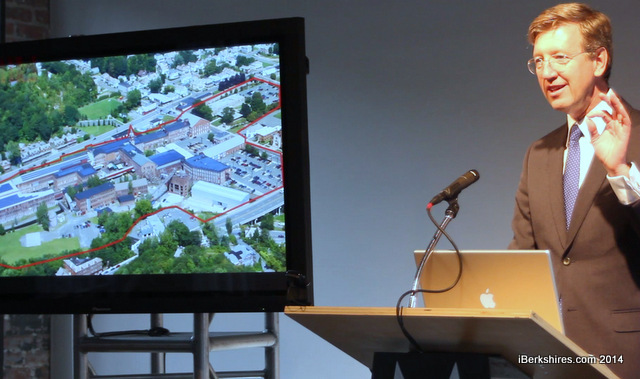
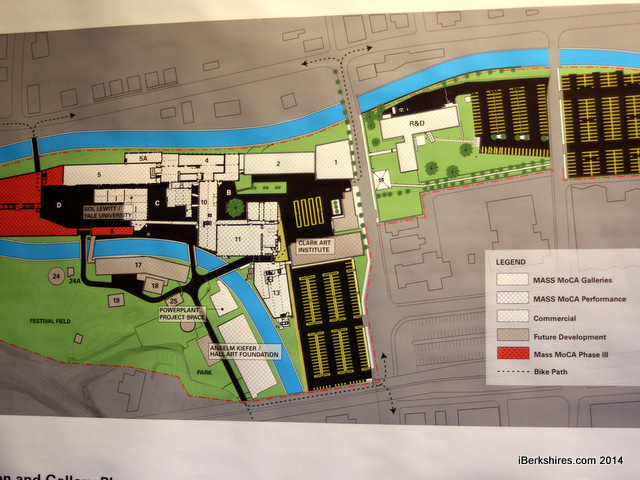
The investments will transform the campus over the next 2 1/2 years by opening up new galleries in now closed buildings to creating public spaces on the campus — including a proposed bike path "tunnel" through the main building that parallels River Street.
"With Phase 3, every courtyard, every field, every walkway, every view inside and outside of the museum will be open and the public will be able realize this as a complex in a way that they've never been able to before," museum Executive Director Joseph Thompson said. "It's going to seem like a quadrupling of space."
The funds will also aid in making the museum more financially sustainable and create a maintenance foundation for the sprawling campus and its historic mill buildings. Museum officials said MoCA also will continue to capitalize on its unique situation of having no permanent collections and lots of space — the opposite of most museums with their large collections and little room.
Adding in the location, cost efficiency and "can-do spirit," they believe, makes the confluence and collaboration with large-scale artists and other cultural institutions not only possible but beneficial for both sides. A wish list of partners was developed during that stormy January that will come to fruition with Phase 3's completion.
Among the eclectic mix is Louise Bourgeois' dense abstract sculptures, James Turrell's rooms of light, Jenny Holzer's visual word art and Laurie Anderson's audio and voice. These long-term exhibits won't be making the rounds to New York or Paris.
"You're going to have to come to North Adams to see them," said Thompson.
|
Post by iBerkshires.com.
|
Developing on Mass MoCA's draw — and cultural attractions such as the nearby Clark Art Institute and other venues — the museum hopes to gain on its 125,000 a year visitors and do a better job of dispersing to them to the city's downtown through landscape connections along Marshall Street and to the coming Greylock Market.
Overnight tourists spend 10 times as much as day-trippers, said Thompson. "We want people to stay longer and enjoy more."
Mayor Richard Alcombright said the museum already brings thousands of visitors, cultural assets and jobs.
"With this commitment, we can easily think of MoCA times two," he said. "It will have significant and yet unknown benefits to this city and the greater region."
The mayor took a moment to thank the governor for his commitment to North Adams and the North Berkshire region, a statement greeted with a round of applause.
"From the beginning, Mass MoCA has brought so much to this community in so many ways," said Alcombright.
"For many of us, not so many years ago, we could not picture a city with Mass MoCA, and isn't ironic now we can't picture the city without it."
Tags: governor, mass moca, state grant,