Williamstown Con Comm Blasts Waubeeka for Tree Cutting
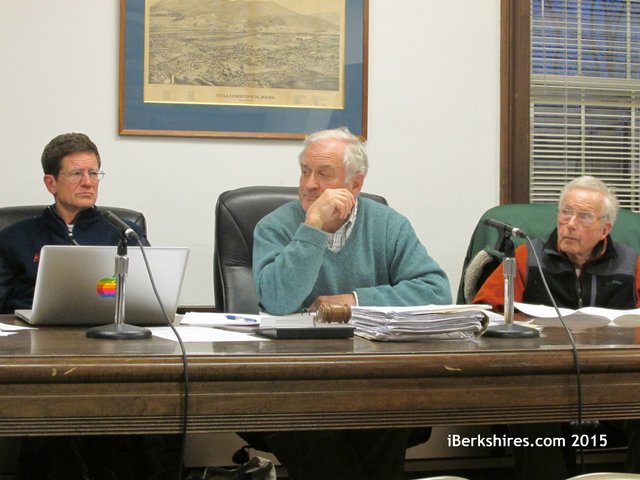 Conservation Commissioners Robert Hatton, left, Chairman Philip McKnight and Hank Art said they expected restoration of the riverbank. Conservation Commissioners Robert Hatton, left, Chairman Philip McKnight and Hank Art said they expected restoration of the riverbank. |
Michael Deep was in front of the commission to ask for its blessing for a couple of other projects at the 18-hole facility on New Ashford Road (Route 7).
But in the course of a Thursday afternoon site visit to prepare for that evening's hearing, something else caught the commissioners' eyes.
"We noticed that a substantial bank on both sides of the Green River was cleared of vegetation — large trees, native trees, willows, along with some native exotics," Commissioner Hank Art told Deep.
Art then proceeded to read at length from the minutes of the commission's May 22, 2014, meeting, at which Deep, having just bought the course, asked for permission to remove some invasive species of plants along the river.
At that time, the panel determined that the kind of work Deep wanted to do required a Notice of Intent and a more thorough examination by the commission.
"Mr. Art stated this has happened in the past (invasive removal) and great care must be taken to not greatly disturb the root systems which can cause excessive sedimentation," the minutes of the 2014 meeting read.
Five paragraphs later, they read: "Mr. Art stressed the importance of having a plan to address which plants will be removed."
Deep asked the commission at the 2014 meeting if it would be comfortable hearing a plan submitted by a representative of the Hoosic River Watershed Association, and the Con Comm agreed that the expert in question would be a good resource.
But several more times, the minutes show that several commissioners said a more detailed plan was needed.
"Mr. [Robert] Hatton also expressed concern that there is a lack of concrete and specific plans and noted that an NOI [Notice of Intent] is likely more appropriate," the minutes read.
"Mr. Deep asked if he will be able to maintain this area," the record of the discussion wraps up. "Mr. [Richard] Schlesinger stated yes, but only if we issue an order of conditions."
After all of that emphasis on the need to have a plan approved, the commissioners appeared dismayed that vegetation was taken out of the natural resource area without its permission.
"Is there any doubt in your mind that you were instructed not to do anything with the riverbank until an NOI was filed?" Con Comm Chairman Philip McKnight asked Deep.
Deep explained the unauthorized cutting by saying it wasn't his intent to go against the commission's wishes.
"We did it," Deep said. "I take full responsibility for that. ... The reason is we wanted to keep the men working all winter, and we had projects lined up. This project turned into a bigger project than I thought it was.
"It shouldn't have been done. I acknowledge that. I'm prepared, with the permission of the commission, to put back what was there."
The commission asked deep to come to its April 23 meeting with a repair plan. After the panel reviews that proposal, it likely will issue an enforcement order in May, McKnight said.
 Waubeeka owner Michael Deep received permission for two other projects. Waubeeka owner Michael Deep received permission for two other projects. |
"My preference would be to require restoration of that site and to do that through an NOI. That would require someone who knew the wetland plants."
Since Deep appeared at Thursday's meeting with two representatives from the civil engineering firm Guntlow & Associates, the commission asked engineer Charlie LeBatt and wetland scientist Megan Myers to help Deep develop a plan to restore native vegetation to the denuded areas.
"This is an extraordinarily disturbing matter," Con Comm Chairman Philip McKnight said. "This commission is required to protect the water resources.
"For something as blatant as this to occur — to have that disobeyed so flagrantly is really disturbing to us.
"We want you to put your best efforts into repairing that riverbank. Do you understand the commission's intent?"
Deep said he did and indicated that he would return to for the April 23 meeting as requested.
In the meantime, he walked out of there with the commission's approval and a set of conditions to undergo a pair of projects on the golf course starting this year.
According to a plan developed by Guntlow, Deep wants to rehabilitate a pond by repairing an existing dam and dredging the pond. In addition, Deep sought permission to install subsurface drainage and improve irrigation in one part of the property and drill a well to supplement the course's irrigation needs.
All of that work was approved with conditions by the commission. McKnight made a point of emphasizing the terms of the permission.
"Mr. Deep, have you heard clearly what we've done tonight with respect to the Notice of Intent you brought to us?" McKnight asked.
"Yes," Deep replied.
Tags: conservation commission, notice of intent, wetlands,