Pittsfield Weighing All Aspects of Trash Collection
PITTSFIELD, Mass. — The group looking at a possible overhaul of the city's trash collection is putting nearly everything on the table.
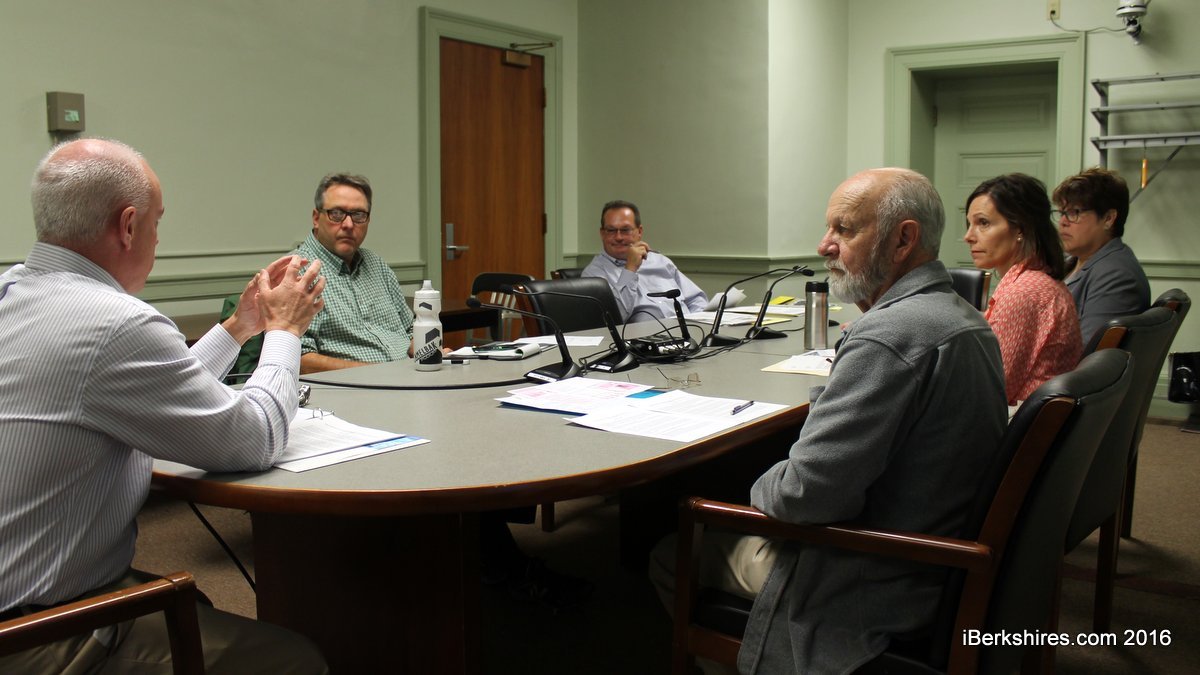
The Resource Recovery Committee met for its second meeting this month in its ongoing look into changing the way the trash system operates. Currently, the city has a curbside pickup model in which Republic Services collects all of the trash and brings it to Covanta, where it is burned to make energy to sell to Crane & Co.
The recycling is transported from Covanta to a recycler who pays the city based on tonnage and market value. The city gets a minimum of $10 a ton for single-steam and there is profit sharing should the market go up. If the city goes to a dual-steam, there is no minimum but the profit sharing would still be involved. Last year, the city recycled some 1,700 tons.
However, big changes are possible on the horizon. Covanta plans to close its facility in March 2017 and concurrently City Councilor Nicholas Caccamo filed a petition to move to a two-toter system to increase recycling, lower the city's cost, and clean up the streets.
Changing to a toter system has twice failed to get City Council approval, in 2006 and in 2009. But that isn't deterring the committee, nor is Covanta's closing.
According to Director of Finance Matthew Kerwood, the closure of Covanta isn't a done deal. The city is currently looking to help the company with capital expenses to help make the numbers work while the state has added provisions to incentivize the operations, and Crane & Co. is negotiating its contracts for the steam.
"My belief is that if all three legs of the stool don't stay, the stool will fall and we may not get what we want out of this," Kerwood said.
Mayor Linda Tyer has asked the City Council to release up to $562,000 from the Pittsfield Economic Development Fund to help Covanta.
"In the wake of this news, the city has been working toward a viable solution to maintain the facility's operation. Pursuant to this effort, I am respectfully submitting for your consideration a request for economic development funding in the amount of $562,000 for Covanta to establish a Recycling Consolidation Enclosure and incorporate upgrades to its Fossil Fuel Boiler, which will facilitate continuing operations for the next four years," Tyer wrote in a memo to the council.
The money would go toward two capital projects on site and in return, Covanta would promise to keep the facility open. Tyer estimates that the closure of the plant would cost the city "nearly $900,000 a year" which Tyer believes is "far outweighing the city's capital investment."
Essentially, Tyer believes that spending $562,000 will result in avoiding $3.6 million over those four years. Kerwood added that there are clawback provision should the company close within those four years after receiving the money.
"It may not be all of that. There is language in there about how that money will be dispersed," Kerwood said on Thursday.
The money would help Covanta comply with a state Department of Environmental Protection ruling requiring the area where recyclables are kept be covered and replace a failing backup boiler. That will request will be heard by the City Council's Committee on Community and Economic Development on Wednesday and is expected to go before the full council the following Tuesday.
"I think it would be probably helpful to the conversation both at the committee level and at the full council level if this committee went on record with its desire to keep Covanta running," Kerwood told the Resource Recovery Committee, though the committee members felt they would like to review the proposal a little further before taking a stance.
But the city's part doesn't close the cost gap weighing on Covanta alone. The company said it opted to close because it was no longer economically viable. The state added its part by including tax incentives for waste to energy plants like Covanta.
"With Senator Downing's lead and my support on the house side, we have put in a provision that gives tax credits to waste to energy facilities. And that will be very useful when it comes to the Covanta plant. It might, possibly, allow it to continue operating as it is with the continued ownership of Covanta. We're not sure that can happen but at least this legislation has made it possible," state Rep. Tricia Farley-Bouvier said in August, right when the bill was passed.
The third piece is Crane & Co.'s negotiations with Covanta. Details of that negotiation hasn't been disclosed to Kerwood or members of the Resource Recovery Committee.
If the efforts to keep the facility open does not come to fruition, the Resource Recovery Committee is still asked to provide the mayor with recommendations of changes for cost containment - which could be implemented regardless of Covanta's decision.
The toter system as proposed by Caccamo is eyed to do that and the committee's first meeting on Sept. 13 focused mostly on that issue.
Kerwood was a city councilor in 2006 when the first iteration of a toter system was brought before the city. Then a group had crafted a plan that gave every resident one tote for trash, and then any extra would be disposed of through the purchasing of bag from the city. Kerwood called it a "hybrid pay as you throw" system.
"The real hang up in 2006 was the bag piece, the fee for bags," Kerwood said of the City Council's rejection of the plan then. "It was really the concept of having to pay for the trash and the bags. Where you purchase them wasn't the issue, it was the concept of doing something different in paying for the bags."
That proposal had little support. But it came back in a new form in 2009. Then the plan offered each resident a 65-gallon tote for trash and offered those with larger trash disposal needs to purchase a second one for $420 per year.
"The council at the time, and I stress at the time, I think really had concerns about the concept of having a limit and then having to pay for disposing of whatever is above that.," Kerwood said.
The 2009 proposal also wasn't fully automated, as the most recent discussion has been, and there were provisions for certain neighborhoods that couldn't be served by automated trucks in that proposal. The 2006 proposal had no automation whatsoever and was just focused on getting the totes and bags for sale while still utilizing the existing pick up methods.
But the past isn't going to get in the way of the committee's look this time around. Chairwoman Rhonda Serre said the committee could use one of those proposals, or craft a new one with pieces of those models, in its final recommendation.
"This is kind of a background on what discussion had already taken place but it was a different time in the city," Serre said. "Things have changed and just because something wasn't accepted the first time, it still may be the right answer."
The concept presented to the board at the first meeting this month was to give residents two totes - a 65-gallon one for trash and a 90-gallon one for recycling.
While all of those options are currently being looked at, one program has been excluded so far. In Portland,Ore. There is a system using four different totes - one for organics, one for single-stream recycling, one for glass, and one for trash.
"I think we can safely say our recommendations are not going to go to that extreme," Serre said.
Jamie Cahillane presented that option to show the possibilities in trash collection. There there is curbside pickup but also programs for backyard composting and an biowaste to energy converter at the city's wastewater treatment center.
"It is just out there, something we can reference when we are continuing to discuss what makes the most sense for Pittsfield," he said.
Gregory Yon runs a waste hauling business and he is asking for deeper financial information about the city's current contracts and costs. Plus, he'd like a deeper look at the estimated $1.8 million up front cost association with purchasing totes. That way he can piece together cost comparisons.
"I just want to get a clearer picture of the process," Yon said.
No matter what the group decides to recommend to the mayor, Kerwood said any changes must include a significant educational process so residents know about the changes and what they will need to do.
"No matter what we propose as recommendations, a strong educational program is going to have to be ahead of implementation," Kerwood said.
The group plans to meet next week to discuss taking a stance on the city's expenditure for Covanta and meanwhile wait for the deeper financials Yon requested. The mayor hopes to have a report back by December.
Tags: trash, waste collections,