Williamstown Planners Make Proposed Pot Bylaw More Restrictive

Wendy Penner argues against a zoning bylaw that would have allowed marijuana dispensaries in four commercials zones. The board revamped the bylaw to limit them to two.
But one of those bylaw amendments underwent a major revision and the board decided to ask voters to set aside a fifth amendment it previously planned to recommend.
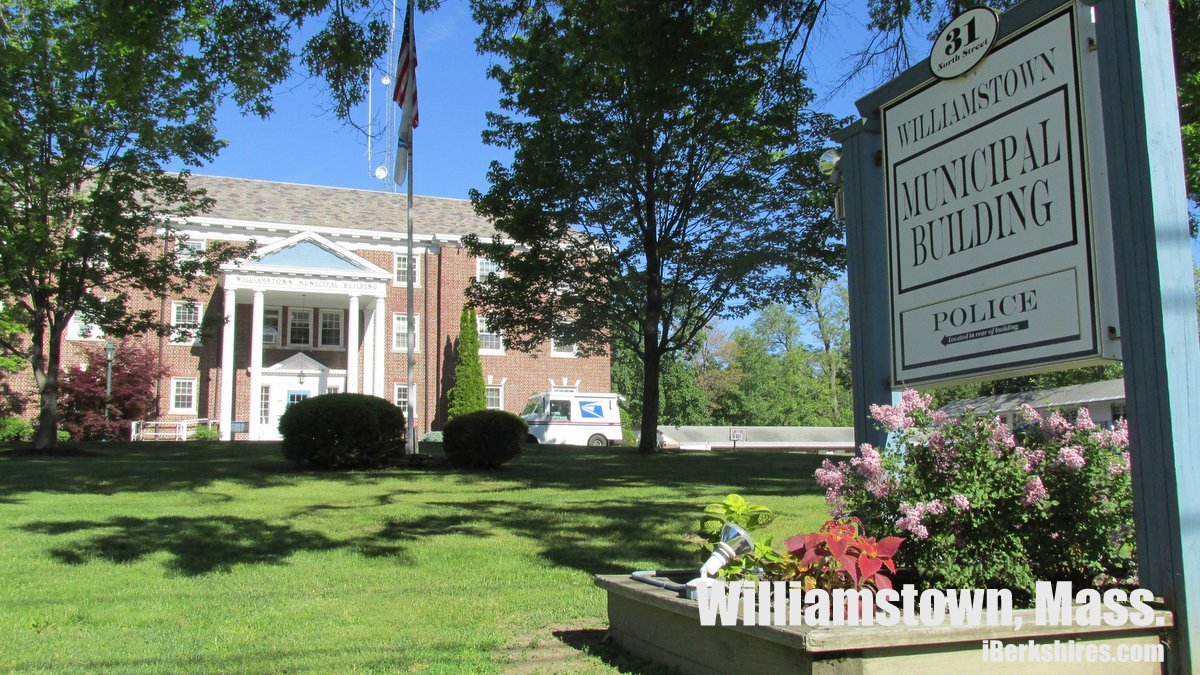
The board's annual public hearing to consider articles for town meeting drew a nearly full house to the Board of Selectmen's Meeting Room. Several residents addressed the board about its proposed bylaws, and, in two cases, board members were persuaded to change direction.
The lengthiest discussion of the night concerned Article 37 on the warrant, an amendment to create a regulatory framework for marijuana operations inside the town's borders.
The Planning Board went into Monday's hearing with a proposed marijuana bylaw draft that allowed retail pot sales by right in three commercial districts and by special permit from the Zoning Board of Appeals in a fourth.
It left Monday's hearing with a bylaw amendment that allows pot sales by right in just one district, the Planned Business district on the Main Street (Route 2) corridor, and by special permit in the Southern Gateway (the Cold Spring Road section of Route 7).
By a 4-1 vote, the board changed its proposal to the May 17 annual town meeting by prohibiting marijuana sales in the Village Business District and the Limited Business District.
The majority of planners were persuaded that pot sales in the Village Business, essentially Spring Street and Water Street, and Limited Business, which includes the commercial district at the north end of Cole Avenue, could potentially harm youth.
Board member Ann McCallum referred to correspondence the board received from local pediatrician Kathryn Wiseman and community activist Wendy Penner, who also addressed the board in person on Monday night.
"I must say, I feel a little ill prepared about this whole issue because I didn't realize how devastating marijuana can be to teenage brains," McCallum said. "Or this chart about kids principally in marijuana having to go into treatment.
"Given that, I'd be in favor of keeping the retail out of places where kids tend to congregate. That would mean limiting retail sales to Planned Business."
Chris Winters argued in favor of keeping the bylaw amendment as drafted, reminding his colleagues of a prior meeting at which they had discussed treating pot like another legal product that some consider a vice, alcohol.
"This is not joints in a vending machine," Winters said. "This is a highly regulated product. The idea that young people will be flooded with opportunities to possess and use it is unrealistic."
"Do you mean like tobacco, which is illegal to buy when you're under 18?" Chris Kapiloff asked Winters.
"Kids who want marijuana today can obtain it," Winters shot back. "A regulated economy is a safer economy.
"I think we had a principled discussion, and I believe all the existing business districts are appropriate."
Penner, who spoke on her own behalf but works as director of prevention and wellness at North Adams' Northern Berkshire Community Coalition, brought a different principled argument to the discussion. She said Colorado, the first state to legalize pot, leads the nation in youth drug use.
"We have an opportunity to choose how we want to invite or if we want to invite marijuana into the community and to be mindful of the messages that our youth will receive from those decisions," Penner said.
Penner also took a shot at the notion raised Monday by a couple of the planners that overly restrictive regulation in Williamstown would send potential pot purveyors to neighboring towns.
"The idea that we want to enrich ourselves by inviting this vice into our community and not miss out is distasteful to me," Penner said.
Winters ultimately voted in the minority of a 4-1 vote to change the proposed bylaw to make it more restrictive of the areas where marijuana can be sold.
Kapiloff did the reverse, voting with the majority to make the proposed bylaw more restrictive and ultimately voting against recommending the bylaw amendment's adoption by town meeting. That vote also went 4-1.
Kapiloff was the only member of the Planning Board to reveal how he voted on Proposition 4, the November 2016 ballot initiative that legalized recreational marijuana in the commonwealth. He voted against the initiative, which was supported by a 60-40 ratio in Williamstown.
"I'm incredibly conflicted," he said. "I have these two things. The first is my personal belief that mind-altering substances are not beneficial to society as a whole. … There are far more destructive things in our society that we've learned to live with, and we'll learn how to live with this. But I don't think it's good for us as a nation or as a state and it's not good for Spring Street.
"However, having said that, if our town moves forward with allowing us to sell it here, I believe this is close to the best way that's possible," he said before voting to amend the proposed bylaw.
While the Planning Board was divided in its approach to the pot bylaw, it was unanimous in its decision to ask town meeting to effectively table Article 35, which would rezone a town-owned parcel that includes part of Eastlawn Cemetery from Limited Industrial to General Residence.
Procedurally, the board could not withdraw the article, but it was persuaded by residents Jeffrey Thomas and Paula Consolini, who argued that the town ought not to eliminate part of its modest inventory of land that could be developed commercially, even if the parcel in question has no identifiable commercial use at this time.
The other bylaw that generated significant debate on Monday was Article 38, which amends the zoning map to expand the Village Business District to include the parcel on which sits the clubhouse for Taconic Golf Club. The club currently operates as an accessory use to the golf course and, as such, has an ambiguous zoning status when it comes to inviting the public and non-golfers to patronize its restaurant.
The operators of the golf course, who have a 99-year lease from landowner Williams College, are asking the town to remove that ambiguity from the clubhouse, which already welcomes members of the public. The course argues that as long as the clubhouse is not technically a public amenity, it is prohibited from advertising the restaurant to the general public.
The Planning Board voted unanimously to recommend town meeting pass Article 38 as well as Articles 34 and 36, which generated considerably less discussion.
Article 34 seeks to simplify and reduce the zoning bylaw's requirements for off-street parking in multi-family residences. Article 36 will remove an overlay district from the land that formerly housed the Spruces Mobile Home Park and apply that overlay district to the land at Pines Lodge Park. The Spruces officially closed early last year; Pines Lodge currently operates under several special permits and use variances, Town Planner Andrew Groff explained.
Tags: marijuana, Planning Board, public hearing, town meeting 2017, zoning,