'Farm to Hand' Food Truck Wins MCLA's First Entrepreneur Challenge

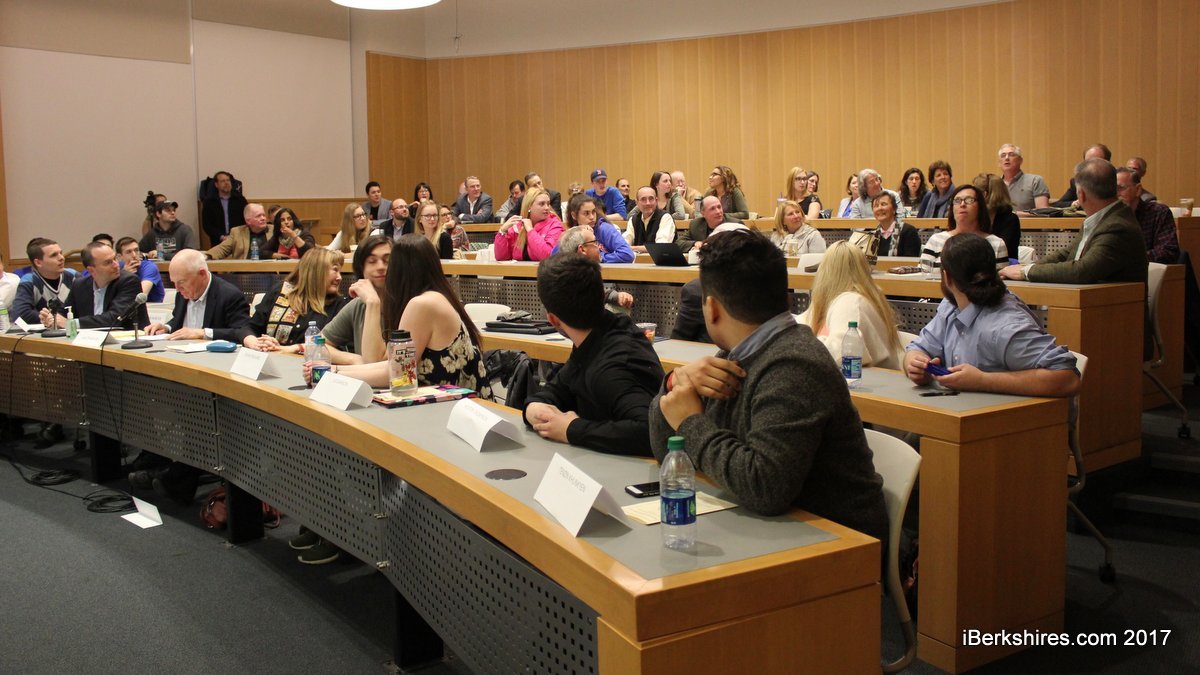
Judges J.D. Chesloff, Jack Wadsworth and Nancy Fitzpatrick prepare to give their feedback to the contestants.
"I feel like J. Lo, everybody's great!" said J.D. Chesloff, channeling the singer/star from "American Idol."
Twenty-seven teams of two to five students entered the Innovation and Entrepreneurship Challenge last fall, the first-ever competition held by Massachusetts College of Liberal Arts and funded by the Feigenbaum Fund and Jack and Susy Wadsworth. After months of research, planning, and guidance by mentors, four finalist teams stood to present their business plans.
And the proposal for a locally sourced "healthy fast food" venture beat out runner-up WiseEye, an app for finding local sites of interest and restaurants; Taproot, a non-profit K-12 summer program with a STEAM (science, tech, engineering, art and math) focus; and Aqua Bob, a GPS tracking system to find and recover commercial fishing equipment.
"It's so overwhelming, I put my heart and soul into this and I feel like it paid off, it's indescribable," M.J. Shannon of LoCal said. "It's been my dream forever. I've just always wanted healthy food to go and it's been living inside me, this idea."
The entrepreneur competition, and its twin at Williams College, came about from conversations among local business and community leaders on rebuilding employment opportunities.
"What we decided five years ago was we would have to start a process in this part of the world that would create new companies," said John "Jack" Wadsworth, a Williams alum and advisory director at Morgan Stanley and one of the judges. "The future of this planet is in the hands of people who are at MCLA or Williams College and great institutions of learning across the world ... our hosts are with a vital, new, energized generation that really buys into the idea that creativity, innovation, new ideas, entrepreneurship and risk taking is what's going to make the world a better place to be."
It's a long-term goal of getting four or five startups a year over the next couple decades," he said. "If we can get 10 of them to stay and become big companies, we will have won that battle."
Each team made a presentation and then answered questions from judges Wadsworth, Fitzpatrick and Chesloff, vice chairman of the trustees and executive director of the Massachusetts Business Roundtable. After deliberations, the judges also provided some feedback for the contestants.
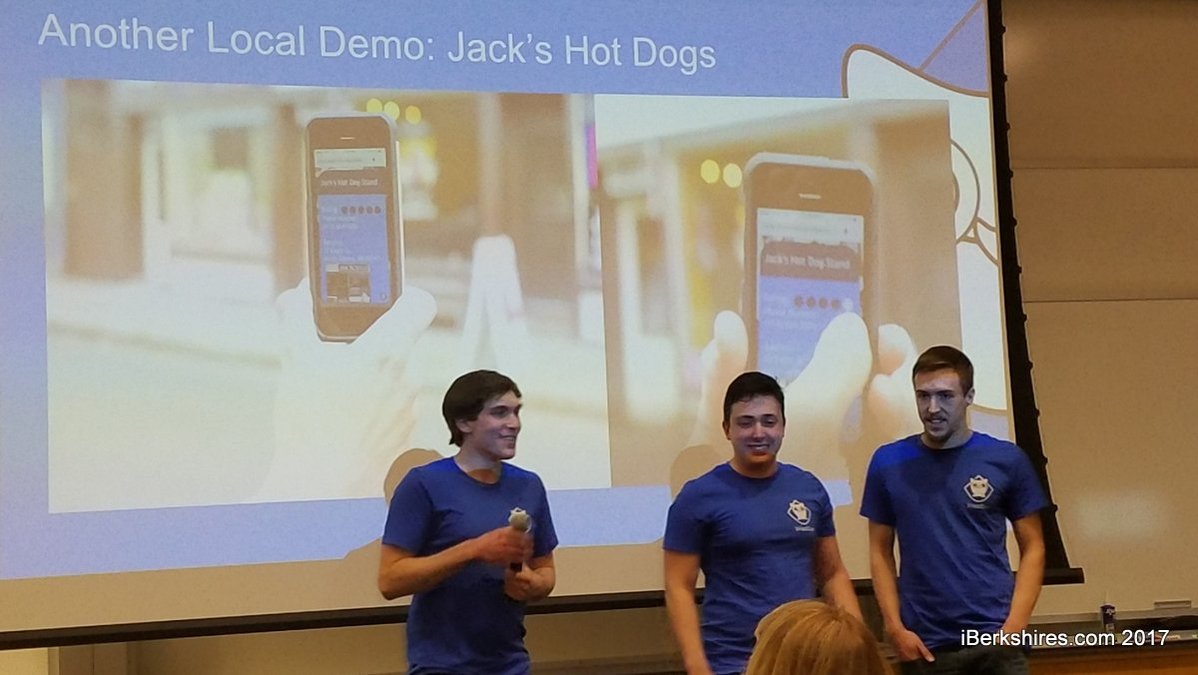
Joseph Berardis, Peter Chase and Daniel Heinen presented WiseEye, an app to "stimulate the economy of the Berkshires" by using an augmented reality similar to Pokemon Go. Tourists or others could find out what was immediately around them by using the camera function or expand to use a Google map. Focusing on a building would pull up the business, hours and even menus.
"The Berkshires is an amazing place to be," said Heinen. "It's not that tourists don't want to come, it's that they don't know we're here."
In addition to a "visually pleasing" interface that would orient you, the app could be interactive by displaying coupons when passing a particular retailer or engaging the user in a game at particular points. Heinen gave an example of seeing a "ghost" at the Houghton Mansion who might drop a clue to something on Mount Greylock.
The team anticipated revenue through selling enhanced business listings or user options. They were currently working on simple rating system that would work by simply point the app at location and selecting a rank.
The judges liked the game potential, the accessibility and the focus on the local area while still be scalable.
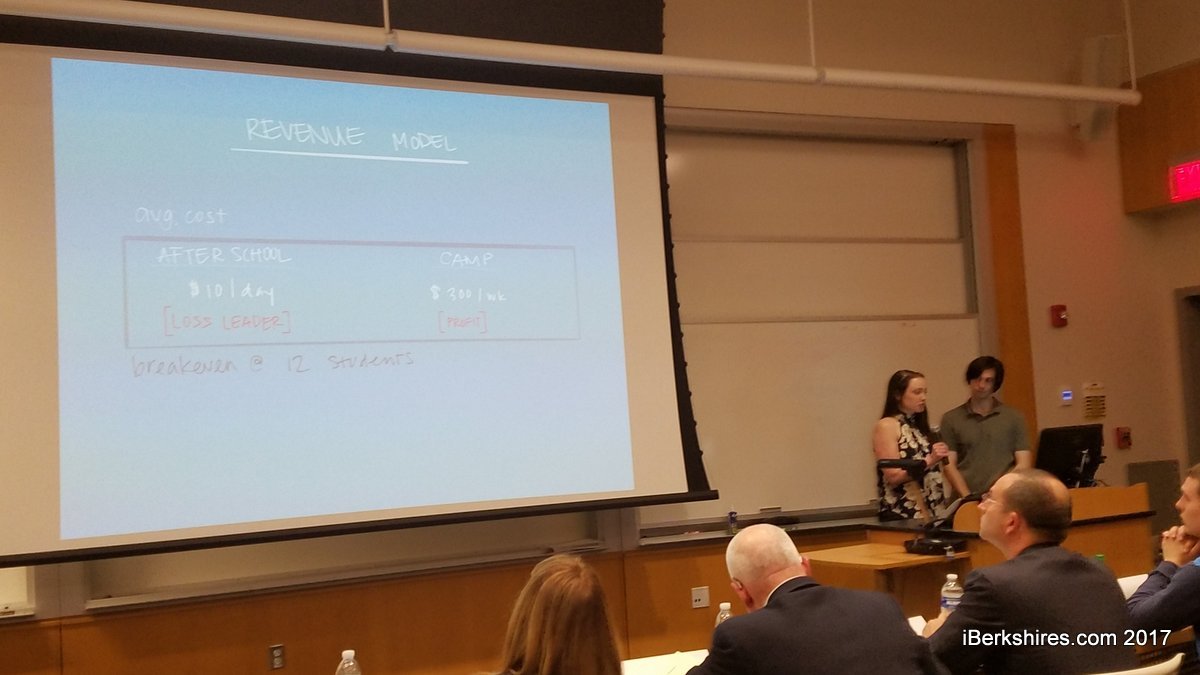
Taproot, presented by Elizabeth Dawson and Dylan Girouard, was different in that it was a non-profit that would require fundraising and grants largely to function with some tuition revenue and possible presentations for a fee. Dawson said the idea was to complement existing STEAM education by offering three series of programs using available resources.
"We're hoping to brainstorm with our partners this summer so we can go live next spring," Dawson said, adding programming would likely involve input from educators with about 20 percent original content with a focus on climate change.
She thought it would take a few years to develop partnerships with organizations and educational systems but it wouldn't have to rely on specific locations and be able to do some stuff "on the fly."
The judges thought the idea of a social enterprise as entrepreneurship was different and liked the STEAM approach, but had concerns over the business plan. Chesloff, who serves on the board of the state's Department of Early Education and Care, said liked the concept and asked to speak with the team afterwards.
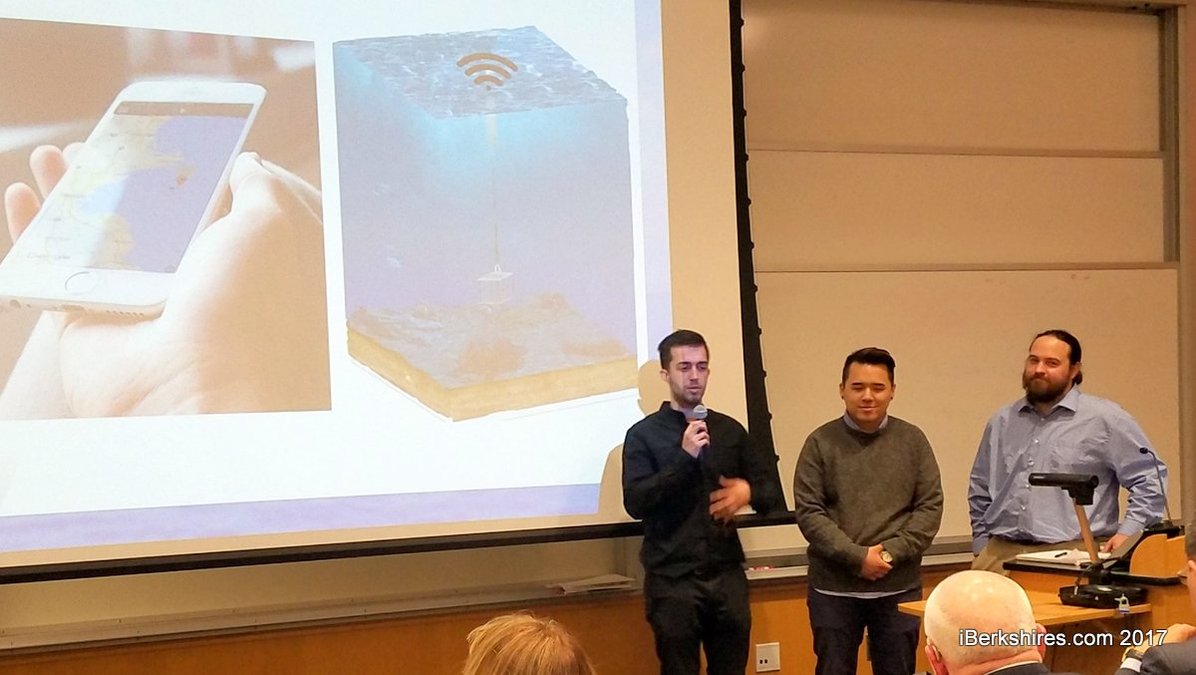
Aqua Bob was probably the most complex and involved concept since it required both programming and manufacturing. Tenzen Khunkyen, Austin Thompson and Richard Shupe proposed a device, an aquatic bobber with a hydroelectric battery, that could be attached to fishing equipment with carabiner or other device. The GPS tracker would allow the owner to find the expensive equipment and, on a signal, the bobber would release on a line to the surface.
Thompson said "ghost fishing," lost equipment like nets and pots, are hazardous to both humans and aquatic life and there's a concern by government agencies, nonprofits and commercial fishermen for find and removing them.
They anticipated their customers would be in all three of those areas; the bobbers would also create a secondary market in which equipment would become salvage after a period and anyone with the accompanying app would be able find the bobbers. They'd spoken with a number of experts in the field and had contacts with government agencies.
"There's nothing quite like this," said Khunkyen, who envisioned it being used for elements beyond fishing equipment.
The judges were impressed with the research and innovation, suggesting they begin to document their intellectual property. However, it wasn't clear the concept would stay in the Berkshires and team was still some ways away from a prototype.
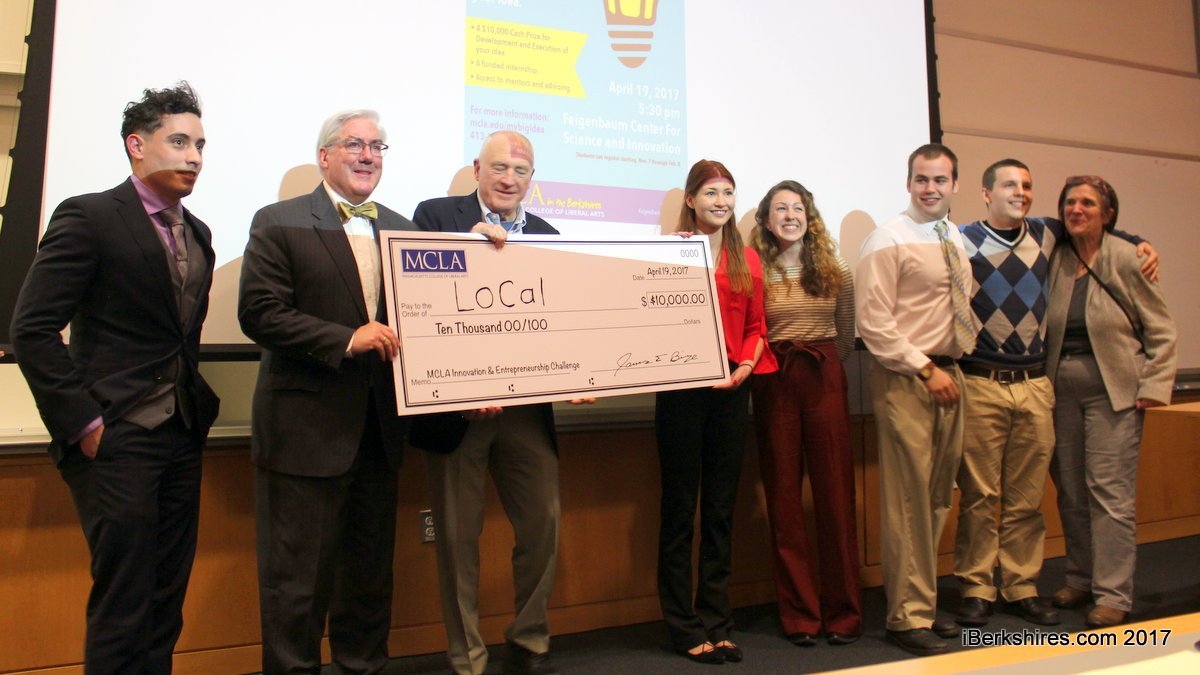
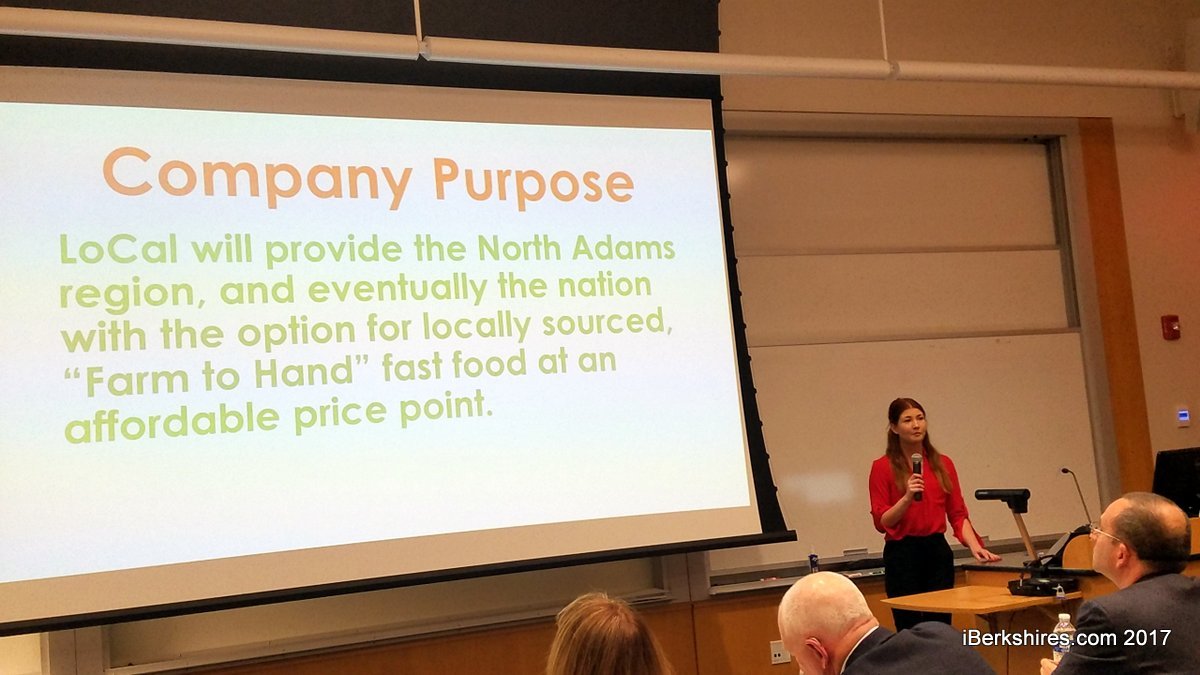
It was LoCal that rang all the bells for them after speaking with Shannon, AJ Cote, Barbara Reeves, Katrina Staaf and Avery Woodbury.
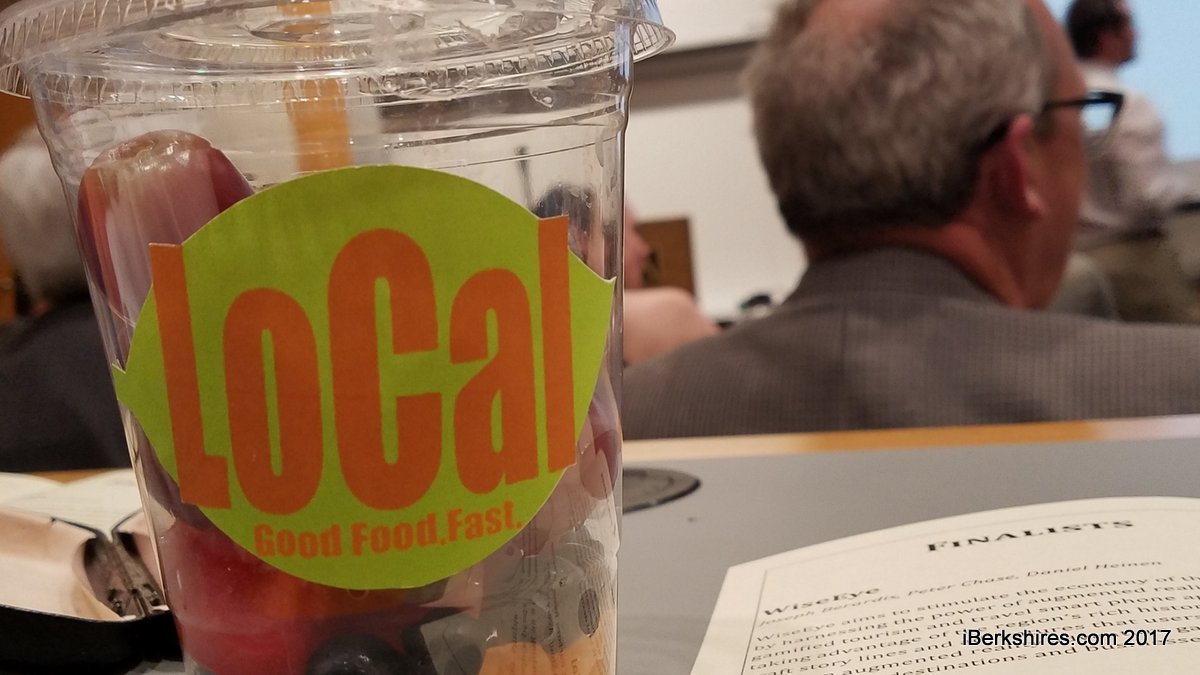
While the judges weren't on board with the "LoCal" name, feeling it sounded more about diets than health, they did like the idea of healthy food delivered via food truck. LoCal would offer fruit cups, vegetable sticks, yogurt parfaits and lettuce wraps.
Shannon's concept is based on a partnership with a volunteer group of gardeners lead by other MCLA students called "Be Great." The community gardens scattered throughout the immediate area had produced 10,000 pounds of food last year.
"I am convinced there is a significant opportunity for food of this nature," she said, offering results from a survey that found some 77 percent of participants would be willing to pay a little more for healthy food.
She calculated a profit in the first year and $60,000 overall in three years of offering "farm to hand" food. Her prices, she noted, were comparable or lower than local markets and while the convenience factor was much higher since she would go to the customer.
"We thought you very nicely addressed the criteria that we had, which was desirability, viability, feasibility and impact," said judge Nancy Fitzpatrick, owner of the Red Lion Inn and chairman of Main Street Hospitality Group. "It would be good for the area, and North Adams, and it does seem to be scalable. ... you are the most analog, the most tried and true."
She did express concern that Shannon's idea of not taking a wage and plowing everything into the business while holding down other jobs may be untenable.
Shannon, however, was ready to move forward and has already made plans to be at the Solid Sound and FreshGrass music festivals.
"We hope to have the truck up and running but if not, we'll be there," she said.
In addition to the $10,000 startup money, winner receives free workspace and further advising from business incubator Lever Inc. valued at $4,000, and personal stipends for up two founders at $4,000 per stipend.
The competition was coordinated by Zachary Feury and Lisa Donovan, professor of arts management, was the evening's emcee.
MCLA President James Birge said the challenge had many elements of a liberal arts education.
"Through this process our students have been challenged to think creatively to problem solve, to work together effectively, to combine ideas from a variety of perspectives to identify issues and propose solutions, and to communicate effectively through every step of the process," he said. "This learning process and it's outcome defines what it is to receive a liberal arts education ...
"I'm extremely proud of all our students who participated in this event."
Tags: competition, entrepreneurs, MCLA, startup,